Penarungan’s Taman Beji Paluh Keeps Bali’s River-Fed Rice Fields and Subak Traditions Alive
Taman Beji Paluh’s natural spring anchors ritual life and daily routines in Penarungan Village in Badung Regency. The beji functions as both a physical water source and a spiritual site that villagers visit for purification rites and traditional healing practices.
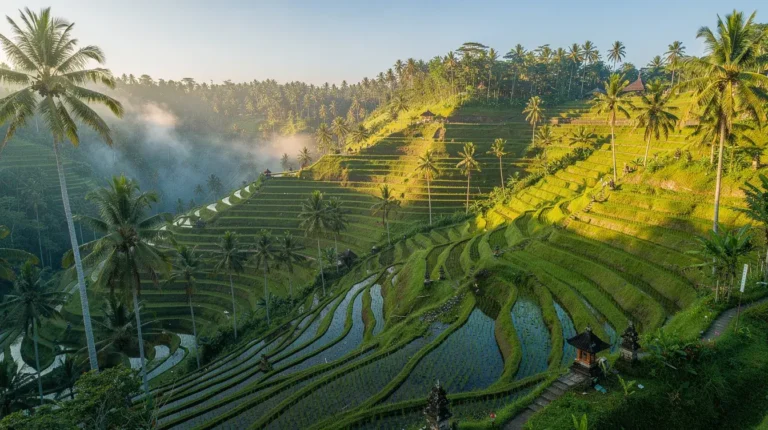
Rice paddies fed by flowing rivers dominate the setting around the village, shaping work schedules and seasonal observances that have been handed down through generations. The calm, rural atmosphere contributes to a strong sense of continuity between people and the environment.
Penarungan sits on a route linking Mengwi, Sangeh, and Ubud. That location places the village on active thoroughfares and opens it to passing travelers, yet its customary practices and village character remain intact. The subak system continues to operate as both an irrigation network and a social institution, coordinating water distribution, planting schedules, and communal rituals. Meetings around subak responsibilities help bind households through collective care for terraces and channels.
The subak relies on customary rules and leaders who call meetings to set planting timetables and to organize channel repairs. Participation in those gatherings is part of daily life, binding people across household lines and keeping water moving through the terraces.
Taman Beji Paluh features a spring that originally fed five fountains named Pancoran Lima or Tirta Sudamala. Those spouts have long been used in purification practices aimed at cleansing elements described as dasamala. The water is believed to support non-medical remedies and to assist with certain medical complaints, with a reputation for easing problems of the eyes and skin.
Additional fountains, referred to as Pancoran Solas, were later built from the same source to serve a larger number of worshippers taking part in cleansing ceremonies. Rituals at Pancoran Solas often seek kerahayuan, a divine blessing connected to Dewa Wisnu, and the spiritual intentions brought by each pemedek differ according to personal need.
Local tradition links the spring’s perceived purity to ancestral teachings. Elders and local healers recommend waters from Pancoran Lima and Pancoran Solas for ritual cleansing before major life events or temple ceremonies. Those practices preserve a form of knowledge that complements practical uses of water for irrigation.
Taman Beji Paluh is wrapped up in oral histories recounted by village elders. They say the spring was once part of a broader river system linked to Tukad Yeh Penet and Bebengan, waterways that historically supported the irrigation of nearby paddies and shaped how land was farmed.
When the Subak of Desa Kapal required extra supply, residents attempted to divert some spring flow from Penarungan. They constructed earthen embankments as barriers, beginning at an area formerly called Banjar Abing, today known as Banjar Dauh Peken. The barriers collapsed on multiple occasions during those efforts.
Elders recount a tragic episode linked to that work. A pangliman, the water regulator, reportedly fell and died near one of the breached embankments. After the incident, the embankment reportedly held. The scarring of the ground where the breach occurred has been described with the term mepaluh-paluh, and the place eventually took the name Taman Beji Paluh.
Beyond the beji site, a jogging track of roughly 1.4 kilometers winds through rice paddies and runs alongside riverbanks, making use of existing plots without converting farmland to recreational use. Local residents and visitors use the path for exercise, photography, and a close look at irrigation practices in action.
The same river is used for what operators describe as a gentle rafting option called the Lazy River. The current is mild, which shifts the focus from thrills to slow drifting and watching the surrounding greenery, small bridges, and farmers at work along the banks.
Taken together, Penarungan Village illustrates how springs, paddies, rivers, and ritual practices remain tightly linked within a socio-cultural framework that villagers actively maintain today.