What the Fruit Bowl Tells You
Bali tropical fruit tells you things no guidebook ever will. It tells you what season you are standing in, what the rain was like last week, how close the village market is to where you sleep.
At the villa, the fruit bowl appears each morning on the terrace table before anyone asks for it. Kadek, our manager, stops at the market on his motorbike ride in. He does not consult a list. He reads the stalls. What is heavy, what is ripe, what the farmers carried down from the hills that day — this is what fills the bowl.
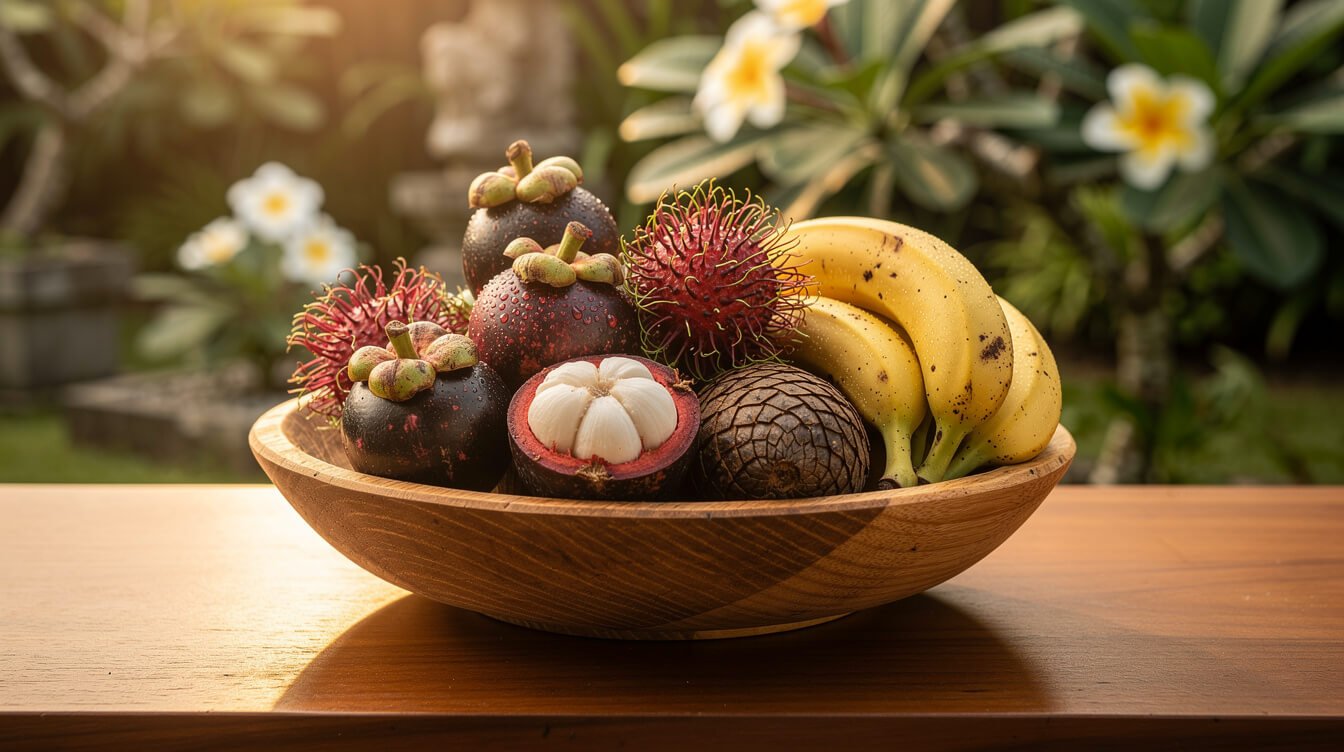
Some mornings it is mangosteen season and the table turns a deep violet-brown. You press your thumbs into the thick rind until it cracks open like a secret, and inside the flesh is white, almost translucent, sweet enough to make you close your eyes. Other mornings the bowl is all rambutan — red and hairy and ridiculous-looking, like something a child would invent if you asked them to draw a fruit. You pull the skin apart and the pale lychee-like flesh slides out, cool and clean.
Then there is salak. Snake fruit. If you have never held one, imagine something the size of a fig, covered in scales the colour of dark caramel. The skin peels away in a single satisfying strip, and inside the fruit is firm, dry, slightly tannic — closer to an apple than anything tropical. Salak is Ubud’s signature. It grows in the volcanic soil east of here, around the village of Sibetan on the slopes of Mount Agung, and it tastes like the earth it came from.
The small Balinese bananas are different from what you know. Shorter than your hand, sweeter, denser. The staff slice them into your morning pancakes or leave them whole beside the coffee that was ground an hour ago. They are so ripe by noon that the kitchen uses them for banana fritters instead — pisang goreng, golden and warm from the oil.
What surprises most guests is how fruit shapes the rhythm of the day. Breakfast is whatever arrived fresh. The mid-afternoon plate on the pool deck is whatever is sweetest at room temperature. The chef slices papaya into the evening salad because this morning’s papaya was perfect and she refuses to let it wait. There is no menu written somewhere. There is only what is good right now.
You start to notice things. The weeks when mangosteen disappears and the bowl shifts to rambutan and dragon fruit. The mornings when three kinds of banana appear because someone’s cousin had a surplus. The way Kadek leaves one perfect mangosteen on top, already cracked open, because he arrived early and wanted you to taste it the moment you walked out.
This is what a staffed villa means in the details most people never describe. Not just someone who cleans and cooks, but someone who reads the market, who knows the seasons in their hands, who places a bowl of fruit on your table each morning as if it were the most ordinary thing — and it is, here. That is what makes it extraordinary.