The Green Gas Cylinders That Clank Down the Lane
It starts as a hollow clank somewhere up the lane, steel knocking against steel, coming closer with the putter of a small engine. Then a motorbike rolls past the gate with six little green gas cylinders hanging off a wooden frame on its back, three on each side, swinging gently on every bump. The rider lifts two fingers off the handlebar to say good morning. A few doors down the clanking stops, and you hear the scrape of an empty cylinder being set down on a tiled step.
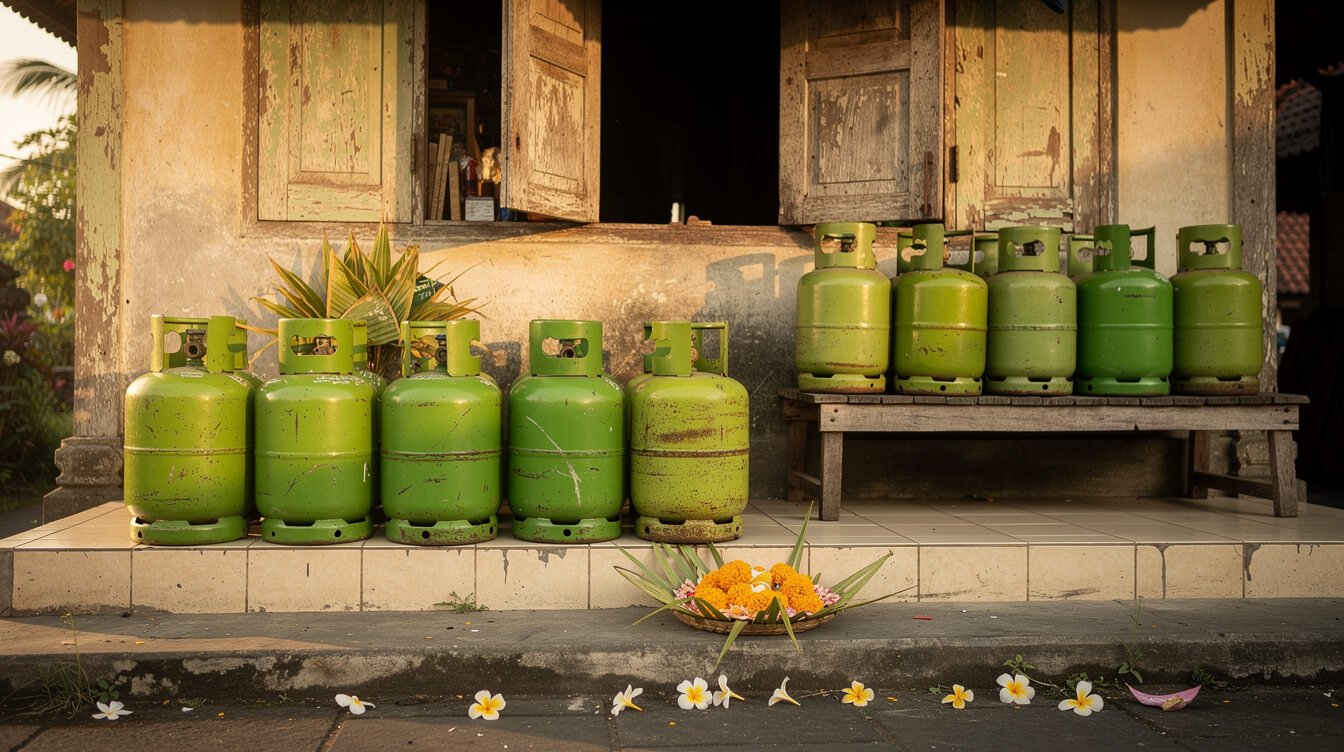
Across Indonesia these 3-kilogram cylinders are called gas melon, after their round shape and their bright lime-green paint. They arrived in the villages in the late 2000s, when the government began moving households off kerosene stoves and onto subsidized LPG, and today they’re everywhere. Almost every family kitchen in Bali cooks on one. So do the night-market stalls and the little warung on the corner.
Get a Free 3-Day Sample Itinerary
A walk down the lane, a long lunch, the rice fields in the last light of the day. We will send you a three-day Ubud rhythm built around the moments most visitors walk straight past.
The system is wonderfully simple. Nobody owns a full cylinder for long. When the flame on the stove starts to sputter, you carry the empty one down to the shop, set it on the step, and walk home with a full one. You pay only for the gas, usually somewhere around twenty thousand rupiah, a bit more up in the hills. That’s why you’ll see them lined up outside so many village shops in the morning, a neat green row with an offering tucked beside them. Lift one and you can feel at once whether it’s full or empty. Everyone in the village can do it without thinking.
Our kitchen runs on the same rhythm. Wayan can tell from the sound of the burner when a cylinder is getting tired, and there’s always a spare waiting by the back door so breakfast never has to wait. If you ever wander into the kitchen and see the team swapping one over, that’s the whole ceremony. A twist of the regulator, a quick sniff, a click, and the blue flame comes back.
Once you’ve noticed the green cylinders, you’ll start seeing them everywhere. They’re strapped to motorbikes in the morning traffic, stacked by the roadside petrol racks, and tucked under the steaming broth pot of the bakso cart that taps its way down the lane at dusk. They’re a small, honest part of how a Balinese village feeds itself, and you’ll find them wherever there’s a stove.

Book the Villa
Three bedrooms, a full in-villa team, and a pool of your own, and mornings slow enough to notice how the village keeps itself running. Check availability for your dates.
If you’re out walking early, listen for the clank. Follow it and you’ll usually find a village shop just opening its shutters, a few people buying sweet jaja wrapped in banana leaf, and a delivery rider swapping full cylinders for empties before moving on to the next lane. It’s an ordinary errand, and that’s exactly why it’s worth stopping for. It’s a few minutes of the morning that wasn’t arranged for visitors.

Join Our Newsletter
Fun, new, exciting Bali news — straight from the villa, every so often.