Besakih Temple: How to Visit Bali’s Mother Temple From Ubud and Understand What You’re Seeing
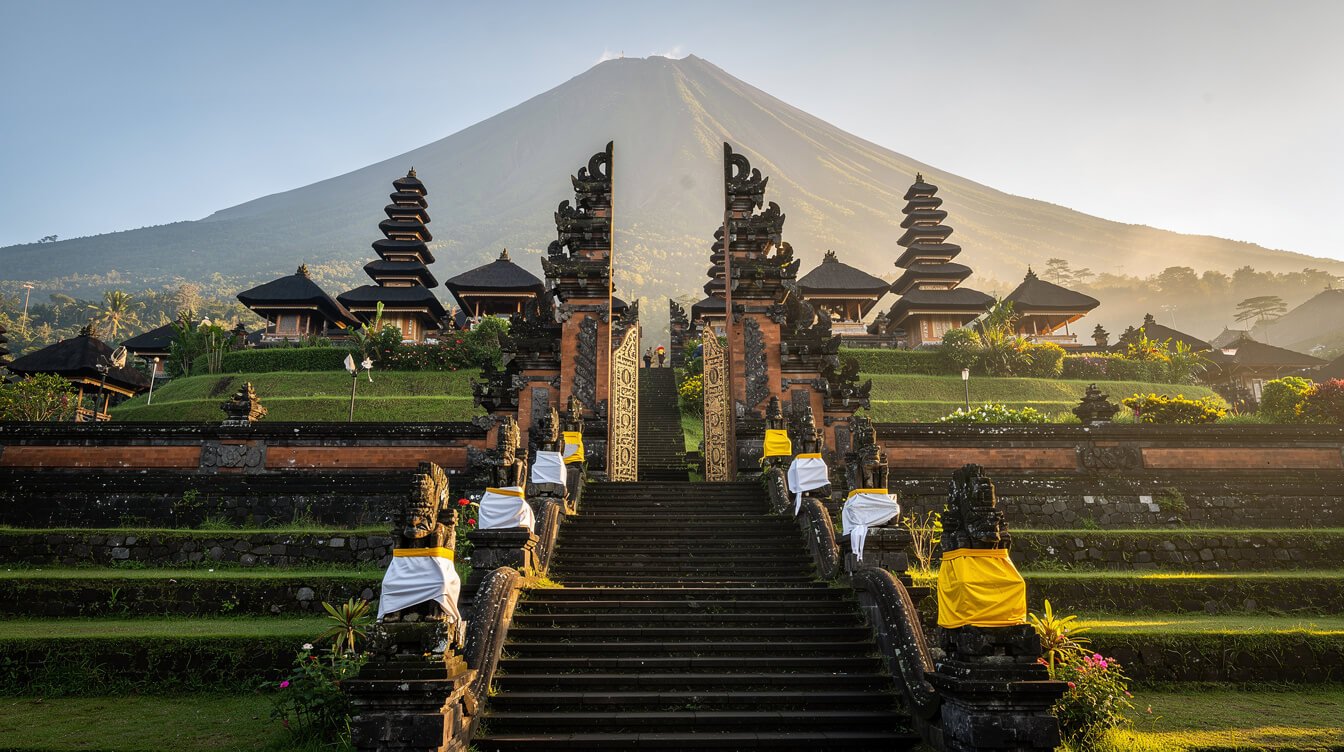
The road climbs out of the rice country and into cooler air. Clove trees line the bends. Then the mountain appears, close and enormous, and below it a whole hillside of stone terraces and black thatched towers rises in tiers toward the clouds. This is Besakih Temple, Pura Besakih, the place the Balinese call the Mother Temple. You will hear the bells before you see the priests.
Most guides to Besakih spend their words on one question: is it a tourist trap? We will answer that honestly. But the more interesting question is what you are actually looking at, and why a family from a village two hours away will dress in white, load the car with offerings and drive up this mountain several times a year. This guide is written for travelers staying in Ubud who want to visit with open eyes: how the complex works, what the red, white and black banners mean, how the ticket and guide system runs today, when to go, how to behave, and how to fold Besakih into one unhurried day in East Bali.
Why Besakih Temple Is Called the Mother Temple
Besakih sits at roughly 1,000 meters on the southwest slope of Mount Agung, in the Rendang district of Karangasem regency. Agung is the highest and most sacred mountain on the island, the axis that Balinese orientation turns around. Shrines face toward it, beds are aligned with it, and the island’s most important temple sits on its flank. If you have read our guide to Mount Agung, you already know why the location is not an accident.
Balinese tradition credits the founding of a sanctuary here to the sage Rsi Markandeya, a holy man said to have come from Java around the 8th century. The stepped stone terraces at the heart of the complex echo much older mountain sanctuaries, and many historians think people were worshipping on this slope long before Hinduism reached Bali. By the 15th century Besakih had become the state temple of the Gelgel kings, and it has remained the spiritual center of Balinese Hinduism ever since.
“Mother Temple” is not a marketing phrase. Besakih is not one temple but a complex of more than twenty separate temples, plus many more shrines, spread across the slope. Many of the island’s clans and old kingdoms keep their own shrine or temple within it. That is why you will see families from every corner of Bali here. For them, coming to Besakih is a little like returning to the oldest house in the family, the one that holds everyone’s ancestors in the same place. Our introduction to religion in Bali explains how that family-and-ancestor thread runs through daily life.
People often ask whether Besakih is the oldest temple in Bali. The honest answer is that it is among the oldest sacred sites on the island, and certainly the most important, but “oldest” is hard to prove for places that were rebuilt many times over centuries. Treat any single founding date you read with gentle skepticism, including ours.
How the Complex Works: Penataran Agung and the Three Temples of the Tri Murti
The first thing most visitors feel at Besakih is a kind of happy confusion. Stairs lead to gates, gates open onto courtyards, and courtyards lead to more stairs. A little structure helps.
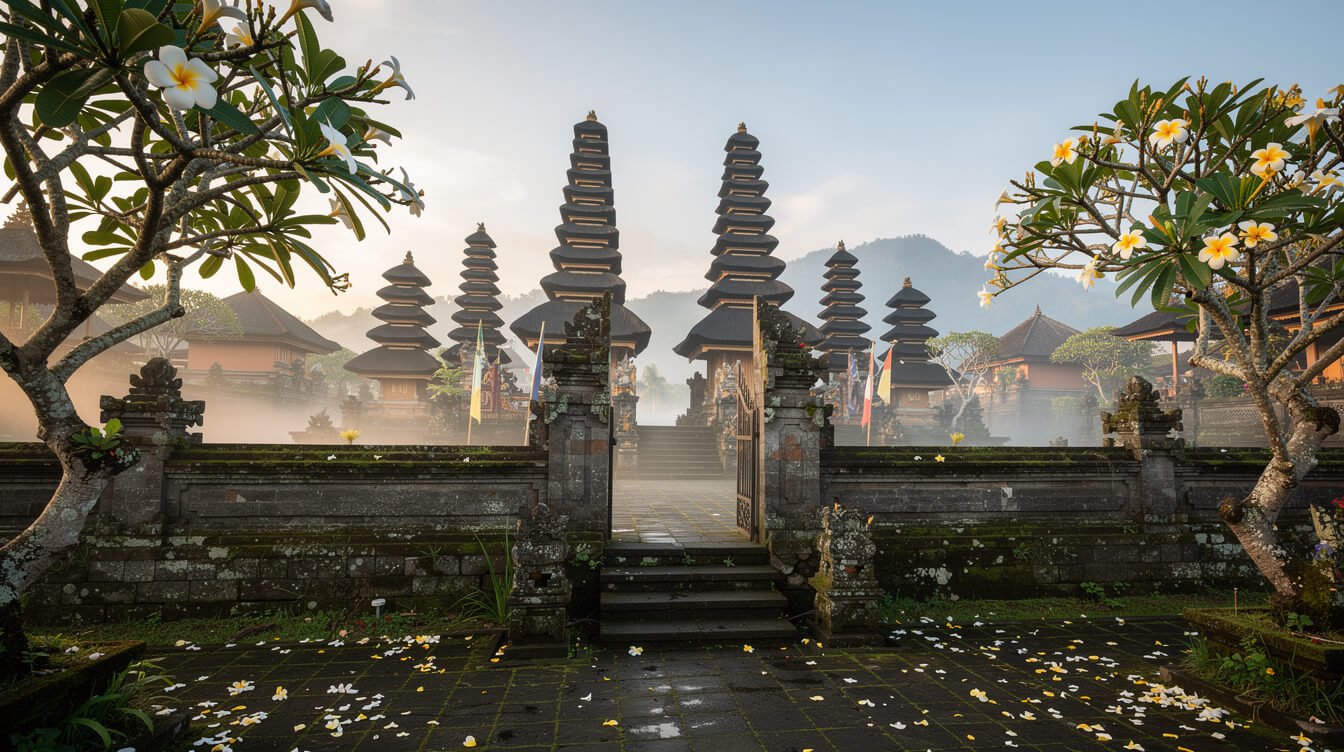
Pura Penataran Agung is the heart of the complex and the part you will spend most of your time around. It climbs the slope in a series of terraced courtyards, entered through a tall carved split gate at the top of a long stone staircase. Inside are the tiered meru towers with their black thatched roofs. The number of tiers, always odd, tells you something about the importance of the deity honored there.
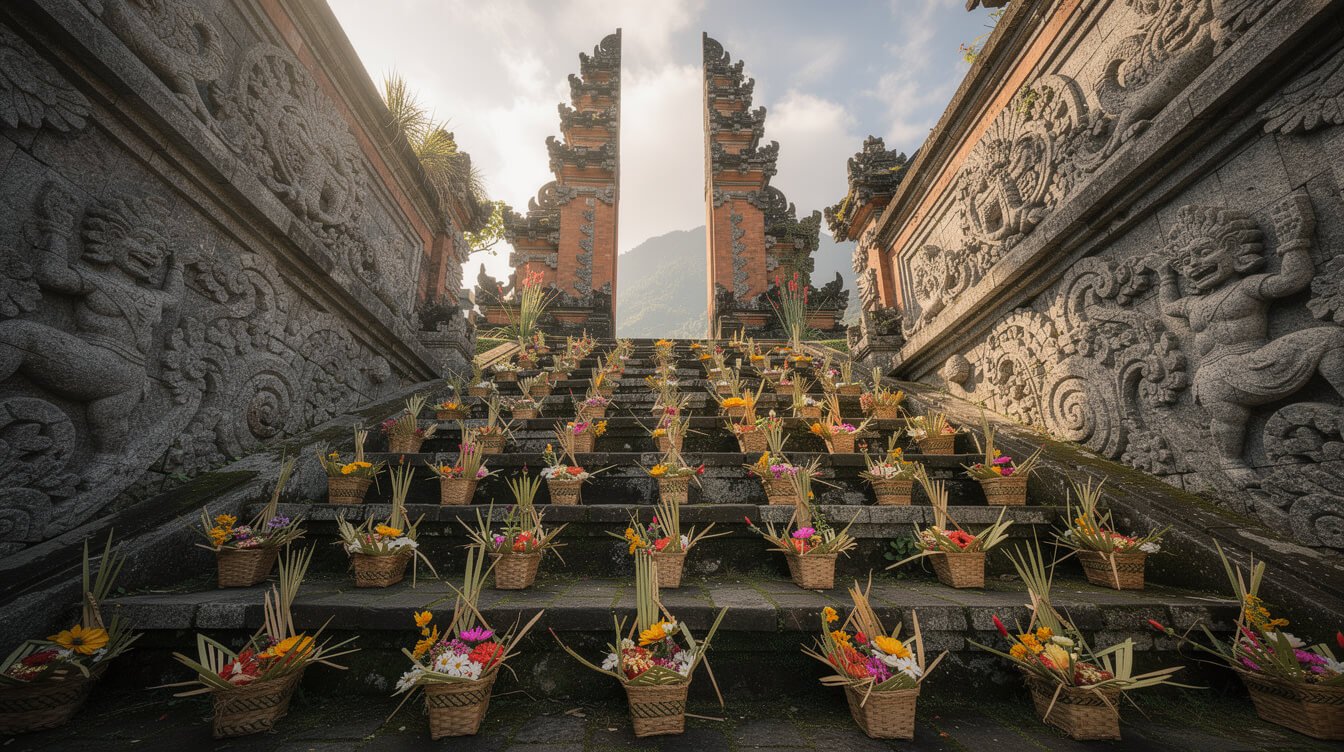
Around Penataran Agung, two other major temples complete a trio linked to the Hindu Tri Murti, the three aspects of the divine:
- Pura Penataran Agung, at the center, is associated with Shiva. Its color is white.
- Pura Kiduling Kreteg, to the right of Penataran Agung as you face the mountain, is associated with Brahma. Its color is red.
- Pura Batu Madeg, to the left, is associated with Vishnu. Its color is black.
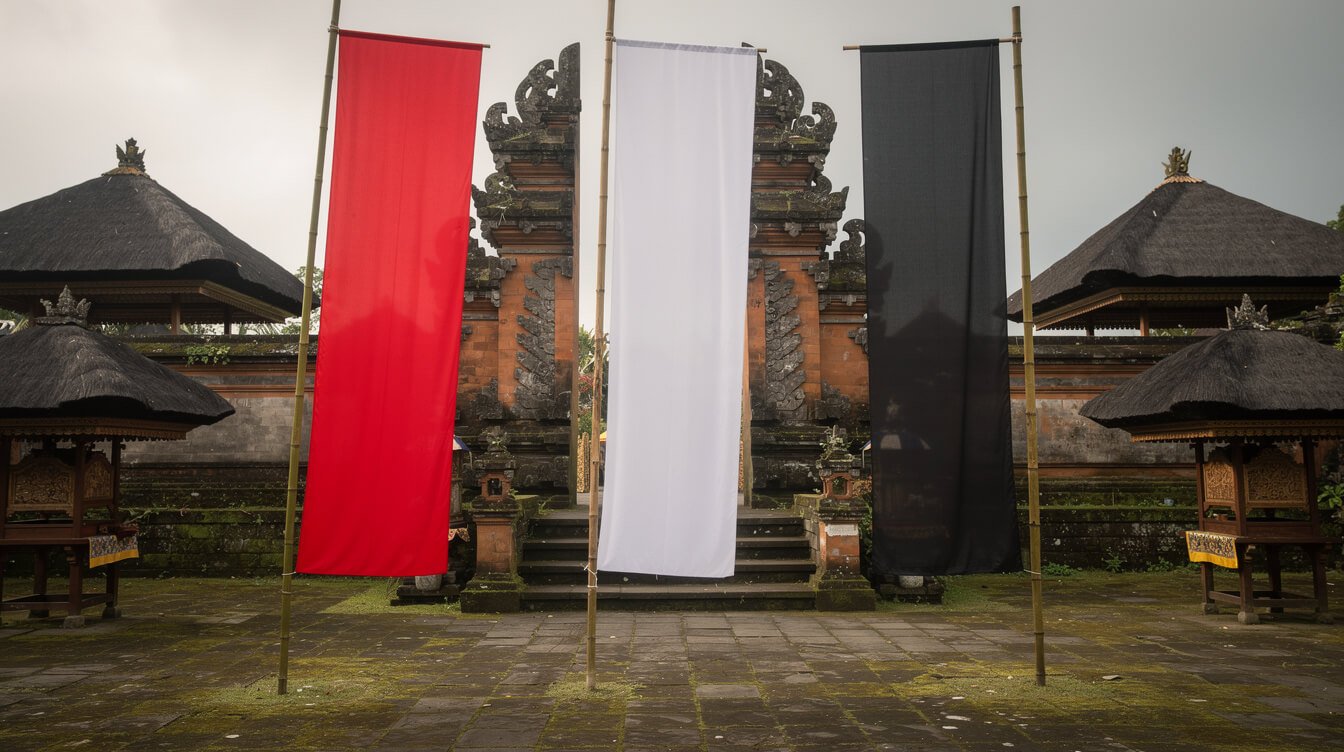
Watch for the banners and cloths. During ceremonies, long red, white and black banners hang from bamboo poles at the three temples, and the colors tell you whose house you are standing near. Once you see the pattern, the hillside starts to read like a map rather than a maze.
This also answers a question that turns up often in search: is there a Vishnu temple in Indonesia? There are several. In Java, the Prambanan complex near Yogyakarta has a large shrine to Vishnu beside its great Shiva temple. In Bali, Pura Batu Madeg at Besakih is the one most closely tied to Vishnu, and you can stand in front of it on the same morning you visit the Mother Temple.
Beyond the trio are many smaller temples belonging to clans, castes and regions, some of them a fair walk up the slope. You do not need to see them all. A good morning at Besakih is about understanding the shape of the place and sitting with it, not ticking off shrines.
Is Besakih Temple Worth Visiting? An Honest Answer About Touts, Guides and Tickets
Search for Besakih and you will find plenty of unhappy reviews. Most of them describe the old days: unofficial “guides” who attached themselves at the car park, demanded large donations, and pressured visitors at every gate. That reputation still follows the temple, and you may still meet someone on the road offering to “help” you.
Things are more organized now. There is an official ticket center at the bottom of the complex. At the time of writing in late 2026, the entrance fee for foreign visitors is around IDR 150,000 per person, and it includes a sarong to borrow if you need one, a wristband, an assigned local guide, and a short shuttle ride up the steep road to the main entrance. You can walk back down in about 10 to 15 minutes or pay a small extra fee, around IDR 20,000, to ride the shuttle down. Card and cash are both usually accepted at the counter, but parking is cash only. Fees change, so check the current price at the counter rather than relying on any blog, including this one.
A few honest tips:
- Buy your ticket only at the official counter. Politely decline anyone who approaches you on the road or in the car park. Your included guide is assigned at the ticket office.
- Talk to your guide. The guides are local, and many have family ties to the temple. Ask what the shrines are for, which ceremonies are coming up, and where their own family prays. The visit changes when you treat the guide as a host, not a gatekeeper.
- Tips are kind but not compulsory. If your guide was good, a tip at the end is a nice gesture. Decide the amount yourself. You should not be pressured.
- Offerings are optional. You may be offered a chance to buy a small offering or to receive a blessing. It is a meaningful experience if you want it. It is fine to say no with a smile.
So, is it worth it? If you want a perfect photo and nothing else, you may leave disappointed, because the mountain is often hidden by cloud and some courtyards are closed to visitors. If you want to understand Bali, Besakih is one of the most rewarding mornings you can spend on the island. Nowhere else shows you so clearly how temple, family, mountain and calendar fit together.
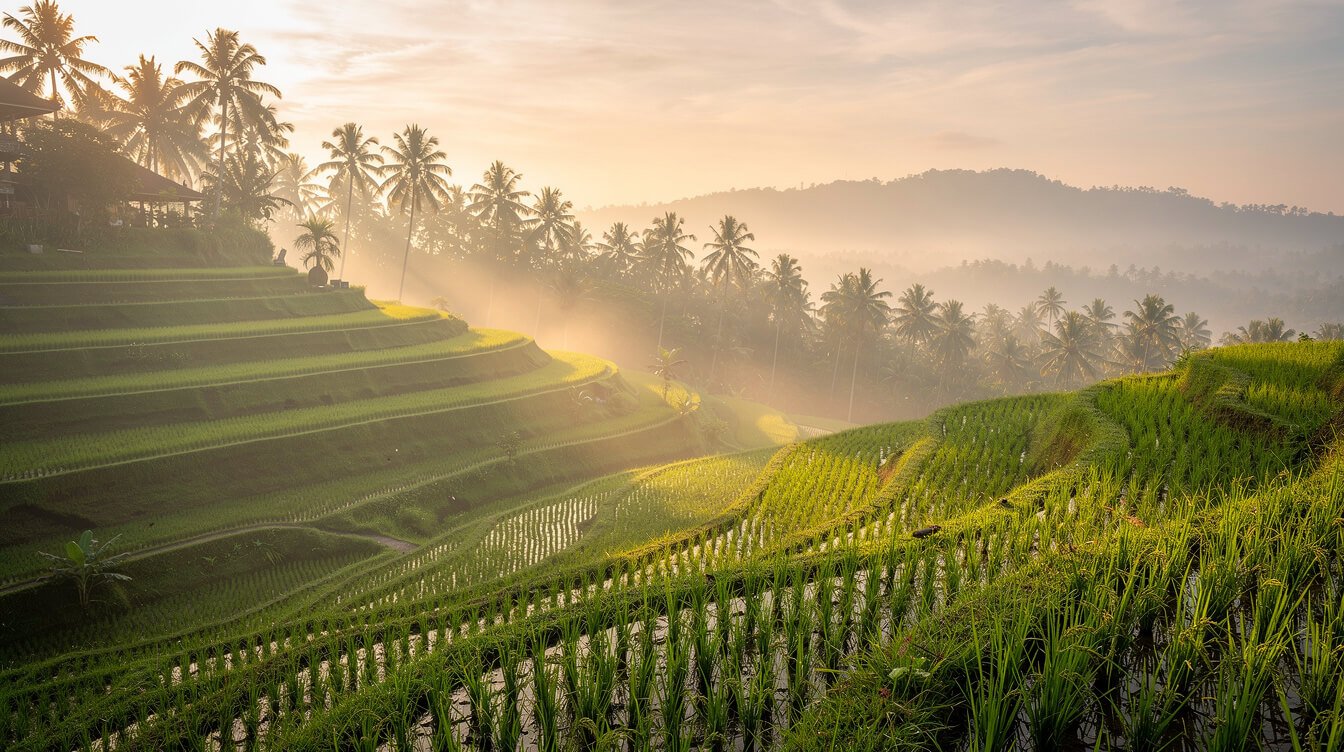
Get a free 3-day sample itinerary
Three easy days from Ubud: rice field walks at first light, a temple morning with time to understand what you are seeing, a market, and one slow day in East Bali. We will send you a free 3-day sample itinerary.
Getting to Besakih From Ubud and Timing Your Visit
From central Ubud, Besakih is roughly 45 to 50 kilometers by road. Map apps usually say a little over an hour. In real traffic, allow 1 hour 15 minutes to 1 hour 30 minutes each way. The common route heads east through Gianyar toward Klungkung and then climbs north through Rendang. The last half hour is a lovely drive, as rice fields give way to clove and coffee gardens and the air cools noticeably.
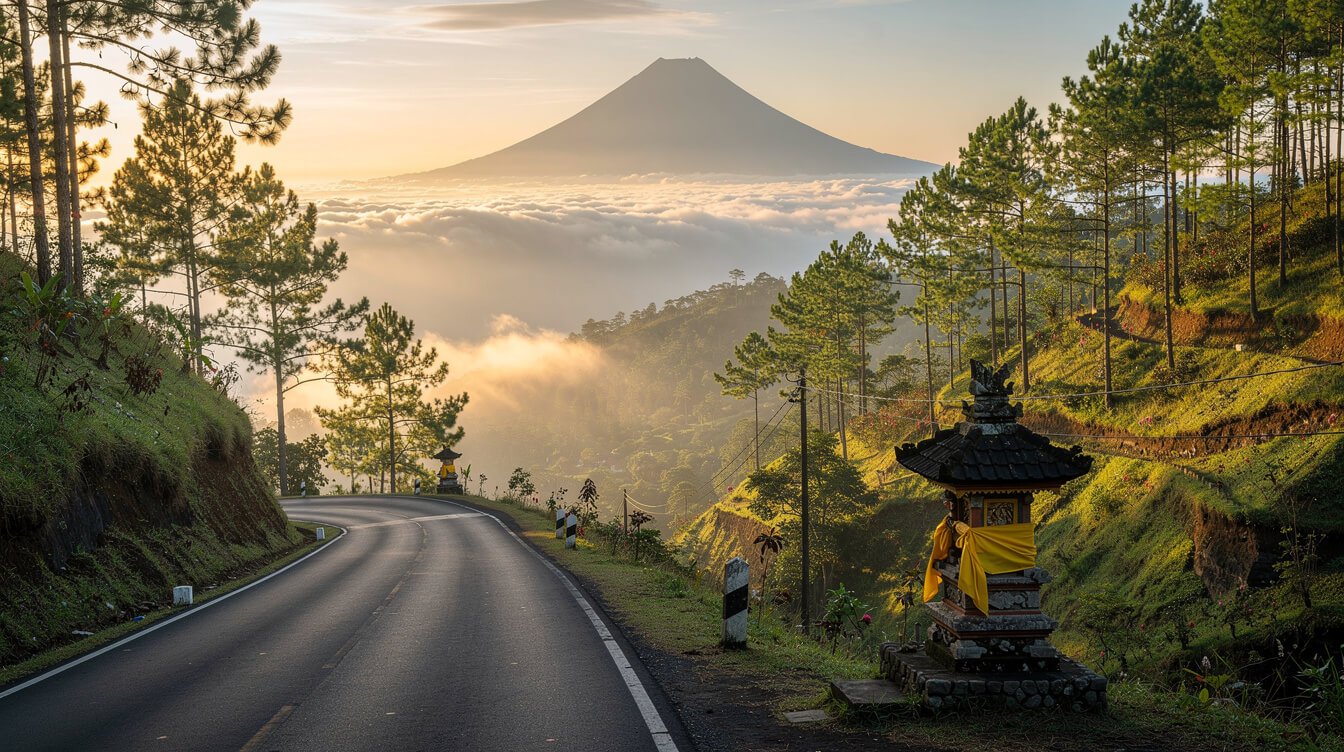
The single most useful piece of timing advice is this: go early. Agung gathers cloud as the day warms up, and by late morning the summit behind the temple is often gone. From November to March, the wetter months, afternoon rain is common too. Leaving Ubud around 6:30 or 7:00 puts you at the temple while the light is soft, the stone is still cool, and the mountain still has a chance of showing itself. You will also arrive before most tour buses.
The easiest way to make the trip is with a private driver who waits for you, so you can stay as long as you like and change the plan on the way home. A scooter is possible for experienced riders, but the mountain roads are steep and winding and the weather changes fast. If you are staying with us, ask the team about drivers when you plan your week. Someone who knows Karangasem well will also know whether a big ceremony is on that day.
Bring layers. At around 1,000 meters it can feel noticeably cooler than Ubud, especially if the clouds roll in.
Ceremony Days: What It Means If You Arrive During a Festival
Besakih is a working temple with a dense ritual calendar. Each temple within the complex has its own anniversary, or odalan, and there are major island-wide ceremonies too. You can read more about how temple anniversaries work in our guide to Ubud’s temples, and about the family side of the calendar in our Galungan guide.
The largest annual gathering is Ida Bhatara Turun Kabeh, which loosely means “the gods all descend together.” Its peak falls on the full moon of the tenth Balinese month, Purnama Kedasa, which usually lands in March or April. In 2026 the peak was April 2, and the ceremony series ran for about three weeks afterward. During that period Balinese Hindus from across the island come to pray, often in huge numbers. Hiking trails on Mount Agung are sometimes closed during major Besakih ceremonies, so check before you plan a climb in the same season.
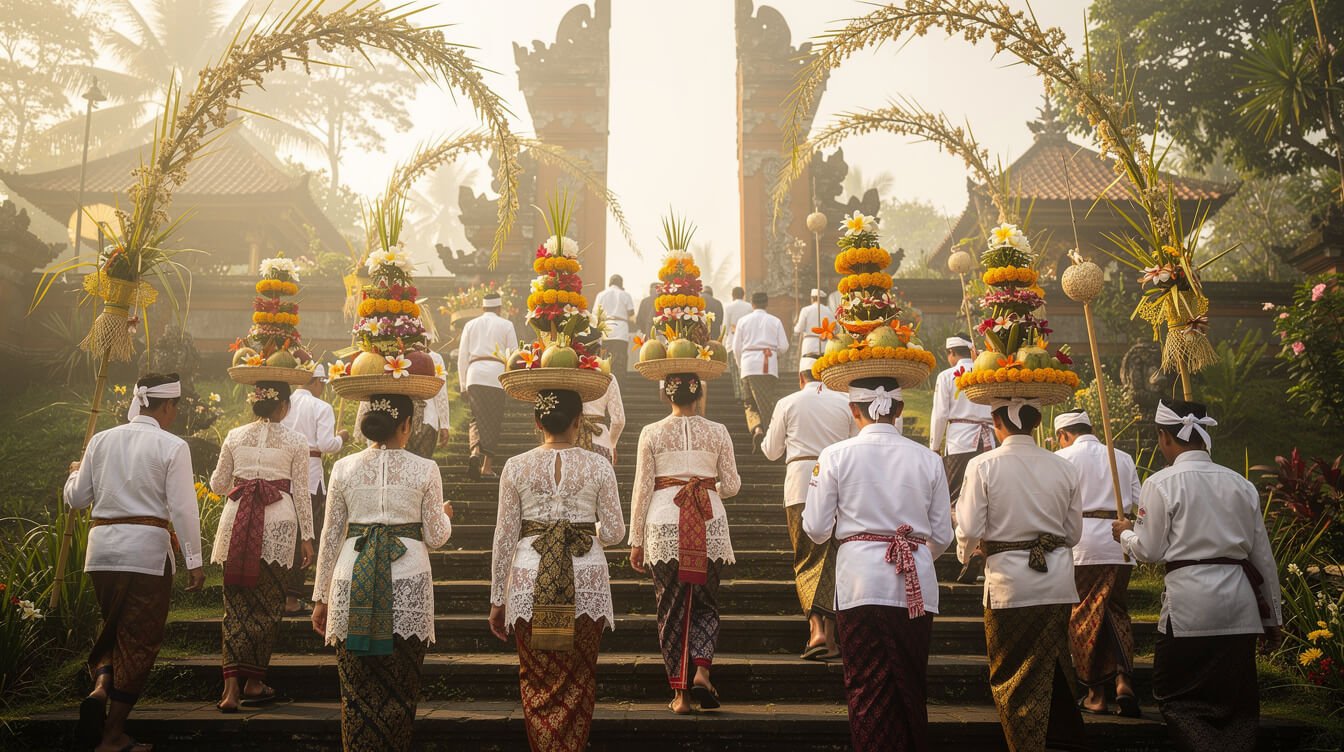
Then there is the ceremony few people alive have seen: Eka Dasa Rudra, a great purification rite tied to the turn of the Balinese century. Its story is one of the most remarkable in Bali. Preparations for the rite in 1963 coincided with the catastrophic eruption of Mount Agung, which killed more than a thousand people. Lava flows passed very close to the complex, yet Besakih itself was largely spared, and many Balinese saw deep meaning in that. The rite was held again in 1979, at the time the priests calculated as correct. It is not something you can plan a holiday around, but knowing the story changes how you look at that mountain behind the gates.
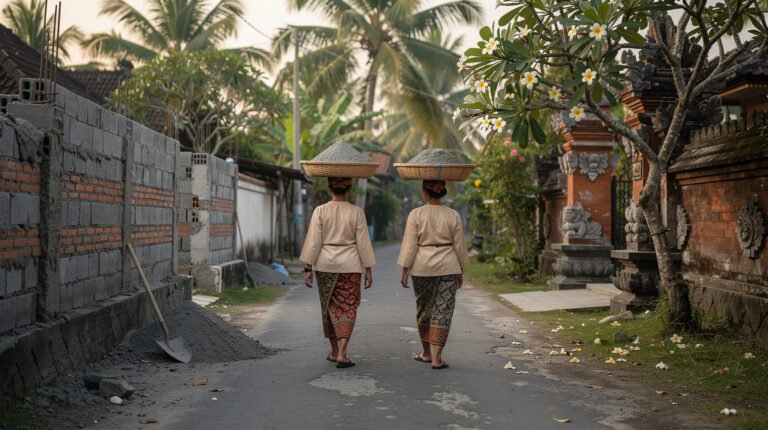
What does this mean for your visit? Arriving on a ceremony day is extraordinary. The steps fill with families dressed in white and gold, women carry tall towers of fruit and flowers on their heads, gamelan drifts from the courtyards, and the whole hillside smells of incense and frangipani. It is also crowded, the inner courtyards are for worshippers only, and your visit will be shorter and more peripheral. If you go, stand back, keep to the edges, and let it be a privilege rather than a photo opportunity. If you would rather see the architecture quietly, choose an ordinary weekday.
Temple Etiquette at Besakih: Dress, Movement and Custom
The rules at Besakih are the same as at any Balinese temple, just held a little more firmly because of where you are.
- Sarong and sash. Everyone wears a sarong tied at the waist and a sash, or selendang, around it. Sarongs are included with your ticket, but bringing your own is a kind and comfortable choice. Our guide to Balinese traditional clothes shows how they are worn.
- Cover your shoulders. A shirt with sleeves is best. Leave swimwear-style tops and very short shorts in the car.
- Never climb on shrines or walls for a photo, and do not sit higher than a priest or than people who are praying.
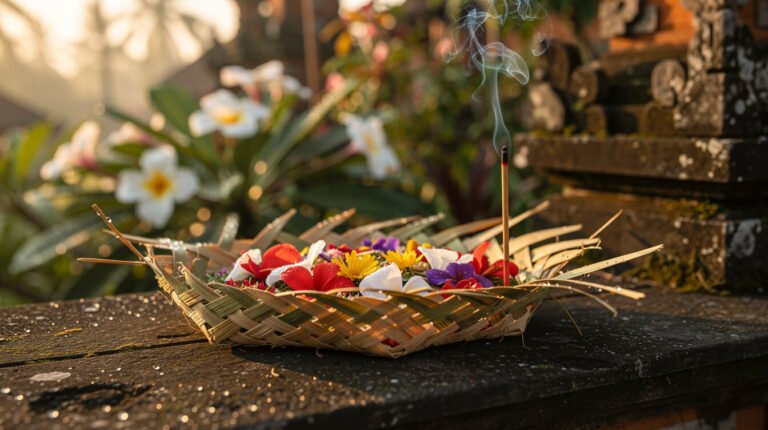
- Do not step on offerings. You will see small palm-leaf trays with flowers on steps and at gates. Walk around them.
- Keep your voice low and ask before photographing anyone at prayer. If the answer is no, or simply a look, put the camera away.
- Respect closed courtyards. If a gate is closed or your guide says an area is for worshippers only, that is the end of the conversation.
There is one more custom to know, and we want to state it plainly and respectfully. Under Balinese Hindu tradition, women who are menstruating are asked not to enter temple grounds. The same applies to people with open, bleeding wounds and to those in a period of mourning after a recent death in the family. These rules come from the Balinese concept of ritual purity, not from any judgment of the person. Visitors are trusted to follow them, and your guide will not ask.
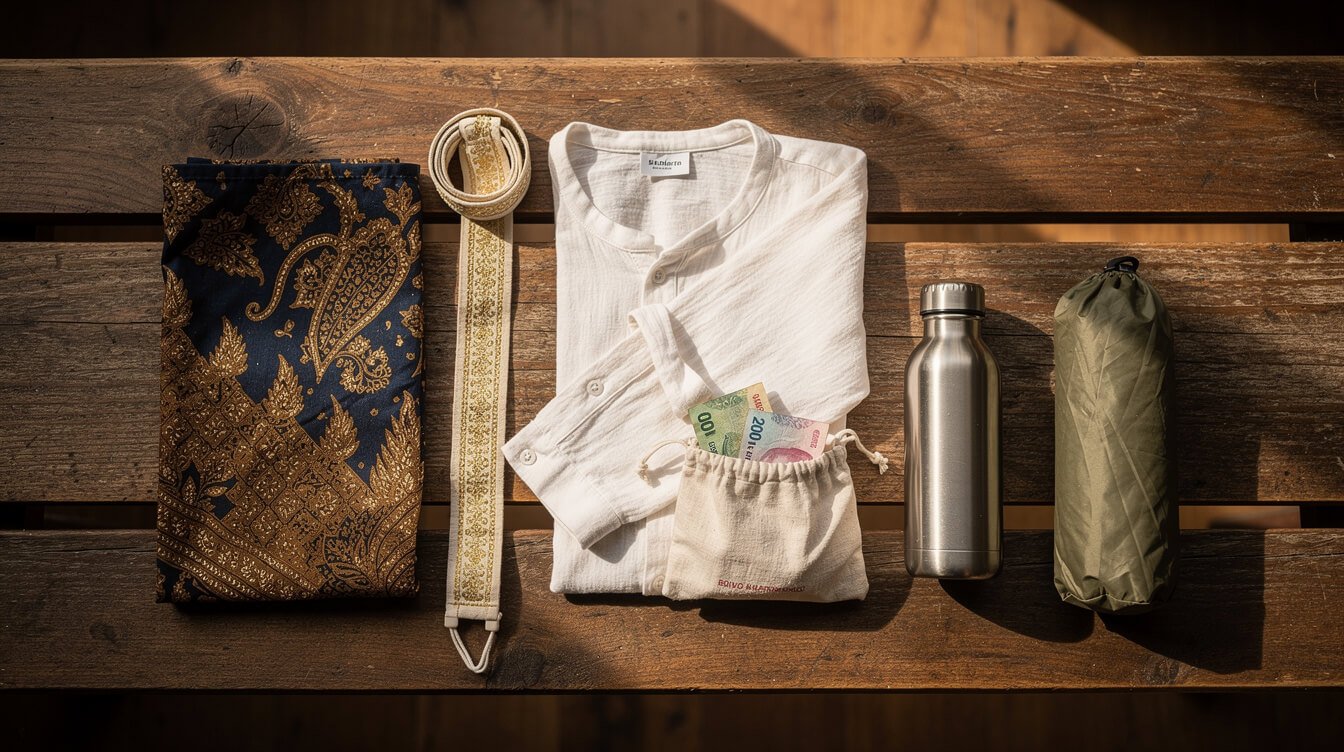
A simple packing list for the day: your own sarong and sash if you have them, a light shirt with sleeves, small rupiah notes for parking, tips and donations, water, a rain jacket from November to March, and sandals that are easy to slip off and on.
Book the Villa
After an early start on the mountain, come home to three bedrooms, a private pool and a quiet tropical garden in Ubud, with a team on hand so the evening stays unhurried. Check availability for your dates.
Pair It: Besakih With Sidemen or Tukad Cepung on One East Bali Day
Besakih is a morning, not a whole day. Once you have walked the terraces and come back down, you have time for one more stop before heading home to Ubud. Three pairings work well.
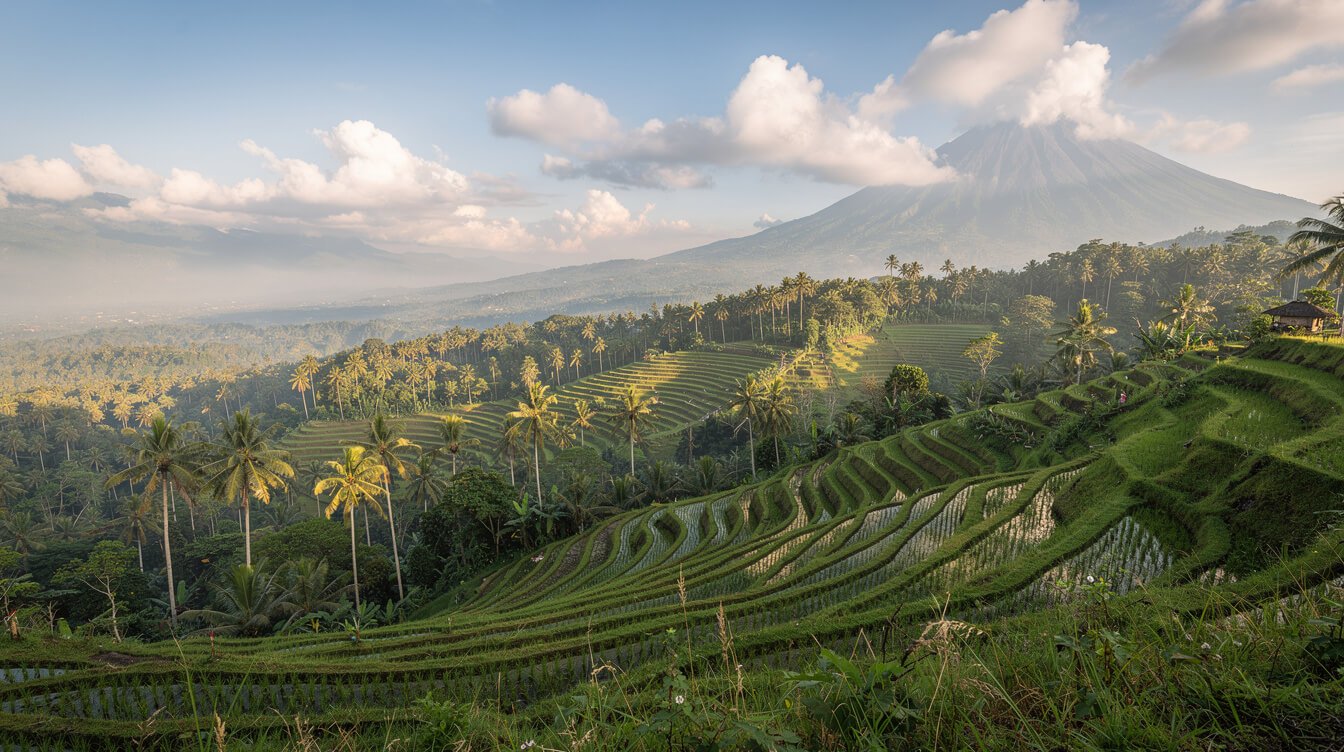
Besakih and Sidemen. The quiet valley of Sidemen lies south of the temple, with Mount Agung rising behind its rice terraces. After the intensity of Besakih, a slow walk on the field paths and a visit to a weaving workshop feels like an exhale. Have lunch in the valley and head home through Klungkung in the afternoon.
Besakih and Tukad Cepung. On the way back toward Ubud, the cave waterfall at Tukad Cepung in Bangli makes a cool, shaded contrast to the mountain temple. The famous light beams come in the morning, so on a Besakih day you are visiting for the cool water and the rock, not the beams.
Besakih and the far east. If you want a longer day, continue east to the water palace at Tirta Gangga or the high gates of Lempuyang, described in our Gates of Heaven guide. Be honest with yourself about the driving time. This makes for a full day, and most people enjoy it more as two separate trips.
A gentle sample day from Ubud:
- 6:30 Leave Ubud with your driver. Coffee and a snack in the car.
- 8:00 Arrive at Besakih. Buy tickets at the official counter, take the shuttle up, and spend about two hours with your guide.
- 10:30 Stop at a roadside viewpoint on the way down for the long valley views toward the sea.
- 11:30 Sidemen. A short field walk and lunch overlooking the terraces.
- 14:00 Head home through Klungkung, ahead of the afternoon rain.
- 15:30 Back in Ubud, with time for a swim before dinner.
Besakih and Ubud’s Own Temples
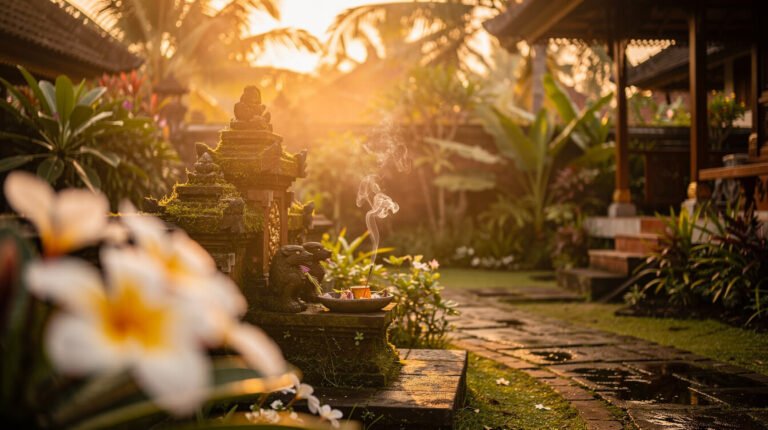
Visiting Besakih changes how you see the small temples around Ubud. The village temple at the end of your lane, the family shrine in a courtyard you pass every day, the water temple where people come to bathe: all of them belong to the same web that leads back up the mountain. After a morning at the Mother Temple, it is worth slowing down at a few of Ubud’s own temples. Our list of Ubud temples to visit is a good place to start, and our round-up of underrated temples in Bali leads you to quieter places. If you enjoyed reading the hillside at Besakih, the clifftop at Uluwatu tells a very different story about the sea.
Frequently Asked Questions About Besakih Temple
How much does it cost to visit Besakih Temple?
At the time of writing, the fee for foreign visitors is around IDR 150,000 per person, including a guide, sarong, wristband and the shuttle up. Parking is extra and paid in cash. Check the current price at the official ticket counter.
Do I need a guide at Besakih?
A local guide is included in the official ticket. Buy your ticket only at the ticket center and politely decline unofficial offers on the road.
How long should I spend at Besakih?
Two to three hours at the temple is enough for most visitors, plus the drive. Combine it with Sidemen or another East Bali stop for a full, relaxed day.
What is the best time of day to visit?
Early morning. The mountain is more likely to be clear, the light is softer, and it is quieter before the tour groups arrive. In the wet season, afternoon rain is common.
Can tourists enter all of Besakih?
No. Some inner courtyards are reserved for worshippers, especially on ceremony days. Your guide will show you where visitors can go.
Is Besakih the oldest temple in Bali?
It is among the oldest sacred sites on the island and the most important, with traditions reaching back more than a thousand years. Exact founding dates are uncertain because the temple has been rebuilt and extended many times.
Final Thoughts: The Temple Every Family Returns To
The best way to understand Besakih is to watch the people who belong to it. A grandmother rests on a step with her offering basket. A father straightens his son’s headcloth before they pass through the gate. A priest rings a small bell, and the sound carries across the terraces and up toward the mountain. You are a guest in someone’s oldest family home. Dress for it, arrive early, listen to your guide, and let the mountain show itself if it wants to.
Then drive home through the rice country, have a swim, and let the day settle. It will stay with you long after the photos fade.

Join our newsletter — fun, new, exciting Bali news
Ceremony days, temple calendars, market finds and small stories from Ubud. Delivered now and then, always worth opening.