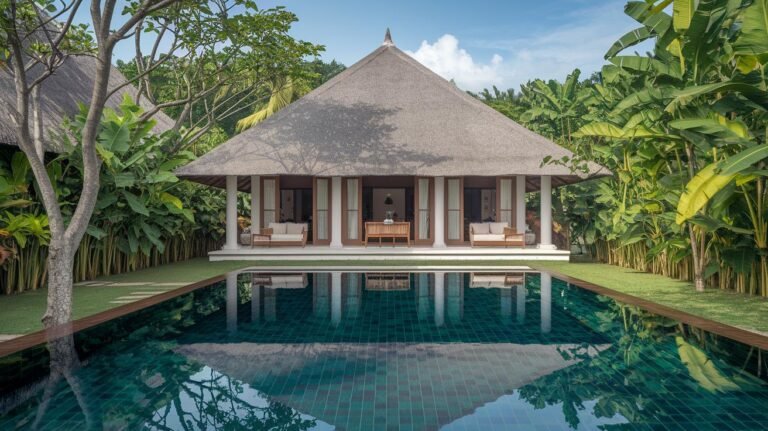
Digital Nomad Bali: Why Ubud Is the Remote Work Base That Actually Holds You
Every digital nomad Bali conversation starts the same way: a spreadsheet of coworking memberships in Canggu, a shortlist of cafes with the fastest wifi, and a six-month plan built around the energy you have on day one. Most people don’t still want that energy by day sixty. The version of remote work that actually lasts here looks different — slower mornings, a desk that’s yours rather than a rented seat, a kitchen that isn’t a food court. Ubud is where that version lives, and it rarely tops anyone’s digital nomad Bali list, because quiet doesn’t photograph as well as a beach bar with good wifi.
This guide is about what daily life actually looks like for remote workers based in Ubud, how it compares honestly to Canggu, Uluwatu, and Seminyak, the practical questions everyone asks first — visa, internet, cost — and why a private staffed villa solves problems a coworking desk was never built to solve.
A Day in the Life of a Digital Nomad in Bali, Based in Ubud

The morning starts earlier than it would at home, not because of discipline but because the light does the convincing for you. Rice-field mist still sits low over the garden at 6:30, the air carries frangipani before the heat burns it off, and the first work block — the one before anyone else is awake, the one with no notifications — gets done on a deck instead of in a bedroom. Someone else has already been by with coffee and fruit. That’s not a staged detail; it’s just what having a villa manager and a cook actually means in practice.
Work itself doesn’t change much. Calls still happen, deadlines still land, the laptop still goes everywhere. What changes is the friction around the work. There’s no hunting for a table with a plug. No fifteen-minute wifi drop mid-call because thirty other people are streaming video in the same cafe. No negotiating with a barista about how long you can occupy a two-top. The desk is the same desk every day, the internet is the same internet every day, and that consistency is worth more to a working routine than almost anything else on a digital nomad’s wishlist.
Midday is for the pool, not because it’s indulgent but because Bali’s heat makes a 1pm meeting feel like a bad idea anyway — better to swim, eat the lunch the chef has made, and come back to the desk once the sun has moved. Afternoons line up well with European evenings and the tail end of the US East Coast morning, which is the actual, unglamorous reason so many remote workers land in this time zone in the first place. Evenings are quiet by design: gamelan drifting from the village temple, the gardener finishing up before dark, a kind of stillness that Canggu’s beach bars were never built to offer.
Weekdays and weekends don’t blur together the way they can on a long trip with no fixed base. A Tuesday looks like a Tuesday — two work blocks, a swim, dinner at the same table — and that repetition is what makes a Friday feel earned instead of arbitrary. Weekends open up without requiring a full relocation: a half-day trip to a waterfall or a temple ceremony, a slow morning with nowhere to be, dinner somewhere in the village instead of wherever happened to be closest to a coworking space. The structure holds because the base doesn’t move.
Canggu, Ubud, Uluwatu, Seminyak: Where Digital Nomads in Bali Actually Land
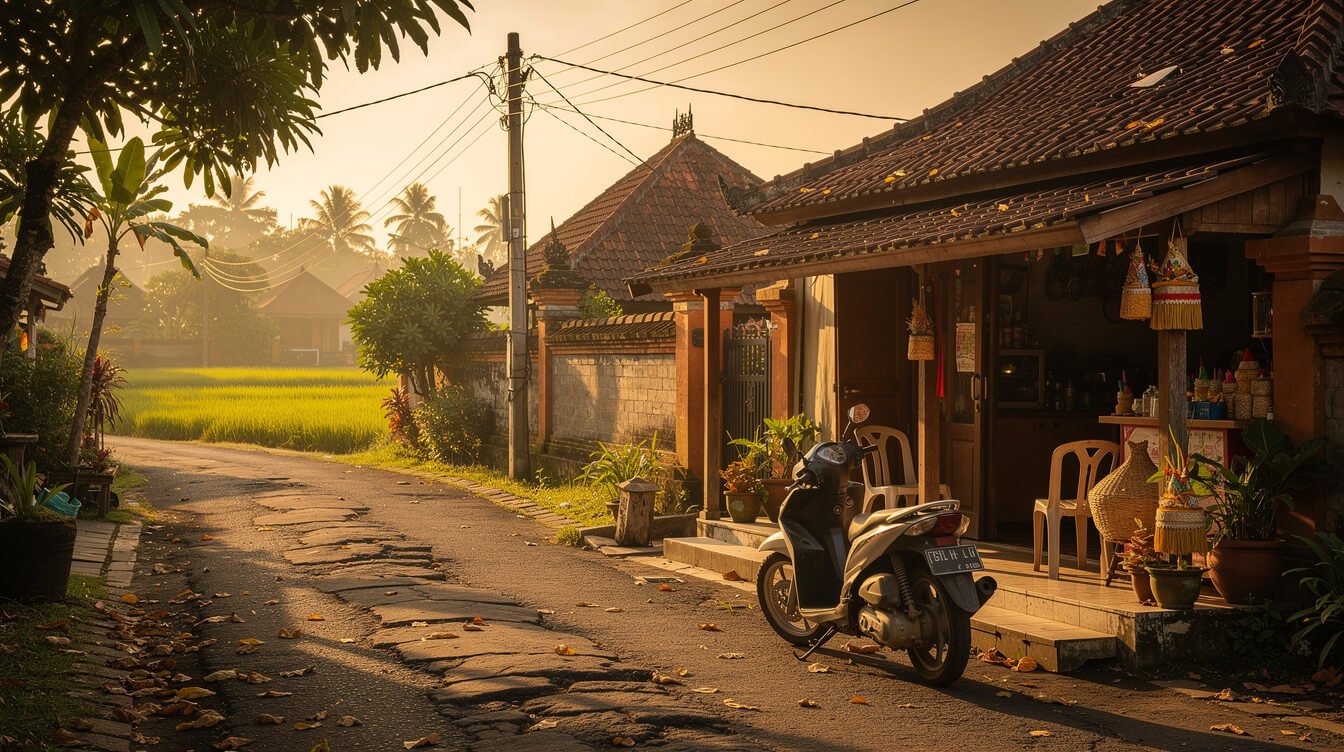
Most comparison guides rank Canggu first, and the data backs that up — it’s the island’s biggest concentration of coworking spaces, nomad-run cafes, and a social scene built specifically around remote workers. It’s also the busiest, most trafficked part of the island, and increasingly, one of the more expensive ones. Scooters queue at intersections that used to be rice paddies. A coworking day pass now costs close to what it did at a proper desk-and-chair office a few years ago.
Ubud sits differently. The internet infrastructure caught up years ago — fiber is common in villa rentals, and the established cafe-and-coworking scene, while smaller than Canggu’s, is reliable rather than oversubscribed. What Ubud actually offers isn’t “cheaper Canggu.” It’s a different relationship to the island altogether: rice terraces instead of rice-paddy real estate developments, a wellness and arts community instead of a surf-and-nightlife one, and a pace that rewards people who are here to work and stay regulated, not just work and recover from the night before. If you want the fuller picture of the town itself, our complete guide to Ubud covers the culture and rhythm in more depth.
Uluwatu suits a narrower type of nomad — surf-focused, comfortable being spread across a cliffside with a scooter as a lifeline, less interested in a walkable social scene. Seminyak is the upscale, convenient option: strong infrastructure, good restaurants, close to the airport, but noticeably fewer dedicated coworking spaces than Canggu and a price tag that reflects the polish. None of the four is objectively “best” — they solve for different versions of the same question, which is really: what do you want your actual, unglamorous Tuesday to feel like?
Within Ubud itself, where you land changes the answer again. Central Ubud puts you walking distance from the market, the palace, and most cafes, at the cost of more scooter and pedestrian traffic than the name “quiet” might suggest. Penestanan and the rice-terrace fringes trade that walkability for actual silence and a view that does the heavy lifting on hard days. Nyuh Kuning and the areas south toward the Monkey Forest sit in between — close enough to town for groceries and dinner out, far enough to not hear the main road. A private villa sidesteps most of this decision entirely, since you’re not choosing a neighborhood for its cafe density, you’re choosing one for the view from your own pool deck. Our guide to where to stay in Ubud breaks down each area in more detail if you’re weighing the trade-offs.
Why Ubud Works Differently for Remote Work

The honest case for Ubud isn’t that it’s quieter — plenty of places are quiet. It’s that the quiet is load-bearing. Deep work needs long, uninterrupted stretches, and Canggu’s energy, however fun, is built around interruption: the next cafe, the next event, the next person pulling up a chair to say hello. Ubud’s rhythm runs the opposite direction. The same slower pace that draws wellness travelers to Ubud’s yoga retreats is what makes it sustainable for someone trying to hold a four-hour focus block without checking their phone every eight minutes.
There’s also a practical case buried in the aesthetic one. Villages here run on a visible rhythm — temple ceremonies, the Wednesday market, offerings set out each morning — and that rhythm gives structure to weeks that would otherwise blur together the way long-term travel often does. Nomads who’ve done six months in Canggu and six months in Ubud tend to describe the second stretch as the one where they actually got things done, not because Ubud is more productive in some abstract sense, but because it removes just enough noise that your own habits can hold.
None of this requires giving up community. Ubud’s expat and remote-work scene is smaller than Canggu’s but well-established — book clubs, co-working meetups, a wellness community that overlaps more than you’d expect with the people building businesses from their laptops between yoga classes. It’s a quieter kind of social life, not an absent one.

Get a Free 3-Day Sample Itinerary
Planning more than a work trip? We will send a three-day Ubud itinerary built around slow mornings and real breaks between work blocks.
The Problem With Cafe-Hopping as Your Only Office
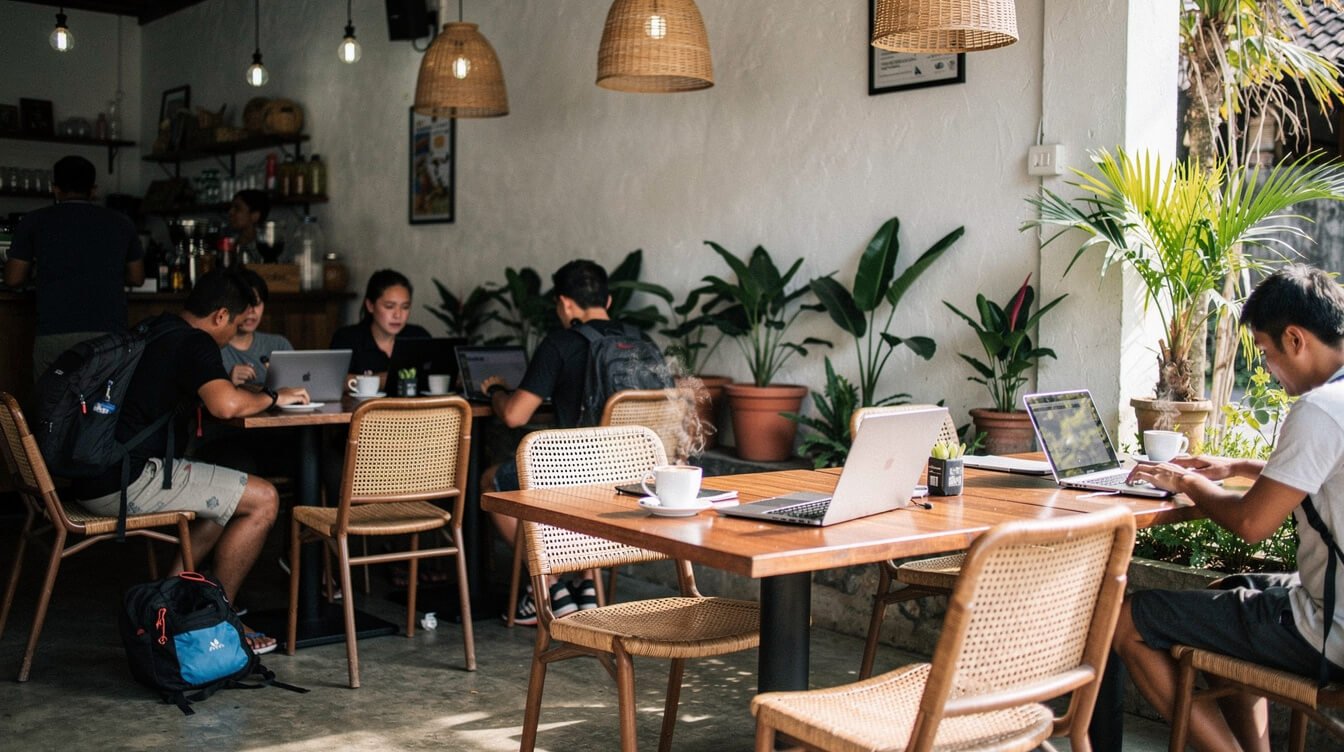
Most digital nomad Bali advice treats the cafe-and-coworking circuit as a given — find the best wifi, rotate venues to avoid burnout on any one space, budget for day passes. It works, for a while. The costs show up slowly: the twenty minutes lost each morning deciding where to go and whether it’ll have a seat, the call you take from a corner table with a hand cupped over your phone because the cafe is loud, the meals that end up being whatever’s near the coworking space rather than what you actually wanted to eat.
The deeper cost is instability. A rented desk is still someone else’s space, with someone else’s hours, someone else’s noise levels, someone else’s wifi outage to wait out. For a trip of two weeks, that’s a fair trade for novelty. For three months of actual client work, it’s a tax you pay every single day, and it adds up to a surprising amount of lost focus by the time you leave.
This isn’t a knock on Canggu’s coworking culture, which is genuinely good at what it does — community, events, a sense of momentum. It’s a specific observation: cafe-hopping and coworking memberships solve for social energy and flexibility, not for the kind of quiet consistency that long stretches of real work actually need.
What a Private Staffed Villa Solves That a Coworking Desk Can’t
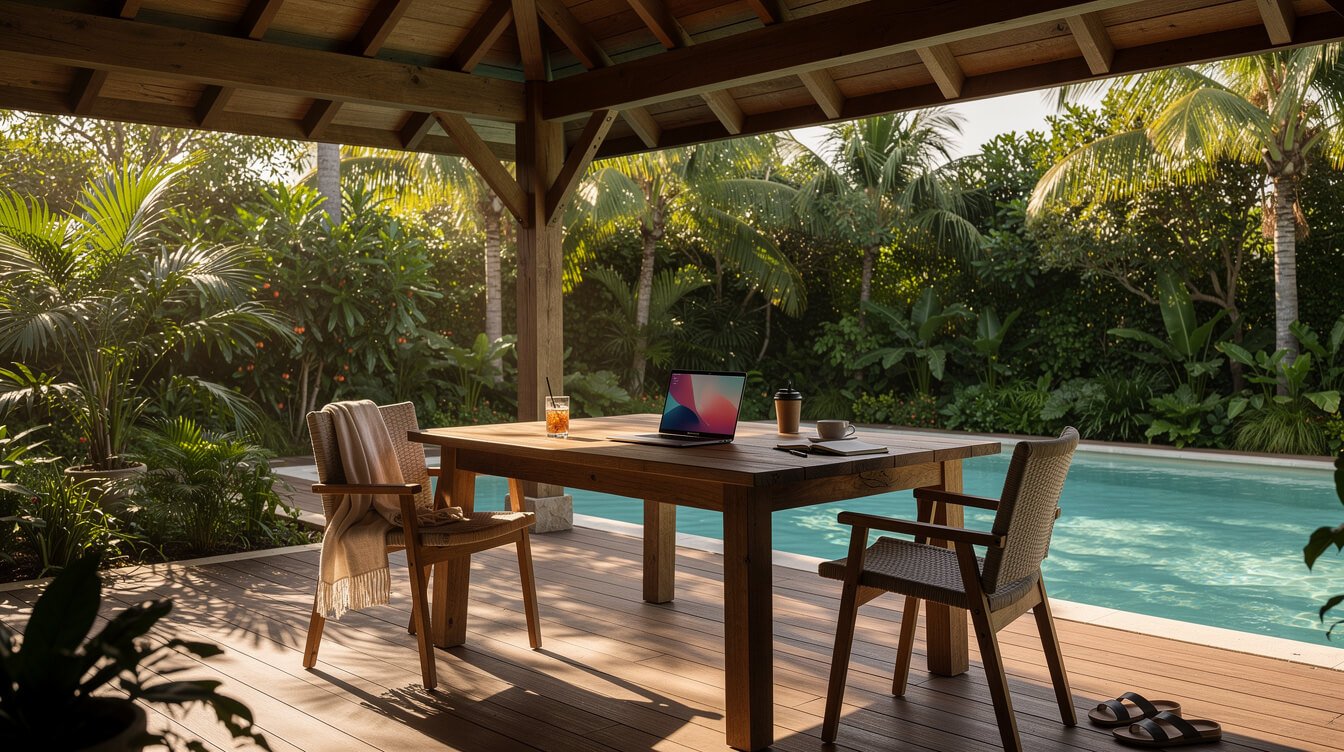
A private villa with full staff solves the instability directly, not by accident but by design. The wifi is fixed and tested before you arrive, not a shared resource thirty other laptops are competing for. The desk is the same desk every day. Meals happen on a schedule that works around your calls instead of the other way around — the chef asks what time you need lunch, not the reverse. Laundry, cleaning, grocery runs: all the small admin that eats into a remote worker’s week gets handled by people whose job it is to handle it, which in practice means hours back every week that would otherwise go to logistics instead of either work or rest.
There’s a quieter benefit too, one that’s harder to put a price on: having a private pool villa as a stable base changes how you experience three months in Bali versus three weeks. You stop living like a tourist moving through someone else’s itinerary and start living like someone who actually lives here for a season — with a gardener who knows your schedule, a cook who’s learned what you actually eat, a rhythm that belongs to you rather than a shared coworking calendar.
This matters most for the nomads who aren’t traveling solo — couples working remotely together, small teams doing a working retreat, families homeschooling while one or both parents work. A three-bedroom villa with staff turns “Bali for a few months” from a logistics project into something closer to actually living somewhere, held by people who are good at their jobs.
It also changes the math on overlapping schedules. Two people working different client time zones out of one coworking membership usually means one of them is on a call in a stairwell. Three bedrooms means three separate quiet spaces — a desk on the pool deck, a second at the garden-facing table, a third inside with the door closed for the calls that need it. Small teams doing a working retreat get the same benefit at a different scale: a shared living room for the parts of the week that are collaborative, private rooms for the parts that need to be heads-down, and a kitchen that can produce lunch for six without anyone leaving the property to find it.
Visa, Internet, and Cost: The Practical Questions First

Visa rules in Indonesia shift often enough that any specific number printed today risks being wrong by the time you read it — check the current Indonesian immigration guidance or a licensed visa agent before booking anything around a specific stay length. In general terms, most remote workers currently use either a standard visitor visa with extensions, or the longer-stay options Indonesia has introduced for remote workers and digital nomads in recent years. Build in a buffer before you lock in flights, and don’t take a cafe forum post as legal advice — rules here change faster than most travel blogs update.
Internet reliability in Ubud has improved substantially over the past several years. Fiber connections are now standard in most villa rentals built or renovated recently, and outages are the exception rather than the routine. That said, always confirm a specific property’s connection speed and backup options (a mobile hotspot as a fallback is cheap insurance) before committing to video-call-heavy client work from anywhere in Bali, Ubud included.
Cost runs noticeably lower in Ubud than in Canggu or Seminyak for an equivalent standard of accommodation — local produce, villa staff wages, and rent all sit at Ubud’s price level rather than Canggu’s increasingly beach-resort pricing. A private villa with full staff costs more upfront than a shared room near a coworking space, but once you account for the meals, laundry, and cleaning a staffed villa already includes, the gap narrows considerably for longer stays.
It’s worth doing the real comparison rather than the headline one. A coworking day pass, a shared room, three meals out a day, a laundry service, and the occasional cleaning fee add up fast once you total a full month — and none of it includes the time spent coordinating all of it. A staffed villa folds most of that into one predictable arrangement: one place, one team, one set of costs you can actually plan around instead of a dozen small transactions scattered across apps and cash payments.
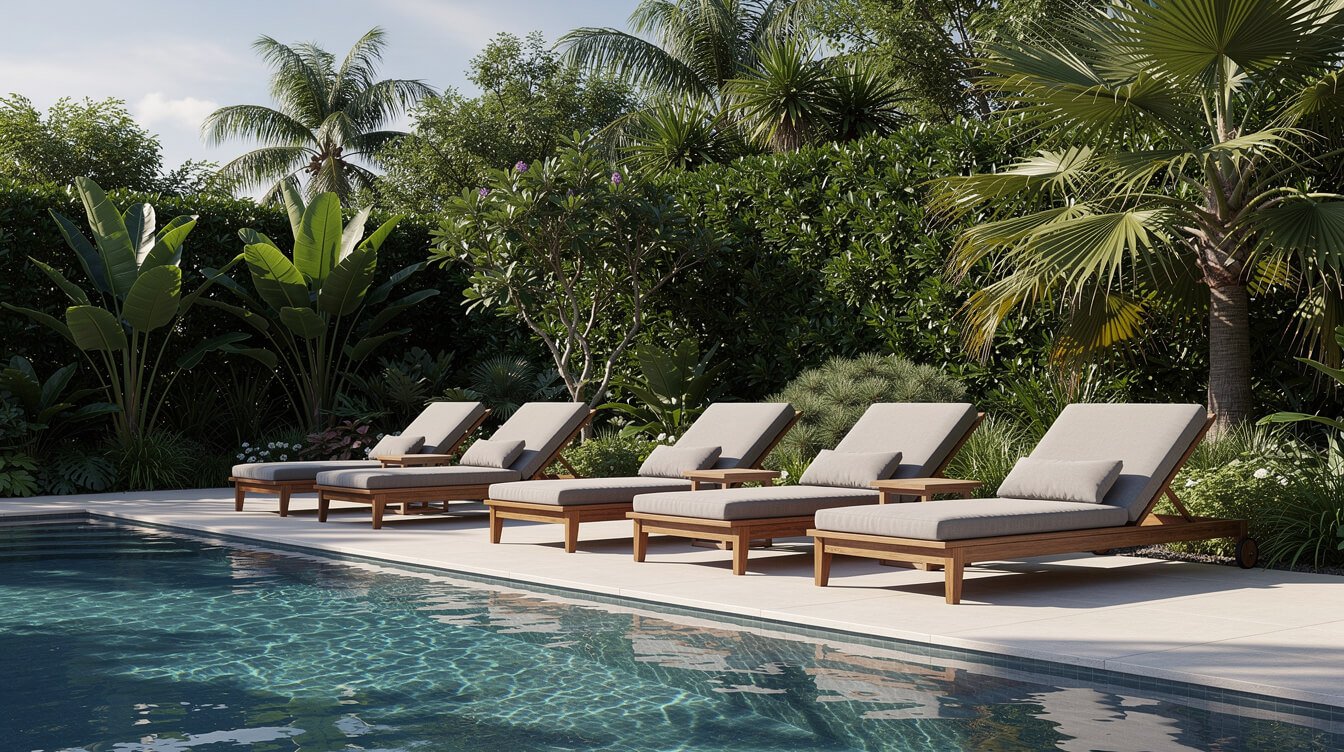
Make Villa Amrita Your Base
Three bedrooms, full staff, a pool deck that doubles as an office, and a kitchen that already knows your schedule. Check availability for your dates.
Frequently Asked Questions About Being a Digital Nomad in Bali

Is Ubud too quiet for digital nomads who want a social scene?
Quieter than Canggu, yes — but not isolated. There’s an established community built around wellness, yoga, and long-term expat life, plus coworking spaces that double as informal meetup spots. It’s a smaller social world, not an absent one.
Is the internet in Ubud reliable enough for daily video calls?
Generally yes, especially in villas with dedicated fiber connections. Always confirm a specific property’s speed and have a mobile hotspot as backup, the same way you would anywhere.
How long can digital nomads stay in Bali?
It depends on the visa type and changes periodically with Indonesian immigration policy. Check current official guidance or a visa agent directly before planning a stay length — don’t rely on outdated blog posts, including this one, for the exact current rules.
Is it cheaper to be a digital nomad in Ubud than Canggu?
Generally yes for day-to-day costs — food, transport, and rent all sit lower than Canggu’s increasingly resort-level pricing. A staffed villa costs more upfront than a shared coworking-adjacent room, but it also includes meals, cleaning, and laundry that would otherwise be separate costs.
What’s there to do in Ubud outside of work hours?
More than most first-timers expect — temple ceremonies, rice-terrace walks, art markets, cooking classes, the full range covered in our guide to things to do in Ubud.
Final Thoughts
The digital nomad Bali story that gets told most often is Canggu’s — and for a certain kind of stay, it’s the right one. But for the version of remote work that depends on consistency more than scene, Ubud quietly does the job better, and has for longer than most comparison guides give it credit for. The difference between three weeks and three months here usually comes down to the same thing: whether your base actually holds you, or whether you’re rebuilding your setup in a new cafe every few days.

Join Our Newsletter
Fun, new, exciting Bali news — straight from the villa, every so often.