Bali Elopement: Your Complete Guide to an Intimate Wedding in Ubud and Beyond
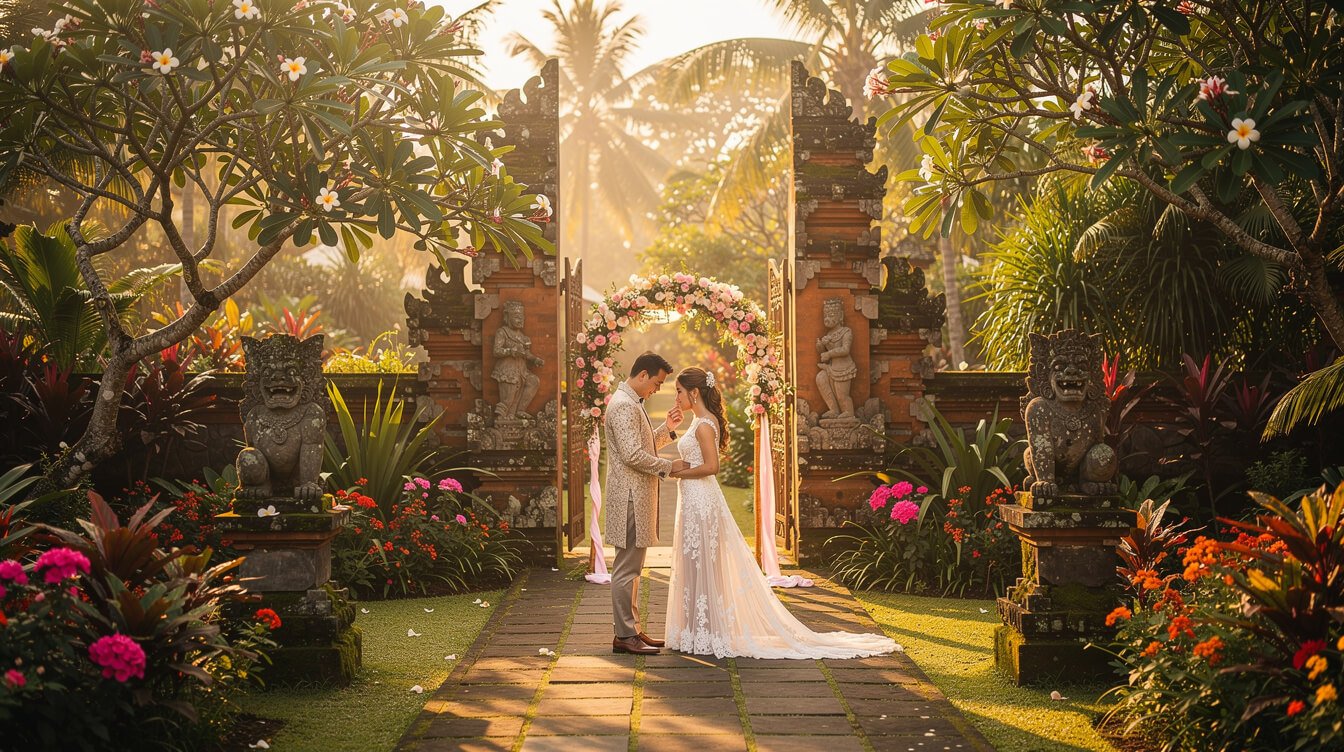
A Bali elopement is one of those rare decisions that feels exactly right the moment you make it. No guest lists to agonize over, no seating charts, no six-month planning timelines. Just you, your partner, and an island that somehow manages to hold both ancient ceremony and effortless warmth in the same breath. If you have been imagining a wedding that feels genuinely yours — intimate, unhurried, alive with tropical light and the scent of frangipani — this guide covers everything you need to know about making it happen.
Whether you are drawn to Ubud’s rice terraces, a clifftop above the Indian Ocean, or a private villa garden where the only witnesses are stone carvings and birdsong, Bali gives you options that most destinations cannot match. This guide walks you through the best locations, legal requirements, realistic budgets, and the kind of planning details that turn a Bali elopement from a dream into an actual date on the calendar.
Why Bali Is the Ideal Bali Elopement Destination
Every month, hundreds of couples from across the globe choose Bali for their elopement. The island earns that attention honestly. Here is what makes it different from the usual destination-wedding shortlist.
A landscape built for ceremonies
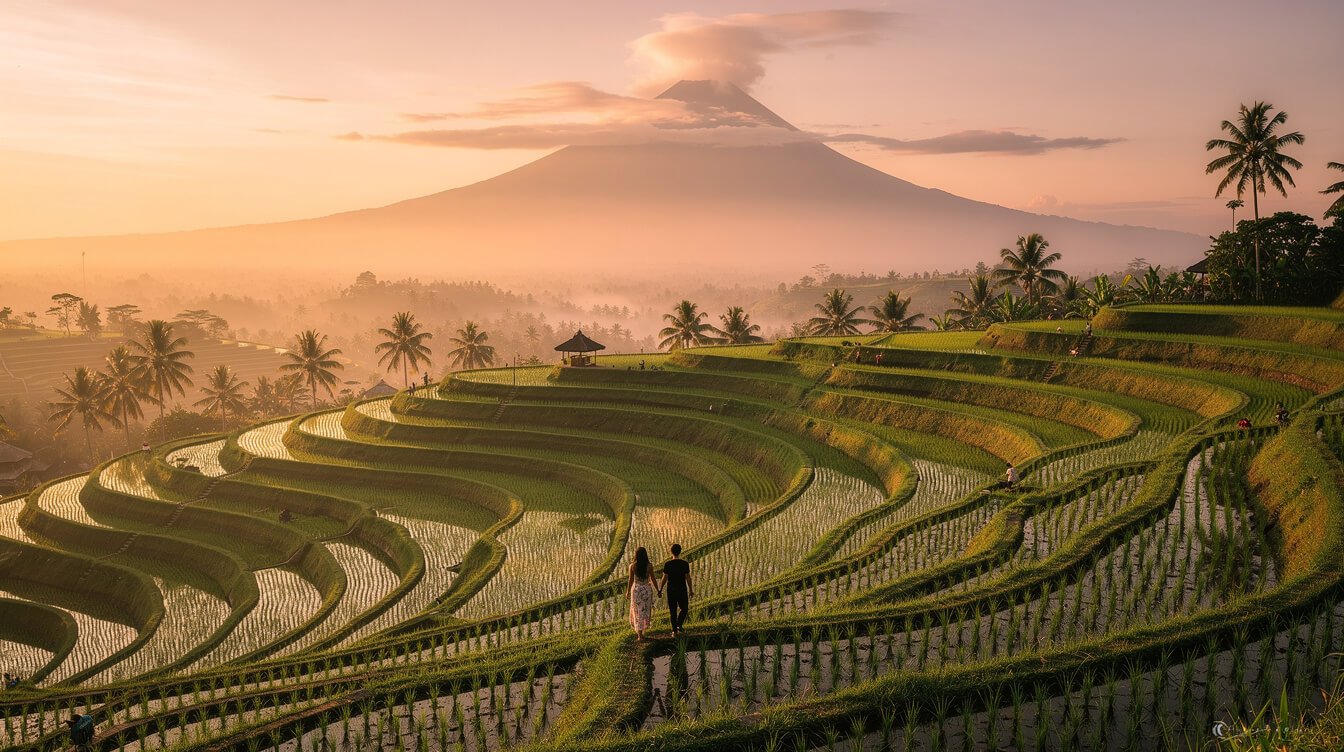
Bali’s geography reads like a wedding planner’s wish list: terraced rice fields that glow green and gold in the morning light, volcanic ridges above the cloud line, jungle waterfalls accessible by a short walk from the road, and black-sand beaches that empty out by late afternoon. Every setting carries a sense of occasion without needing decoration.
A living ceremony culture
This is not a place where you are layering a wedding onto an indifferent backdrop. Bali is an island of daily offerings, temple ceremonies, and community rituals. When you hold a ceremony here — whether legally binding or symbolic — you are stepping into a culture that takes ceremony seriously. Local vendors understand the weight and the joy of the moment because it mirrors their own traditions.
Practical advantages
Beyond the beauty, Bali delivers on logistics. The cost of living makes your wedding dollar stretch significantly further than in Europe, Hawaii, or the Caribbean. English is widely spoken in tourist areas. International flights connect through major Asian hubs. And the wedding vendor ecosystem — photographers, florists, celebrants, makeup artists — is mature, competitive, and genuinely talented.
For couples thinking about planning a first trip to Bali, adding an elopement to the itinerary turns a vacation into something you will talk about for decades.
Best Places for a Bali Elopement
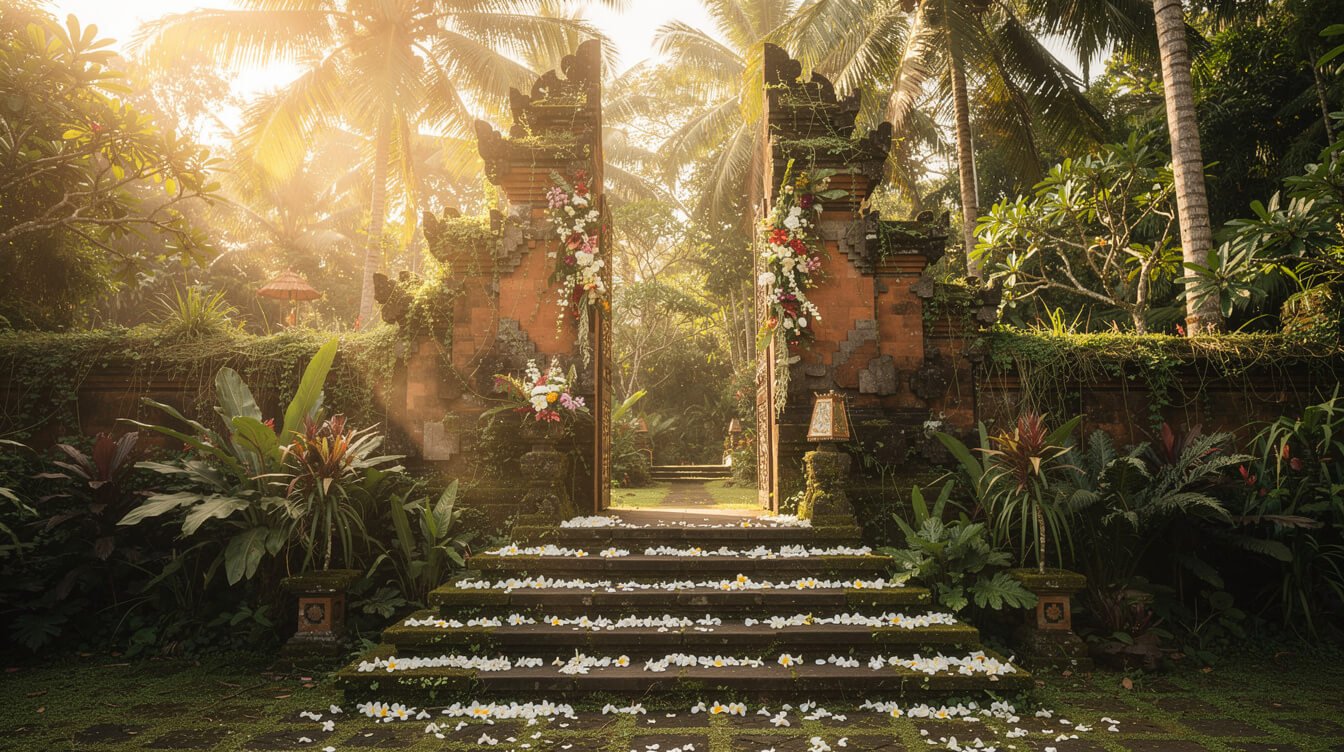
Choosing where to hold your ceremony is the single biggest decision in your Bali elopement planning. Each region has a different personality, and the right one depends on what kind of moment you want to create.
Ubud — rice fields, jungle, and village intimacy
Ubud sits in the cultural heart of Bali, surrounded by rice terraces, river valleys, and temple compounds. An elopement here feels grounded and spiritual — less “beach party,” more “morning mist and the sound of gamelan from the village.” Tegallalang rice terraces offer dramatic tiered landscapes. The Campuhan Ridge Walk gives you an elevated panorama at sunrise. Private villas in the Penestanan or Sayan ridges put you above jungle canopy with views that disappear into blue distance.
If you want your ceremony to feel held by the landscape rather than performing for it, Ubud is your place. And after the ceremony, Ubud’s dining scene offers everything from intimate fine dining to farm-to-table warungs where your celebration dinner becomes its own experience.
Clifftop venues — Uluwatu and the Bukit Peninsula
The southern tip of Bali delivers dramatic ocean views from limestone cliffs. Uluwatu’s coastline, with its famous temple perched on the edge, offers sunset ceremonies where the Indian Ocean stretches to the horizon behind you. The wind is stronger here, the light more theatrical. Couples who want a ceremony that feels cinematic and expansive gravitate toward the Bukit.
Beaches — Seminyak, Canggu, and the East Coast
Beach elopements are the classic Bali image: bare feet in sand, waves in the background, golden hour light painting everything warm. Seminyak and Canggu offer accessibility and vendor convenience. For something quieter, the east coast — Candidasa, Amed, or the black-sand beaches near Gianyar — gives you the same ocean without the crowd.
Waterfalls — Tibumana, Tegenungan, Tukad Cepung
If you want your ceremony photos to stop people mid-scroll, a waterfall backdrop does the work. Tibumana and Tukad Cepung near Ubud are favorites for elopements — accessible enough for a small team but dramatic enough to feel otherworldly. The trade-off: morning light is limited in narrow valleys, and the walk in can be steep in formal shoes. Plan accordingly.

Get a Free 3-Day Sample Itinerary
Planning your Bali trip around an elopement? See how three perfect days in Ubud can unfold — from morning rice-field walks to sunset celebration dinners.
How to Plan Your Bali Elopement Step by Step
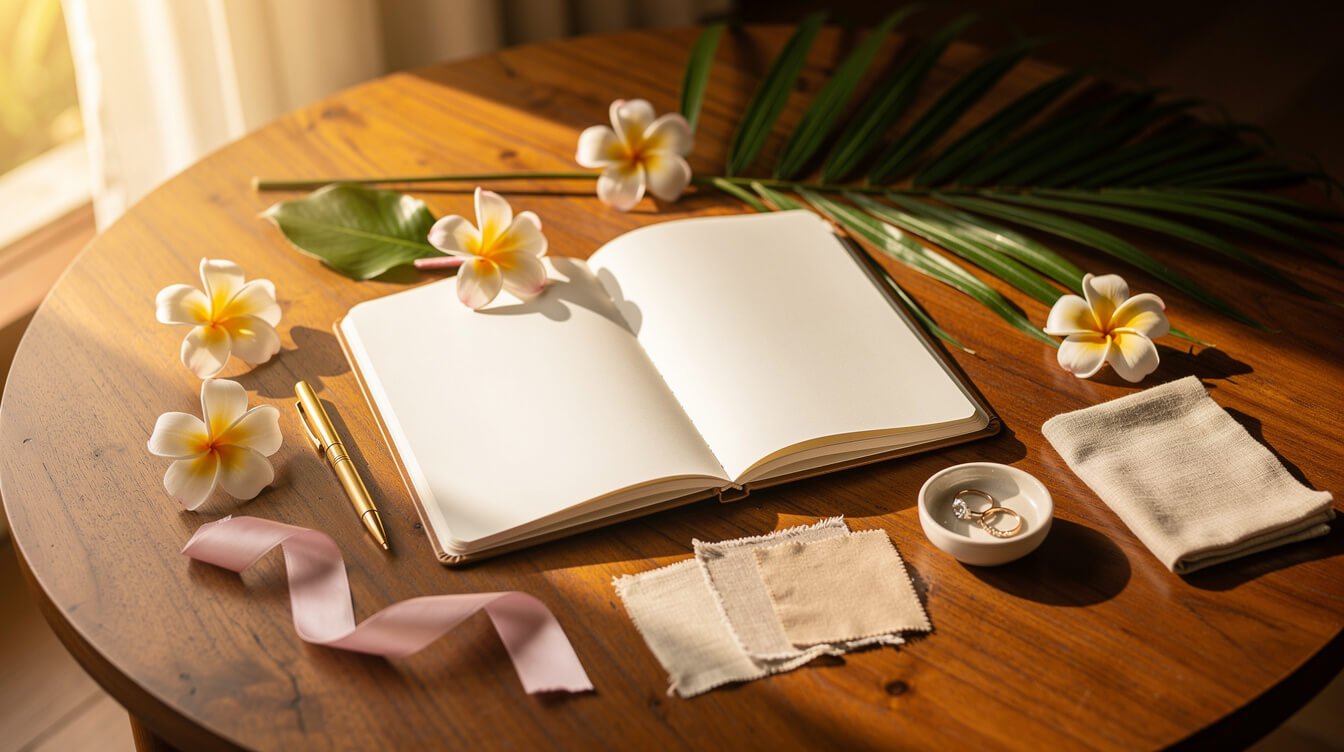
Planning a Bali elopement is simpler than a traditional wedding, but it still benefits from a clear timeline. Here is a practical step-by-step breakdown.
Six to four months before
Choose your ceremony style. Decide whether you want a legally binding marriage in Bali, a symbolic ceremony on the island followed by legal paperwork at home, or a combination. Most international couples choose the symbolic route and handle legalities in their home country — it is significantly simpler and gives you complete freedom with your ceremony format.
Book your accommodation. Your stay matters as much as the ceremony itself. A private pool villa in Ubud gives you a home base where you can get ready together, host a small celebration dinner, and wake up the next morning in the same place where you exchanged vows. Look for properties with staff — having a cook, a gardener, and a villa manager means the logistics of your stay are handled by people who know the area intimately.
Hire your vendors. At minimum, you need a celebrant (or officiant), a photographer, and someone to coordinate the day. Most Bali elopement planners offer packages that bundle these. If you are going the DIY route, book your photographer first — the best ones fill up months in advance.
Three to two months before
Finalize your location. Visit the ceremony site if you are already in Bali, or ask your planner for recent photos and video of the exact spot. Confirm any permits required — some temples and waterfalls charge a small ceremony fee.
Plan your outfits. Bali’s heat and humidity matter. Lightweight fabrics, flowing silhouettes, and breathable shoes are practical and photograph beautifully. Many couples get custom outfits made by Bali-based tailors in Seminyak or Ubud.
Arrange hair and makeup. Bali has a deep bench of talented artists who specialize in wedding styling. Book someone who has worked at your chosen venue type before — a clifftop in wind requires different technique than a sheltered garden.
Two weeks before
Confirm everything in writing. Send a final confirmation email to every vendor with date, time, and location. Share your phone number and your accommodation address. Ask your photographer for a shot list if you have specific images in mind.
Check the weather forecast. Bali’s dry season (April through October) is safest, but even in wet season, rain usually falls in short afternoon bursts. A morning ceremony avoids most risk. Have a backup plan — your villa or a covered terrace — just in case.
The day before
Slow down. Get a couples massage. Walk the rice fields. Have dinner at one of Ubud’s best restaurants. Let the anticipation build naturally. The whole point of eloping is that you do not need to manage anyone else’s experience — just your own.
Legal Requirements for a Bali Elopement
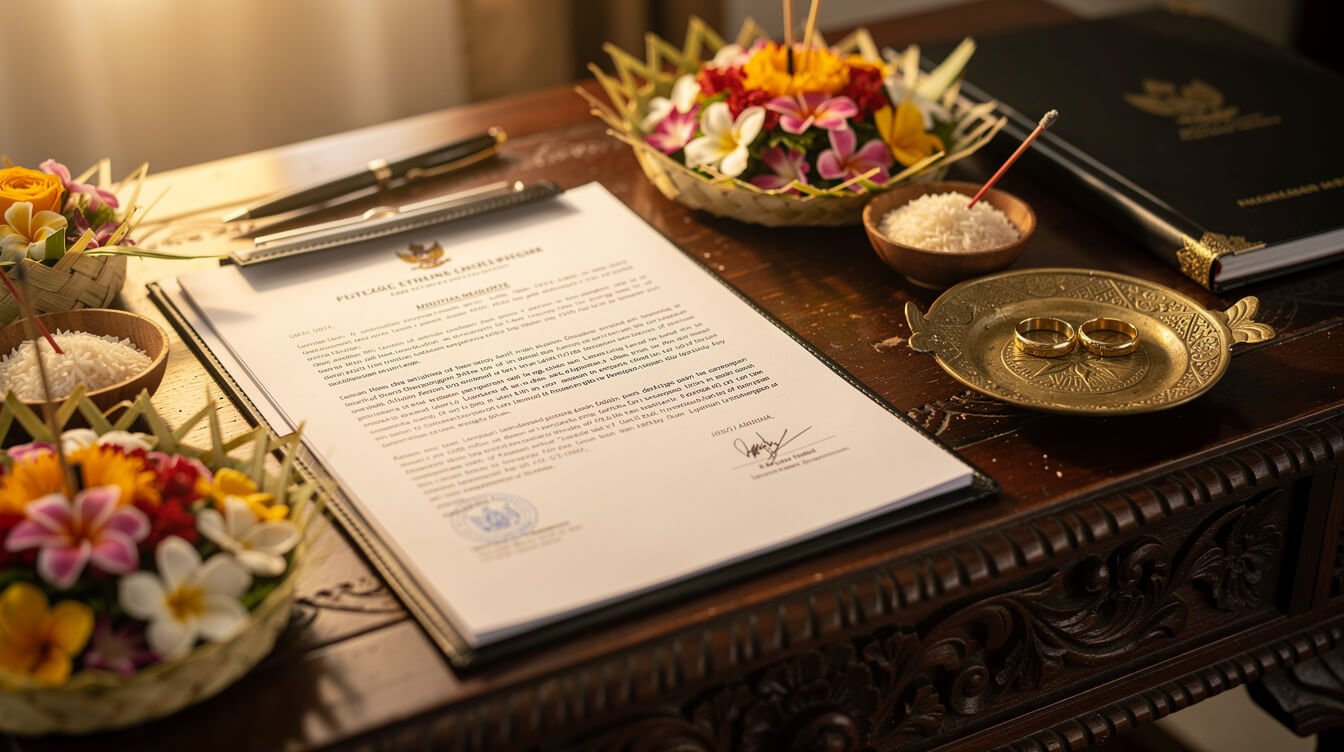
Understanding the legal side of a Bali elopement removes most of the anxiety from planning. Here is what you actually need to know.
Option 1: Legal marriage in Bali (Indonesian civil ceremony)
Indonesia requires that marriages be conducted under one of six recognized religions: Islam, Protestantism, Catholicism, Hinduism, Buddhism, or Confucianism. Both partners must declare a shared religion for the ceremony. The process involves:
- Submitting documents to the local Civil Registry Office (Catatan Sipil) at least 10 business days before the ceremony
- Required documents: valid passports, birth certificates (apostilled or legalized), single-status certificates from your home country, passport-size photos, and a letter of no impediment from your embassy
- A religious ceremony conducted by an authorized clergy member
- Registration of the marriage certificate with the Civil Registry
- Legalization at the Ministry of Foreign Affairs for international recognition
The entire process typically takes two to three weeks and costs between $500 and $1,500 USD including document translation and notarization. Many couples work with a local legal coordinator who handles the paperwork and government liaisons.
Option 2: Symbolic ceremony in Bali + legal marriage at home
This is the route most international couples choose, and for good reason. You design your dream ceremony in Bali — any format, any location, any words — without the constraints of Indonesian religious requirements. Then you handle the legal paperwork through a simple courthouse visit or registry office ceremony in your home country before or after your trip.
The symbolic approach gives you complete creative freedom. Your ceremony can be spiritual without being religious, personal without being prescribed, and held anywhere — a waterfall, a private villa garden, a rice field at dawn — without worrying about venue permits for legal ceremonies.
Important considerations
Whichever route you choose, your Bali elopement planner or legal coordinator should be your first call. Requirements change, and local expertise saves you from discovering a missing document the week before your ceremony. If you are visiting Bali for the first time, factor in extra days for any government office appointments.
How Much Does a Bali Elopement Cost

One of the strongest arguments for a Bali elopement is the value. Your money goes dramatically further here than in most Western destinations, without sacrificing quality. Here is a realistic breakdown.
Core ceremony costs
| Item | Budget Range (USD) | Notes |
|---|---|---|
| Elopement planner/coordinator | $300–$800 | Handles logistics, vendor coordination, permits |
| Celebrant/officiant | $150–$400 | Often included in planner packages |
| Photographer (4–6 hours) | $500–$1,500 | Bali has world-class wedding photographers |
| Videographer | $400–$1,200 | Optional but increasingly popular |
| Flowers and decor | $200–$600 | Tropical flowers are abundant and affordable |
| Hair and makeup | $100–$300 | Including trial session |
| Venue or permit fees | $0–$500 | Varies widely by location |
Total ceremony budget ranges
- Intimate and simple (photographer + celebrant + flowers): $1,500–$2,500
- Mid-range with full styling (planner + full vendor team + decor): $2,500–$5,000
- Premium with extras (videographer + drone + elaborate decor + luxury venue): $5,000–$10,000
Accommodation — where you stay shapes the whole experience
Your accommodation is not just a place to sleep — for an elopement, it becomes part of the experience. A staffed villa with a private chef means your celebration dinner happens at your own pool deck, prepared by someone who shops the morning market for your menu. You wake up the morning after in the same garden where you held your ceremony. No checkout, no taxi, no transition.
A three-bedroom villa in Ubud typically runs $200–$500 per night, depending on the property and season. For a four-to-seven-night elopement trip, budget $800–$3,500 for accommodation. The value compared to a hotel in Hawaii or Tuscany at the same quality level is striking.
Beyond the ceremony
Do not forget the experiences around the ceremony: spa treatments, a sunrise hike to the top of Mount Batur, a cooking class, temple visits. Bali’s experiences are part of why you came — build them into your budget. Most couples spend $100–$300 on activities during their elopement trip.
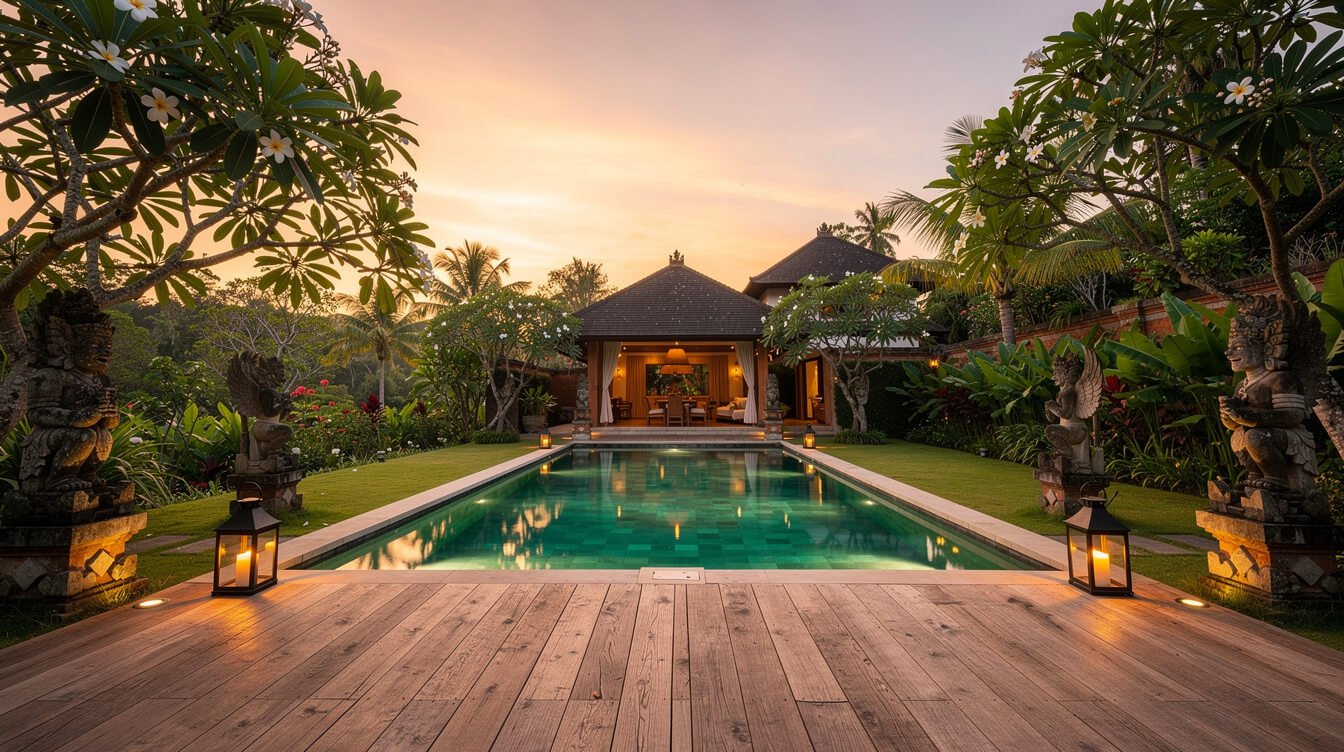
Your Elopement Starts Here
A 3-bedroom staffed pool villa in Ubud — private chef, tropical garden, full team. The kind of place where your elopement and your honeymoon happen in the same breath.
What a Private Villa Bali Elopement in Ubud Looks Like
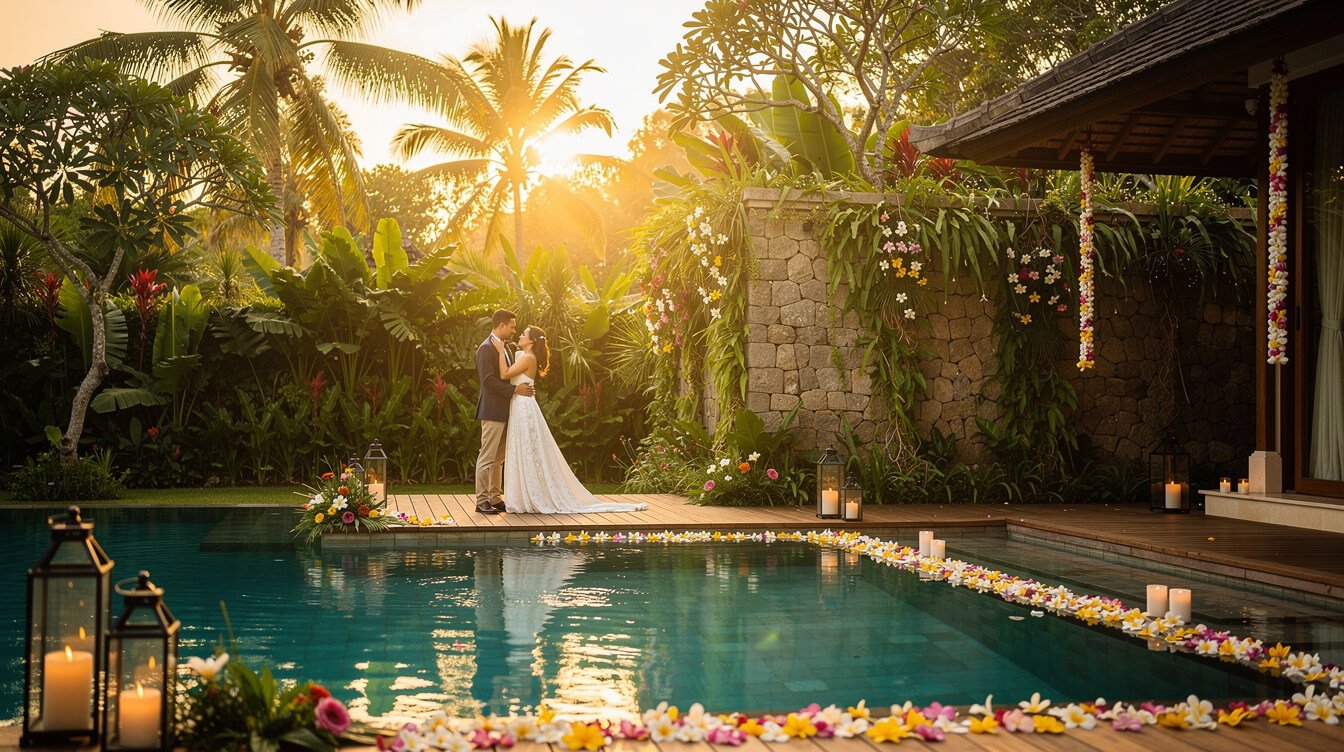
There is a version of a Bali elopement that most guides do not mention: holding your entire ceremony at a private villa. No transfers between venue and hotel. No strangers in the background. Just your own garden, your own pool, your own morning.
Getting ready together
You wake up in the villa. Coffee is already on the pool deck — the villa manager set it out before you stirred. Your makeup artist arrives and sets up in the bright upstairs bedroom. Your partner walks the garden, checks in with the photographer who is capturing the morning light on the stone carvings and frangipani garlands the gardener placed at dawn.
The ceremony
Your celebrant arrives. The ceremony happens on the pool deck, or in the garden under the frangipani tree, or on the upper terrace overlooking the valley. The only soundtrack is birdsong, distant gamelan, and whatever words you have written for each other. Your photographer moves quietly. There is no rush, no next booking on the venue schedule. The space is yours.
The celebration
After the ceremony, your private chef prepares a celebration dinner. Maybe it is a multi-course Balinese tasting menu with dishes from the morning market. Maybe it is a simple grilled seafood spread by the pool with candles on the water. Either way, it is made for you, served at your pace, in a place that already feels like home.
The morning after
You do not check out. You do not pack. You wake up in the same bed, walk downstairs in bare feet, and find breakfast waiting on the pool deck. The gardener is already clipping fresh flowers. The whole experience — ceremony, celebration, and honeymoon — unfolds in one continuous, unhurried arc.
This is the difference between booking a venue for a few hours and staying in a place where every detail is held for you. A villa stay in Ubud turns your elopement from an event into an experience that stretches across days.
Frequently Asked Questions About Bali Elopements

What is the best time of year for a Bali elopement?
Bali’s dry season runs from April through October, with June through September offering the most reliably clear skies. This is also peak tourist season, so book vendors and accommodation well in advance. The shoulder months — April, May, and October — give you the best combination of good weather and lower prices. November through March is wet season, but rain usually comes in short afternoon bursts. A morning ceremony in wet season is entirely viable.
Do we need witnesses for our Bali elopement?
For a symbolic ceremony, no — you set the rules. For a legally binding Indonesian marriage, you need two witnesses. Your planner, photographer, or villa staff can serve as witnesses if needed.
Can we invite a few guests to our elopement?
Absolutely. Many Bali elopements include two to ten guests — parents, close friends, or siblings. A private villa with multiple bedrooms makes this easy: everyone stays together, shares meals, and attends the ceremony without the formality of a traditional wedding. A Bali wedding venue guide can help you think through larger group options if your guest list grows.
How far in advance should we book?
Three to six months is the sweet spot. This gives you enough time to secure your preferred photographer and accommodation without the year-long lead times of a traditional wedding. If you are flexible on dates, two months can work — especially in shoulder season.
What if it rains on our ceremony day?
Bali rain is warm, brief, and oddly beautiful. Most experienced photographers welcome it — the light after tropical rain is extraordinary. That said, always have a covered backup option. A villa with a covered terrace or an open-air pavilion gives you protection without losing the outdoor feeling.
Is Bali safe for international couples?
Bali is one of the safest destinations in Southeast Asia for travelers. The Balinese are genuinely welcoming, the tourist infrastructure is mature, and healthcare facilities in Denpasar and Ubud are solid. Standard travel precautions apply — stay hydrated, use reef-safe sunscreen, and carry travel insurance that covers your activities.
What should we wear?
Anything you want — that is the point of eloping. Lightweight fabrics work best in Bali’s tropical climate. Many brides choose flowing dresses in breathable cotton or silk. Grooms often go with linen pants and a relaxed button-down. Some couples wear Balinese ceremonial dress for a symbolic ceremony. Barefoot on grass or sand is completely appropriate and photographs beautifully.

Join Our Newsletter
Fun, new, exciting Bali news — delivered to your inbox. Tips on Ubud, seasonal travel advice, and the kind of stories that make you start checking flight prices.