Bali’s First Scripts Empower Kings to Inscribe Laws and Forge Early Society
Ancient Bali took its first steps toward organized civilization as writing systems arrived, shaping royal administration and temple rites. This era introduced practices that still echo in modern Balinese rituals. Historians divide this foundational age into three phases: the Singhamandawa era, which laid groundwork before Warmadewa rule; the Warmadewa Dynasty, when local sovereignty flourished; and the Wangsa Jaya era, a continuation of the Warmadewa line.
In the Singhamandawa era, roughly Saka 804–836 (CE 882–995), the Panglapuan office in Singhamandawa recorded royal orders on stone inscriptions. Key texts include the Sukawana A1 of 804 Saka, the Bebetin A1 from 818 Saka, and the Trunyan A1 of 833 Saka. Together they reveal details on sacred temple construction, social welfare measures, and the formal marking of hermitage boundaries around Mount Cintamani. The ruler granted tax relief for community festivals and assigned duties to Buddhist monks, laid out inheritance rules for married couples, and led efforts to rebuild Bharu Village after bandit raids. These edicts also formalized land demarcation and public safety in important mountain passes. Early in the era, four chief offices—sarbwa, dinganga, nayakan makarun, and manuratang ajna—ran state affairs. Over time, the number of high posts grew to address new administrative demands.
Image: The King of Singhamandawa Observing the Condition of Bharu Village (Source: Personal Collection)
Following Singhamandawa, the Warmadewa house rose to power under Sri Kesari Warmadewa, a Mahayana Buddhist appointed from Java. His leadership left lasting political, social, and cultural marks on the island. An inscription on the Blanjong pillar credits him with subduing the regions of Gurun and Suwal, lands scholars locate in Lombok or Nusa Penida, likely to secure key sea routes. Royal edicts of that time appear in both Sanskrit and Old Balinese, reflecting a bilingual court culture. By then Bali had established itself as a fully sovereign realm, free of external rule. Inscriptions at Pejeng and Cempaga A (1103 Saka/1181 CE) refer to Walipuram (the Bali Kingdom) and Balidwipanagara (the Nation of Bali), terms historians link to the later Bedahulu Kingdom, with its capital at Bedahulu village.
Available inscriptions hint that this realm covered all of Bali’s main island and surrounding waters. Central government, known as the prahajyan, sat at the helm. Below it lay village administrations—banua, wanua, thani, or desa—each organized into banjar territorial and communal units. Residents were addressed as anak wanua, tanayan thani, or karaman, depending on their local community. A monarch reigned as chief protector and ruler, expected to embody the Asta Brata virtues and present himself as a living link to the divine. Tax levies and corvée labor followed guidelines from the Niti Sastra, aiming to protect public welfare. Local desa councils handled rice planting schedules, water works, and minor disputes through regular assemblies of village elders.
Image: King Anak Wungsu as the Incarnation of Lord Vishnu (Source: Personal Collection)
Stone inscriptions confirm that Bali’s monarchs did not rule alone. Royal decrees mention a high council where ministers, temple leaders, and community representatives pooled their views before major decisions. That process embodied an early practice of musyawarah mufakat, or consensus-based governance. Key officers included the Senapati, similar to the later Gelgel-era Punggawa, who oversaw military levies; the Samgat, which functioned like a supreme court; the Dhikara or judges; and Shiva and Buddhist priests, who often served as royal advisors on ritual and legal matters. Council minutes carved on stone reference debates over temple land grants, border disputes among villages, and approval of royal marriage alliances.
Under King Anak Wungsu, society divided into two broad categories: the Catur Warna and the Kahula or Kaula slaves, who stood outside the caste system. Catur Warna comprised Brahmana (priests and scholars), Ksatriya (rulers and warriors), Waisya (merchants and traders), and Sudra (service providers). Strict rules governed marriages across these strata: known as nyerot, a union where a high-caste woman married below her rank required payment of a pamucuk fine. Slaves served in temple kitchens, royal households, and on agricultural estates; some won their freedom through loyal service or royal decree.
Image: Balinese Society under the Catur Warna System (Source: Personal Collection)
Economic and social life revolved around swagina, or occupational guilds. The kasuwakan, referred to as subak, managed irrigation networks with rotating schedules for river channels across terraced rice paddies. Undahagi craftspeople organized into branches: undahagi watu for stonework, undahagi kayu for carpentry, and undahagi rumah for house building. Pande metalworkers forged weapons and ornaments near ore deposits, and bhandagina performers—musicians and dalang puppeteers—entertained at court gatherings and village fairs. Textile specialists, known as juru mangjahit kajang, produced ceremonial cloth for cremations and temple rituals. Each guild maintained its own patron shrine and held annual festivals to honor their deities. Court craftsmen and performers received higher pay and special privileges compared with their village counterparts.
Agriculture remained the kingdom’s backbone, with fields of rice, coconut groves, clusters of candlenut trees, orange orchards, cardamom beds, and taro patches. Trading activity centered at peken markets, set beside crossroads or under majestic banyan trees. Local merchants exchanged cloth, pottery, and salt, and sea traders docked in Bali’s harbors carrying exotic goods. A monetary system of uang kepeng coins—denominated in suwarna (su), masaka (ma), and kupang (ku)—served as both currency and a unit for valuing commodities. Some trade appears to have extended toward Java, Sulawesi, and beyond.
Image: Illustration of a Market (Peken) in Ancient Bali (Source: Personal Collection)
Most Balinese practiced Shaivism and Buddhism, often blending rituals of both traditions. Central priests, known as Mpungku Sewasogata, led temple rites and advised the palace on matters of state. Shrines honored the Tri Murti—Brahma, Vishnu, and Shiva—with elaborate offerings. Several inscriptions depict King Anak Wungsu as a living incarnation of Lord Vishnu, while catur muka statues reflected Brahma’s four-faced presence. The Gobleg Inscription mentions a Waisnawa group of Vishnu devotees in Tamblingan Village. Temple treasuries, detailed in palm-leaf manuscripts, show how offerings funded repair of sacred sites and distribution of alms to the poor.
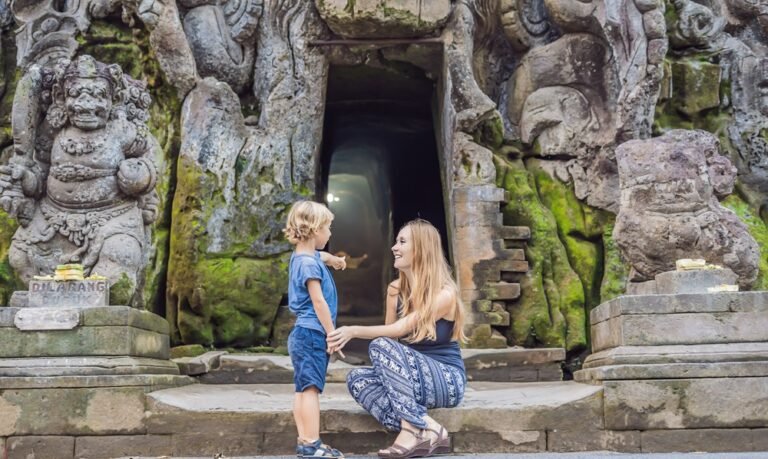
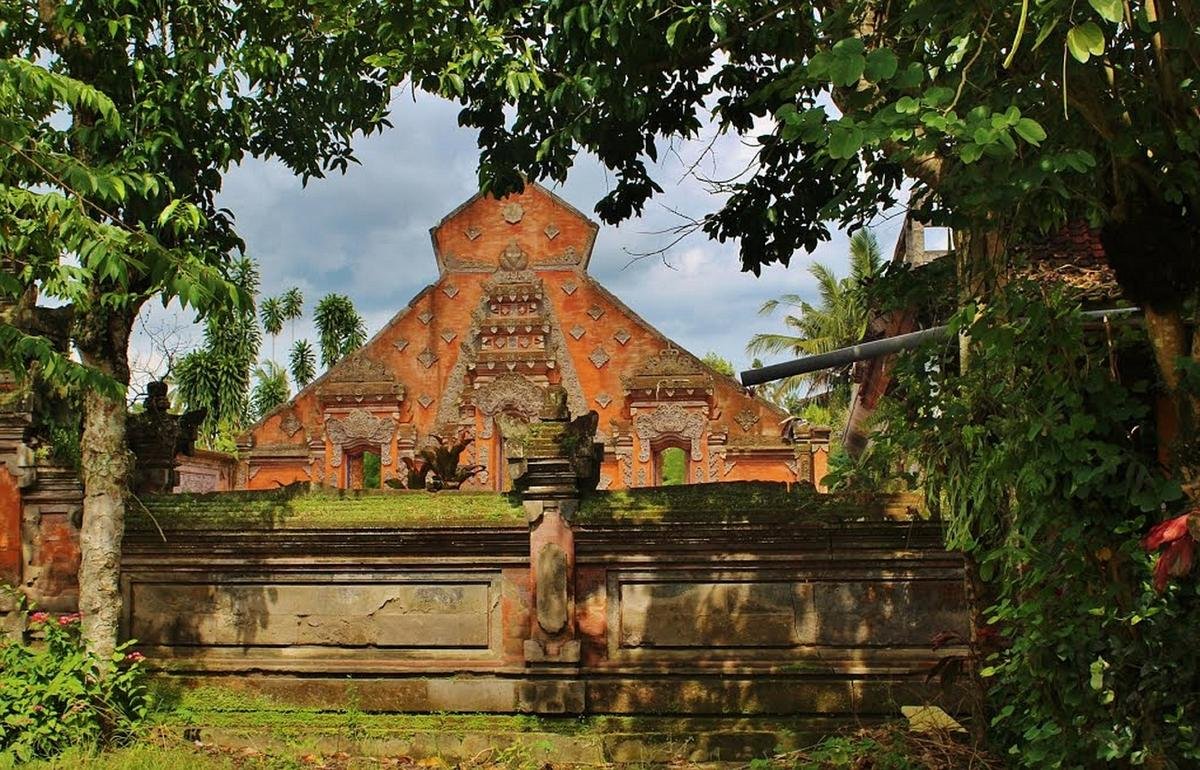
Surviving architectural marvels attest to the era’s craftsmanship and devotion. Pura Pegulingan features intricate stone carvings, while Pura Tirta Empul remains a living water temple with its purification pools. Candi Gunung Kawi’s rock-cut shrines showcase deep relief work carved directly into cliff faces. Goa Gajah, or Elephant Cave, presents a fearsome exterior facade guarding a healing spring within. These sites stand as enduring reminders of a society that fused spirituality with monumental art.
The final chapter unfolded under Wangsa Jaya rule, led by King Jayapangus, a descendant of Sri Kesari Warmadewa. His reign saw a blend of Balinese court customs and Chinese motifs, evident in ceramics and wood-carving styles found at Pura Dalem Balingkang. Archaeological finds include Chinese-style mirrors and painted tiles. That dynasty ended when forces from the Majapahit Kingdom, under Sri Astasura Ratna Bumi Banten, conquered Bali, bringing the Ancient Bali era to a close and integrating the island into the wider Javanese empire until later colonial eras.