What the Garden Sounds Like After Dark in Ubud
You don’t notice it at first. The Ubud garden after dark doesn’t announce itself — it seeps in, the way warmth seeps through the floorboards of an old house. One moment you’re setting down your glass on the terrace table, and the next you’re sitting very still, because something out there has started.
The First Voice Belongs to the Gecko
“To-kay. To-kay.” Two syllables, emphatic and unhurried, like a small creature who knows exactly who he is. The tokay gecko calls from somewhere in the stone wall — you can never quite find him — and his voice carries across the garden with startling clarity. In Bali, they say a tokay calling seven times brings good luck. You’ll lose count trying, because the evening light has gone soft and your mind is already drifting.
Then the Frogs Begin
Not all at once. A single voice from the rice paddy beyond the garden wall — a low, resonant pulse. Then another, slightly higher, from the lotus pond near the entrance. Within minutes the whole garden hums with them, dozens of frogs singing in overlapping rhythms that somehow never clash. It sounds like the earth breathing. If you’ve spent the day visiting Ubud’s temples and rice terraces, this is the sound that tells your body: you’re home now, you can stop.
Get a Free 3-Day Sample Itinerary
The Crickets Keep Time
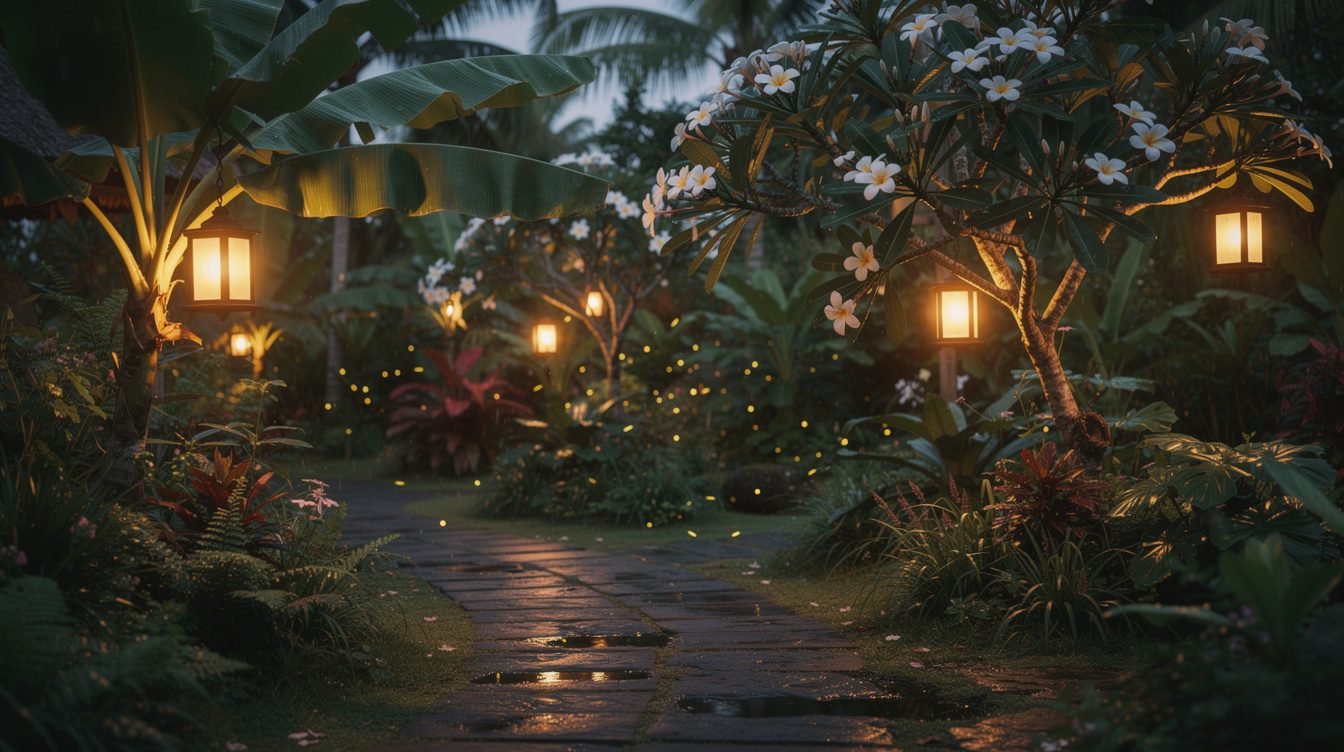
Behind the frogs, a finer texture — the steady, silvery trill of crickets hidden in the frangipani hedge and the tall grass along the stone path. They’re so constant that you stop hearing them as individual sounds. They become the baseline, the hum beneath everything else. This is what silence actually sounds like in Ubud — not emptiness, but fullness. Every leaf, every stone, every warm patch of dark soil has something living in it, and after dark they all speak at once.
Then — the Gamelan
Some evenings, faintly, from the village temple down the road. Bronze and bamboo, a music that doesn’t resolve the way Western music does — it circles, it shimmers, it hangs in the warm air like the scent of incense. You can’t quite tell how far away it is. It could be three houses down or a kilometer across the rice fields. Sound travels differently here at night, when the air is heavy and still and the valley acts like a bowl.
Our villa team can tell you which temple is practicing. Made will say “Ah, that’s Pura Dalem — they have ceremony on Friday.” He knows the rhythm of the village the way you know the rhythm of your own street back home.
The Water Finds Its Own Melody
The pool filter makes a low murmur. A trickle from the garden fountain — not a dramatic cascade, just a thread of water over smooth stone. And if it rained in the afternoon (it usually does, in Ubud, between three and five), the banana leaves are still dripping, each drop landing with a soft, fat sound on the wet earth below. These are not sounds you’d seek out. They find you. You sit on the terrace with a cup of Bali coffee or a glass of wine, and the garden fills in around you.

Book the Villa
What You Won’t Hear
No traffic. No air conditioning units clanking on a hotel rooftop. No elevator dings, no lobby music piped through hidden speakers. A staffed villa in Ubud trades all of that for this: a garden that comes alive the moment the sun goes down, and a team that has already closed the day — the kitchen is clean, the pool towels are fresh for morning, the mosquito coils are lit on the terrace. There’s nothing left to do but listen.
The Sound That Stays With You
Guests tell us this all the time — months after they’ve gone home, it’s the night sounds they remember most. Not the temple visits or the waterfall hikes, though those were extraordinary too. The thing that rewired something in them was lying in bed with the windows open, hearing the full orchestra of a Balinese garden at night, and realizing they hadn’t thought about their phone in three hours.
That’s what the garden sounds like after dark. Not silence. The opposite of silence — a living, breathing, singing world that asks only one thing of you.
Be still. And let it in.

Join Our Newsletter — Fun, New, Exciting Bali News