Bali Language Guide: What People Speak in Ubud and the 20 Words That Open Doors
Your first morning in Ubud, someone will bring you coffee, smile and say a word you don’t quite catch. Maybe it’s suksma. Maybe it’s om swastiastu. Maybe it’s a cheerful “good morning!” in perfect English. The Bali language question isn’t really about which one is “correct”. It’s about which of three languages fits the moment, and how a handful of well-placed words can turn a polite exchange into a real one.
We’re the in-villa team at Villa Amrita, a staffed three-bedroom pool villa in the rice fields outside Ubud. Language is one of the first things guests wonder about, usually somewhere between the airport pickup and the first warung lunch. This is the guide we wish everyone had before landing: who speaks what on the island, why Balinese has “high” and “low” ways to say the same thing, the names you’ll hear on day one, 20 words that genuinely open doors, and how to read the curling script on Ubud’s street signs. No grammar drills. Just enough to make you feel at home.
What Language Do They Speak in Bali?
Short answer: three languages, each with its own job.
Bahasa Indonesia: the language of everyday business
Indonesia’s national language is used in schools, government offices, newspapers, TV, banks and shops across all of the country’s thousands of islands. Every Balinese person you meet speaks it, along with the many Indonesians from Java, Lombok, Flores and beyond who live and work here. If you learn a few words of only one language before your trip, make it this one. It’s the language of prices, menus, directions and taxi apps. It’s also kind to beginners: no verb conjugations, no gendered nouns, no tones, and it’s written in the same Latin alphabet you’re reading now.
Balinese (Basa Bali): the language of home, village and temple
Balinese is the island’s own mother tongue. It’s an Austronesian language, a cousin of Indonesian rather than a dialect of it, with around 3.3 million native speakers counted in the 2000 census. It’s what families speak at home, what neighbors use at the banjar (village association) meeting, and what you’ll hear woven through temple ceremonies, shadow puppet plays and dance dramas. Around Ubud, which is still very much a cluster of traditional villages, you’ll hear it constantly between locals. It’s rarely used with visitors, which is exactly why a single Balinese word from you lands with such warmth.
English: widely understood in Ubud
In Ubud’s cafes, yoga studios, spas, galleries and villas, English is spoken comfortably, often very well. Drivers and guides who work with travelers usually speak it too. Step a few minutes into the back lanes, the village markets or a small family warung, and English thins out quickly. That’s where your Indonesian basics and a smile do the heavy lifting.
A simple rule you can actually use
- Use English in tourist-facing places, and for anything important like medical questions, bookings or directions you can’t afford to get wrong.
- Use Bahasa Indonesia for transactions: ordering, bargaining, paying, asking the way.
- Use a Balinese word or two for warmth: a greeting, a thank you, a compliment to the cook.
That’s it. You don’t need fluency in anything. You need the right word at the right moment, and the willingness to laugh when you get it slightly wrong. Bali is a forgiving place to try. For more of the practical basics, from SIM cards to scooters, our Bali travel tips guide covers the rest.
Balinese Registers, Simply: Why There Are “High” and “Low” Ways to Talk
Here’s the part of the Bali language that fascinates linguists and quietly shapes everyday life. Balinese has a system of speech levels called sor-singgih. Instead of just adding “please” or changing your tone, a Balinese speaker can choose an entirely different word for the same idea, depending on who they’re talking to and who they’re talking about.
Linguists usually describe three main levels:
- Low or common Balinese (basa ketah or basa kapara): the everyday register used among family, friends, peers and younger people. This is what most Balinese speak most of the time.
- Middle Balinese (basa madia): a polite in-between, useful when speaking to someone you don’t know well.
- High Balinese (basa singgih, often called alus, meaning refined): built largely from old Javanese and Sanskrit-rooted words, and reserved for priests, ceremonies, elders and formal occasions. Relatively few people command it fluently.
The difference is lexical, not just tonal. “This” is ené in low Balinese and niki in high Balinese. “What” is apa or napi. “Big” is gedé or ageng. The idea stays the same; the word shows respect.
What it sounds like in real life
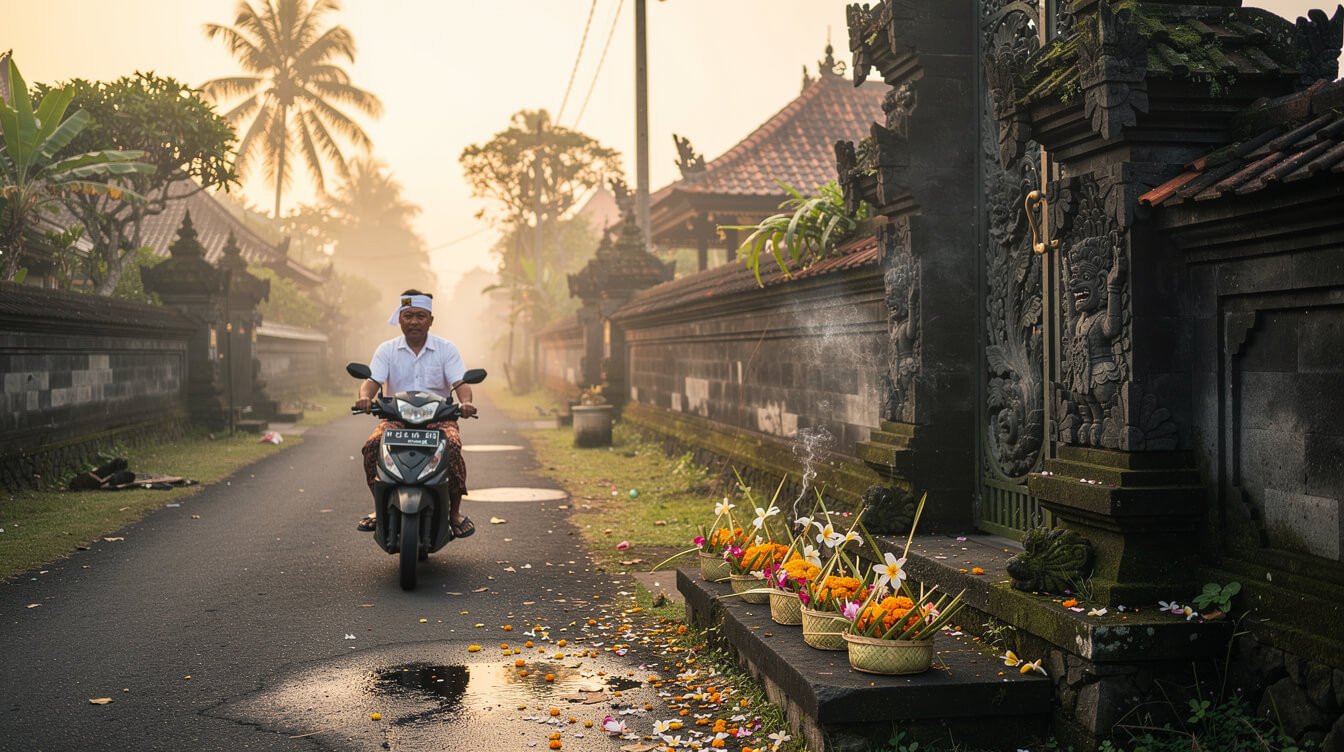
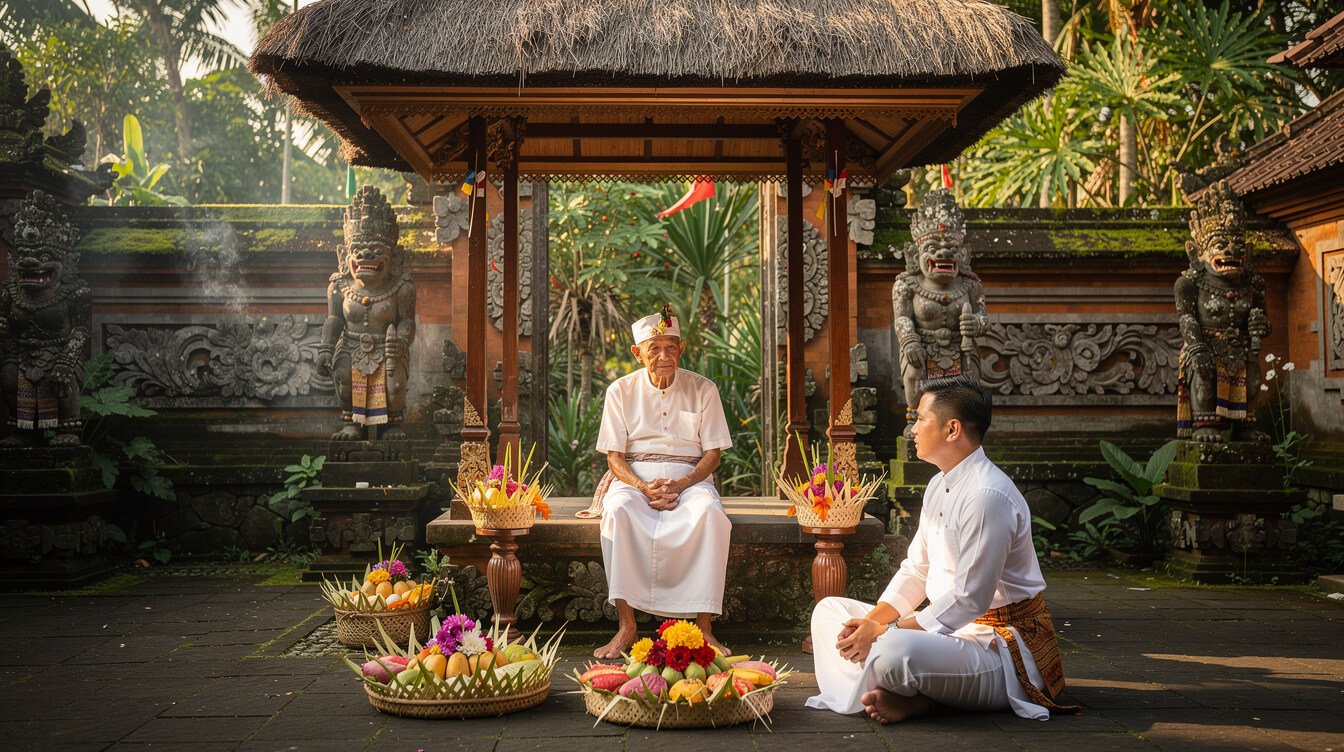
Imagine your driver on the way to a temple. In the car, he jokes with his cousin on the phone in easy, low Balinese. At the temple gate, he greets the pemangku (temple priest) and his vocabulary shifts upward, softer and more formal. Back at the warung for lunch, he orders from the Javanese owner in Indonesian. Three registers, maybe two languages, in a single morning, and nobody thinks twice about it.
The registers grew up alongside Bali’s traditional caste structure, and they can get complicated, which is one reason many Balinese simply switch to Indonesian with someone whose background they don’t know. It’s neutral ground. For you as a visitor, the takeaway is reassuring: nobody expects you to navigate any of this. But knowing it exists helps you understand why a single polite Balinese word, like inggih (a respectful “yes”), carries so much grace. If you’d like the deeper cultural background, our guides to the Balinese people and Bali’s religion pair beautifully with this one.
Get a free 3-day sample itinerary
Temple mornings, rice-field walks, a warung lunch to practice your new words, and plenty of slow time by the pool. We’ll send you a free 3-day sample itinerary for Ubud, paced gently for your first days on the island.
Names You’ll Meet on Day One: Wayan, Made, Nyoman and Ketut
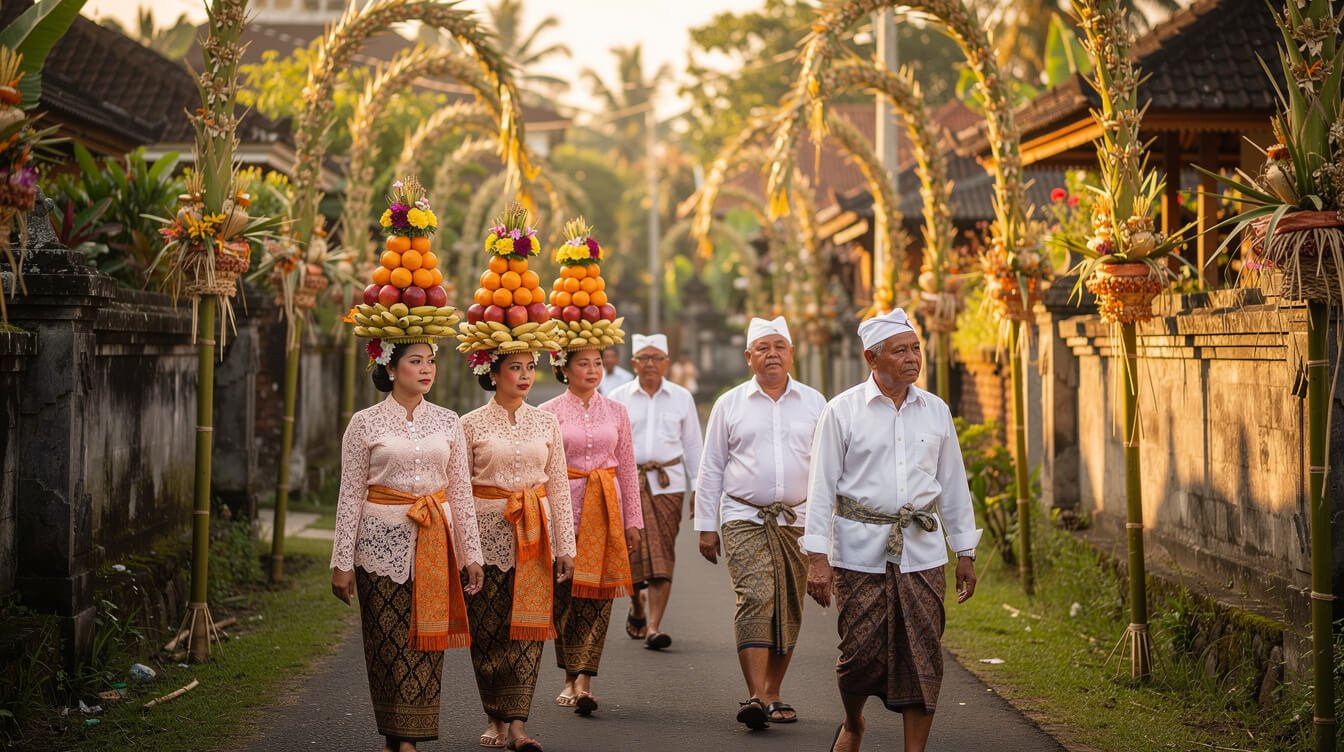
Within your first hour in Bali, you’ll likely meet a Wayan. By dinner, a Made and a Ketut. This isn’t coincidence. Most Balinese Hindu families name their children by birth order, and once you know the pattern, every introduction tells a small story.
| Birth order | Common names | Pronunciation |
|---|---|---|
| First-born | Wayan, Putu, Gede (often for boys), Luh (often for girls) | WAH-yahn, POO-too, guh-DAY |
| Second-born | Made, Kadek, Nengah | MAH-day, KAH-deck, nuh-NGAH |
| Third-born | Nyoman, Komang | NYOH-mahn, KOH-mahng |
| Fourth-born | Ketut | kuh-TOOT |
A fifth child usually starts the cycle again with Wayan or Putu, sometimes with an extra word to tell them apart. The names work for both boys and girls, so the small prefix in front helps: I marks a male name (I Wayan) and Ni a female one (Ni Made). Then comes a personal name, which is often what close friends actually use.
You’ll also hear titles that point to a family’s traditional caste lineage. Ida Bagus and Ida Ayu belong to Brahmin (priestly) families. Anak Agung, Cokorda and Dewa point to the old noble houses. Ubud’s own royal family carries the title Cokorda, which you’ll notice on plaques around the Ubud Palace. Gusti is common too. You don’t need to treat anyone differently because of a title. Just use the name they introduce themselves with.
Bli, Mbok and the art of addressing people
When you don’t know someone’s name, Balinese have a lovely solution. Call a man Bli (blee, “older brother”) and a woman Mbok (mmbok, “older sister”), or Gek for a younger woman. “Suksma, Bli!” to your driver, “Selamat pagi, Mbok” to the woman selling fruit. It’s friendly, respectful, and instantly sounds like you’ve been here longer than three days.
At a staffed villa like ours, you’ll be on first-name terms with the team quickly, and the birth-order names make it easy to remember who’s who. If you want a glimpse of how a villa day unfolds around those names, our morning with the villa manager story is a gentle place to start, and our staffed villa guide explains how the team works.
20 Bali Language Words That Open Doors
Here’s a simple phrase table, organized by moment rather than by grammar. (I) marks Bahasa Indonesia and (B) marks Balinese. Pronunciation is approximate, with the stressed syllable in capitals. Two tips first: in Indonesian, c sounds like the “ch” in “church”, and every vowel is pronounced, so maaf is mah-AHF.
Greetings and courtesy
| # | Word or phrase | Meaning | Say it like |
|---|---|---|---|
| 1 | Om swastiastu (B) | A respectful Balinese Hindu greeting | ohm swahs-tee-AHS-too |
| 2 | Selamat pagi / siang / sore / malam (I) | Good morning / midday / afternoon / evening | suh-LAH-maht PAH-gee / see-AHNG / SOR-ay / MAH-lahm |
| 3 | Apa kabar? (I) | How are you? | AH-pah KAH-bar |
| 4 | Kenken kabare? (B) | How are you? (casual Balinese) | KEN-ken kah-BAH-ray |
| 5 | Baik (I) / Becik (B) | Fine, good | BUY-k / buh-CHEEK |
| 6 | Terima kasih (I) | Thank you | tuh-REE-mah KAH-see |
| 7 | Suksma / Matur suksma (B) | Thank you / thank you very much (more polite) | SOOKS-mah / MAH-toor SOOKS-mah |
| 8 | Sama-sama (I) | You’re welcome | SAH-mah SAH-mah |
| 9 | Permisi (I) | Excuse me (to pass, or to get attention) | per-MEE-see |
| 10 | Maaf (I) | Sorry | mah-AHF |
Yes, no and please
| # | Word or phrase | Meaning | Say it like |
|---|---|---|---|
| 11 | Ya / Tidak (I) | Yes / no | yah / TEE-dahk |
| 12 | Inggih / Nenten (B) | Yes / no (polite Balinese) | ING-gee / nuh-NTEN |
| 13 | Tolong (I) | Please (when asking for help or a favor) | TOH-long |
At the warung and the market
| # | Word or phrase | Meaning | Say it like |
|---|---|---|---|
| 14 | Berapa? (I) | How much? | buh-RAH-pah |
| 15 | Boleh kurang? (I) | Could it be a little less? | BOH-leh KOO-rahng |
| 16 | Enak (I) / Jaen (B) | Delicious | EH-nahk / jah-EN |
| 17 | Tidak pedas (I) | Not spicy | TEE-dahk puh-DAHS |
| 18 | Air putih (I) | Plain drinking water | AH-eer POO-tee |
Getting around
| # | Word or phrase | Meaning | Say it like |
|---|---|---|---|
| 19 | Pelan-pelan (I) | Slowly, please (to a driver, or to someone speaking fast) | puh-LAHN puh-LAHN |
| 20 | Bli / Mbok (B) | “Brother” / “sister”, a friendly way to address a man or woman | blee / mmbok |
How to use them without feeling awkward
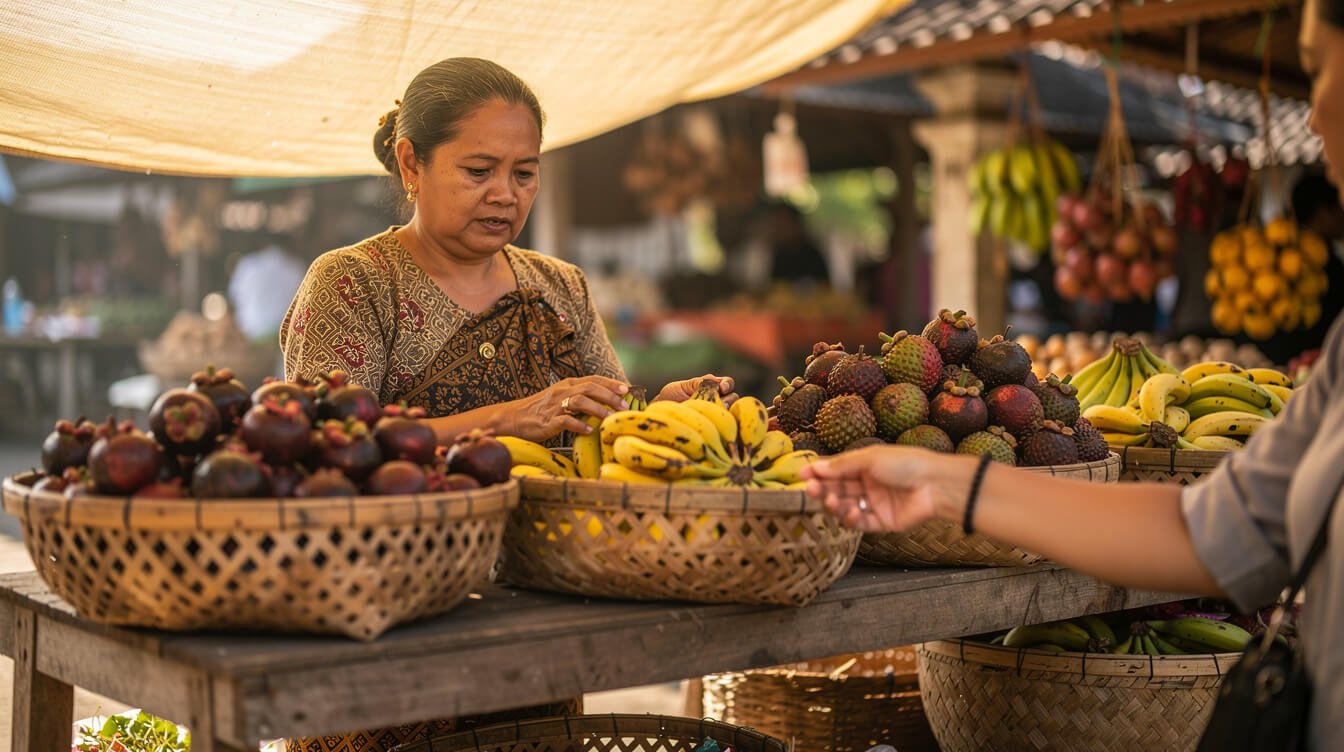
At the market, bargaining is a friendly conversation, not a battle. Ask “Berapa?”, smile at the answer, try “Boleh kurang?”, and settle somewhere that feels fair to you both. Our Ubud market guide and Ubud shopping guide explain where gentle bargaining is expected and where prices are fixed. Knowing your rupiah helps too, and our Balinese currency guide makes the zeros less dizzying.
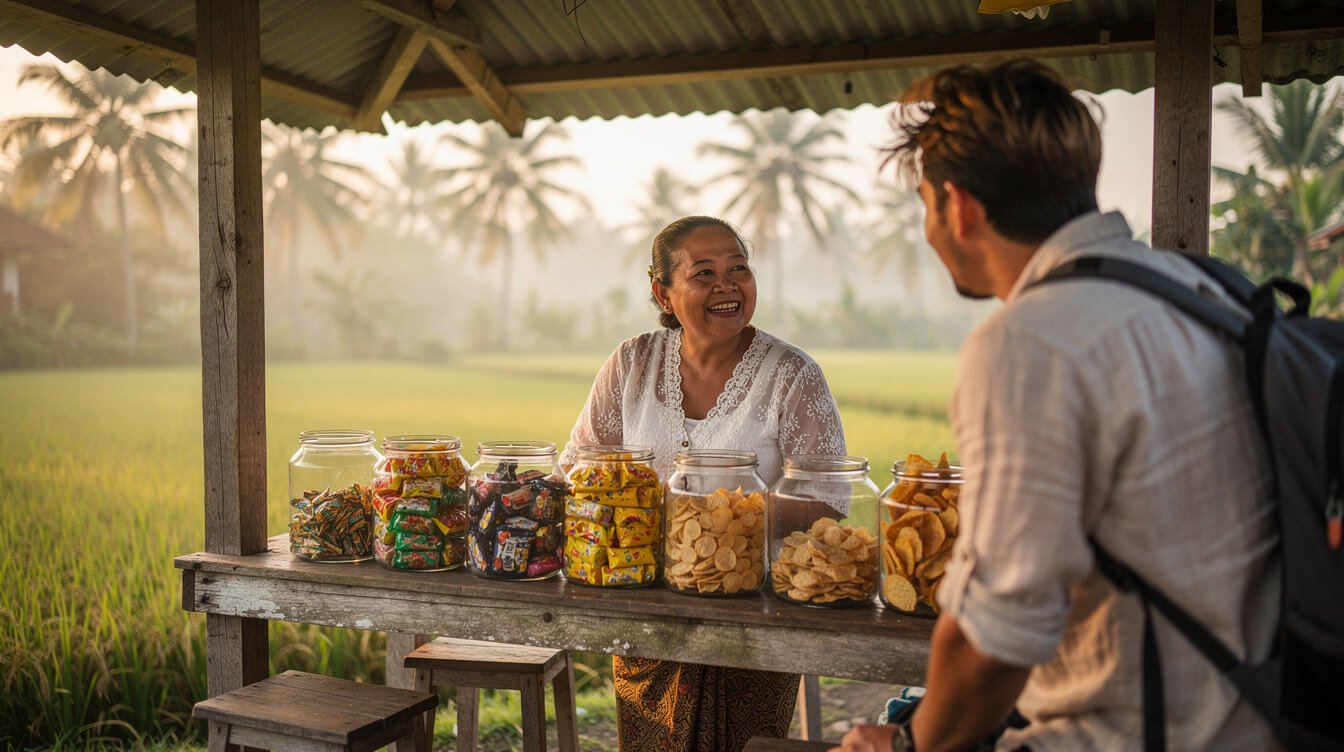
At the warung, “tidak pedas” is the phrase that saves many a first lunch, and “air putih” gets you plain water. If your stomach is still adjusting, our guide to Bali belly is worth a read. When the plate is empty, “enak!” or, better still, “jaen!” to the cook will earn you a grin. Our favorite warungs near Ubud are lovely places to practice.
With your driver, “pelan-pelan, Bli” is the kindest way to ask for a calmer ride on Bali’s winding roads, and a “suksma” at the end of the day always lands well.
The Balinese Words Locals Love Hearing
If you learn only two Balinese expressions, make them these. They’re small, but they carry a lot of feeling.
Om swastiastu
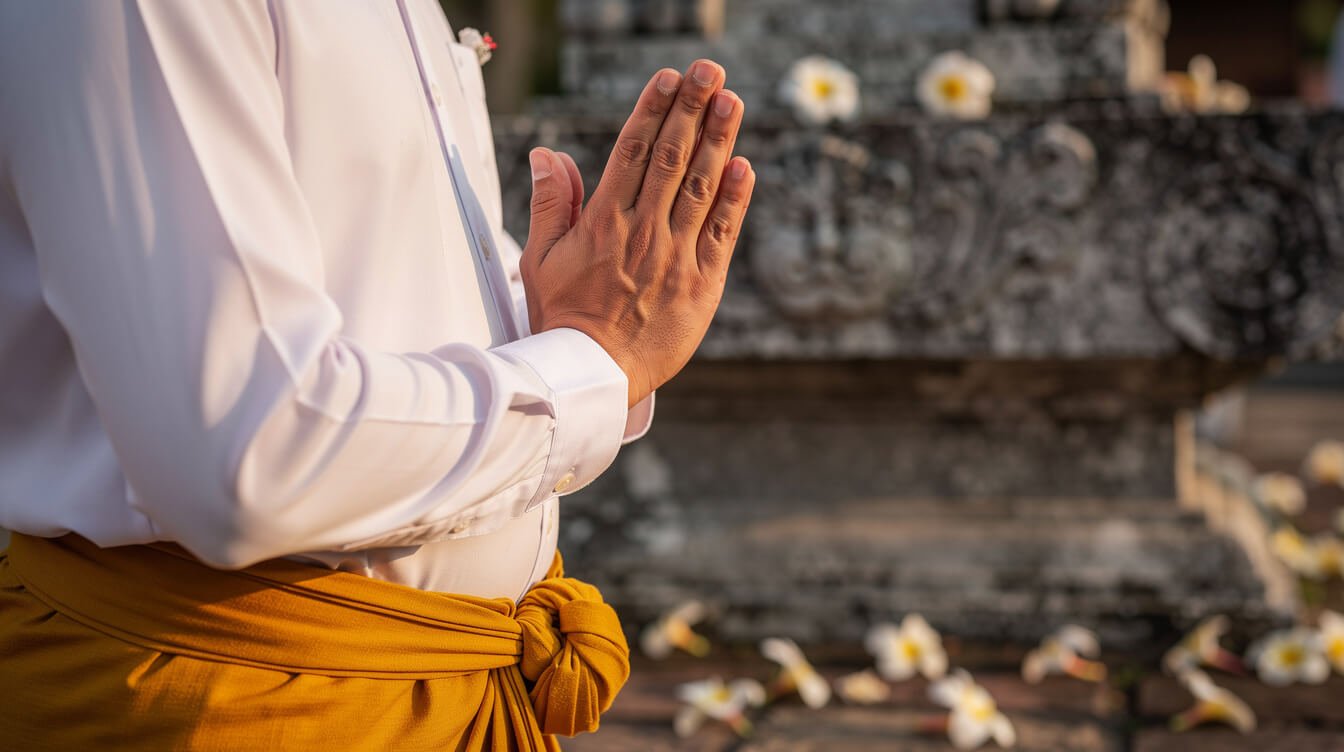
This is the greeting you’ll hear at temple gates, at the start of speeches and ceremonies, and from hosts welcoming you into a home. It comes from Sanskrit and is usually understood as a blessing: may peace and goodness be with you, by the grace of God. It’s often said with the palms pressed together at the chest, fingertips up, in the gesture called sembah. The reply is the same words back.
Use it with Balinese Hindus, especially in a temple, at a ceremony, or when you’re welcomed somewhere for the first time. Many Balinese say it with real delight when a visitor greets them this way first. In shops and offices in mixed communities, a simple “selamat pagi” is just as polite, since not everyone on the island is Hindu. At the end of a formal speech or ceremony you may also hear om shanti shanti shanti om, a wish for peace that closes what om swastiastu opened.
Suksma
Suksma (SOOKS-mah) is Balinese for thank you, and it may be the most useful single word you learn. Indonesian terima kasih is perfectly correct everywhere, but “suksma” says something extra: that you’ve noticed where you are. Add matur in front for a warmer, more formal thank you to an elder, a priest or someone who’s gone out of their way for you. You may hear mewali in return, roughly “back to you”.
A word about “good morning” in Balinese
You’ll see rahajeng semeng (good morning) and rahajeng wengi (good night) in many phrase lists, and they’re real Balinese phrases. Balinese speakers don’t traditionally greet each other by time of day the way English speakers do, though. Locals are far more likely to ask “Where are you going?” or “Have you eaten?” as a greeting. So if you say rahajeng semeng, expect a surprised, happy laugh. That’s not a bad result at all.
Book the Villa
Three bedrooms, a private pool deck for slow morning coffee, and a team of manager, chef, housekeeper and gardener who look after the details. You enjoy Ubud. We’ll take care of the rest. Check availability for your dates.
Reading the Signs: Aksara Bali, the Island’s Own Script
Drive through Ubud and you’ll notice that many shop fronts, offices and street signs carry two lines of writing: familiar Latin letters, and above them a row of graceful, curling characters. That’s Aksara Bali, the Balinese script.
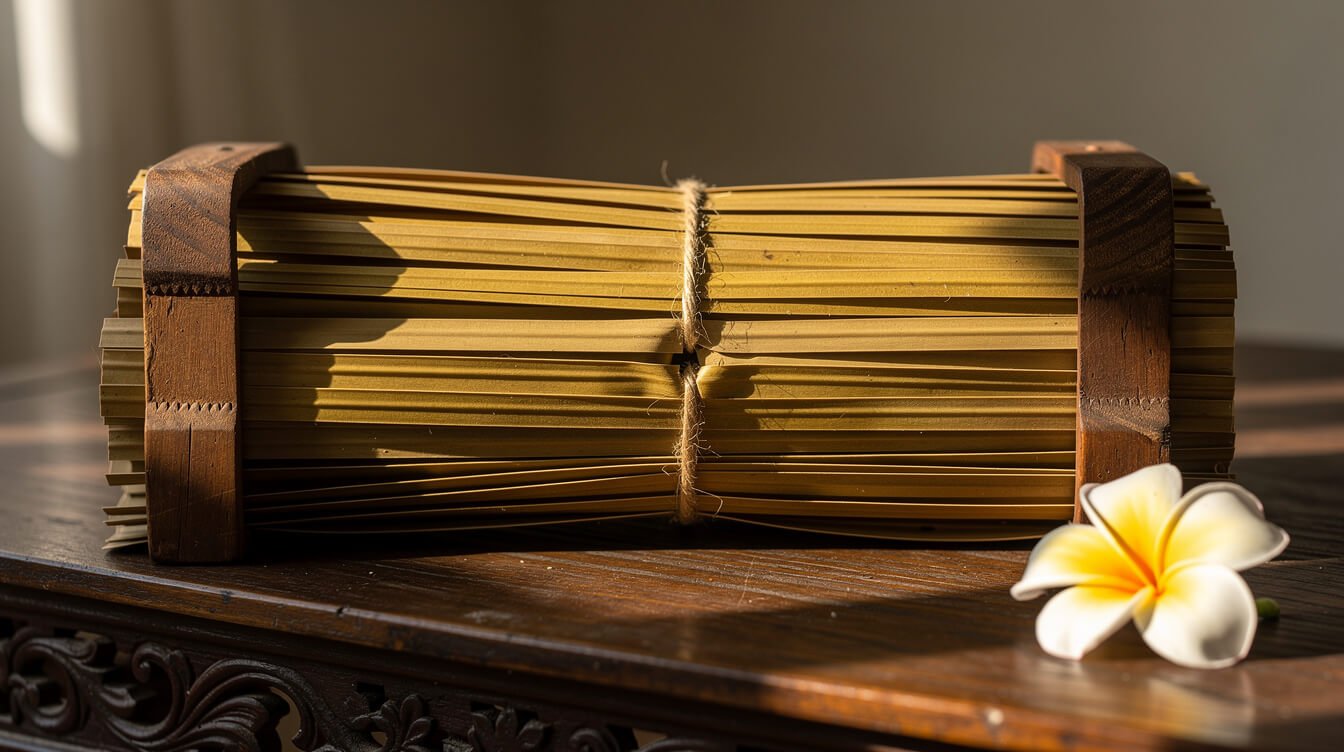
Aksara Bali is an abugida, a writing system where each character stands for a consonant with a built-in vowel, and small marks above, below or beside it change that vowel. It belongs to the great family of Brahmic scripts and descends, through the old Kawi script of Java, from writing systems that traveled from India more than a thousand years ago. For centuries, priests and scholars incised it into dried lontar palm leaves, bound into bundles that held everything from religious texts and medicine to poetry, astronomy and law. Some families still keep lontar at home, and you can see beautiful collections in museums around the island. Our story on the Indian roots and sacred role of Balinese script goes deeper into that history.
For a while, Aksara Bali was mostly confined to temples and ceremonial objects. Then in 2018, the provincial government introduced regulations protecting the Balinese language, script and literature and requiring them in public life. Since then, the script has come back onto public signage across the island, including in tourist areas. Every February, schools, villages and government offices also celebrate Bulan Bahasa Bali, Bali Language Month, with script-writing competitions, recitations and performances. 2026 marked its eighth year. If you’re visiting in February, ask around. A village lontar-writing contest is a quietly unforgettable thing to watch.
You don’t need to read Aksara Bali to enjoy it. But next time you pass a sign, pause and notice the two scripts stacked together: an ancient one and a modern one, side by side. It’s a small, very Balinese way of keeping something precious alive.
Bali Language FAQ
How do you say hello in Balinese?
The most common formal greeting is om swastiastu (ohm swahs-tee-AHS-too), used especially with Balinese Hindus and at temples or ceremonies. In everyday Indonesian, “halo” or “selamat pagi” (good morning) works anywhere on the island.
Is English enough in Ubud?
For most practical purposes, yes. English is widely spoken in Ubud’s cafes, restaurants, spas, villas and tour services. Outside those places, especially in village markets, small warungs and rural areas, a few words of Bahasa Indonesia make life easier and friendlier. Download Indonesian for offline use in your translation app before you arrive, just in case.
Is Bali Hindu or Islamic?
Bali is predominantly Hindu, unlike most of Indonesia. Roughly 87% of Bali’s population follows Balinese Hinduism, according to the 2020 census, while Indonesia as a whole is majority Muslim. That’s why you’ll see daily offerings, temple festivals and greetings like om swastiastu everywhere. Our guide to Bali religion explains more.
Is Balinese the same as Indonesian?
No. They’re related Austronesian languages and share some vocabulary, but Balinese has its own words, its own speech levels and its own script. A Balinese speaker will understand Indonesian, but an Indonesian speaker from another island usually won’t understand Balinese.
Should I learn Indonesian or Balinese first?
Indonesian, if you’re learning for practical use. It’s easier to start, it works across the whole country, and many modern Balinese words come from it anyway. Then sprinkle in a few Balinese words, like suksma and om swastiastu, for warmth.
How many people speak Balinese?
Around 3.3 million native speakers were counted in the 2000 census, mostly on Bali, with communities on Nusa Penida, western Lombok and parts of eastern Java. Linguists have raised concerns that fewer young people use it daily, which is one reason the province actively promotes it today.
Do I need a visa or documents in Indonesian?
No. Immigration forms and the e-VoA system are available in English. Our Bali visa guide for US citizens walks through the current process step by step.
A last thought from all of us here in Ubud. The Bali language isn’t a test you need to pass. It’s an invitation. Say suksma to the person who brings your coffee, om swastiastu at the temple gate, and “jaen!” to the cook, and watch how the island answers you. Those small words turn into some of the warmest memories of a trip.

Join our newsletter — fun, new, exciting Bali news
Seasonal notes from Ubud, warungs worth the detour, ceremony days to plan around, and small stories from our garden and kitchen. Delivered now and then, always worth opening.