Balinese Currency: A Calm Guide to Rupiah, Cash, Cards and Tipping in Ubud
The first time you pay for something in Ubud, it usually goes like this. A coconut costs a number with a lot of zeros on it. You open your wallet, pull out a red note covered in more zeros, hand it over with the faint worry that you’ve just paid for the whole tree, and get back a soft fold of blue and green paper and a big smile. Welcome to the Balinese currency. It’s friendlier than it looks, and after a day or two your fingers will know the notes before your eyes do.
Most guides to Bali money are written by companies that want to sell you a card or a transfer. This one comes from people who live and work here: the team that runs a staffed villa in the rice fields outside Ubud and handles rupiah every day, at the market, the temple, the petrol stall and the warung down the lane. We’ll cover what the notes look like and how to read them, where cash still rules and where cards work, how to use ATMs and money changers safely, what to bring from home, what a real day of spending looks like, and how tipping and temple donations work. No card to sell. Just the money guide we’d give a friend.
What Is the Balinese Currency? Reading the Rupiah
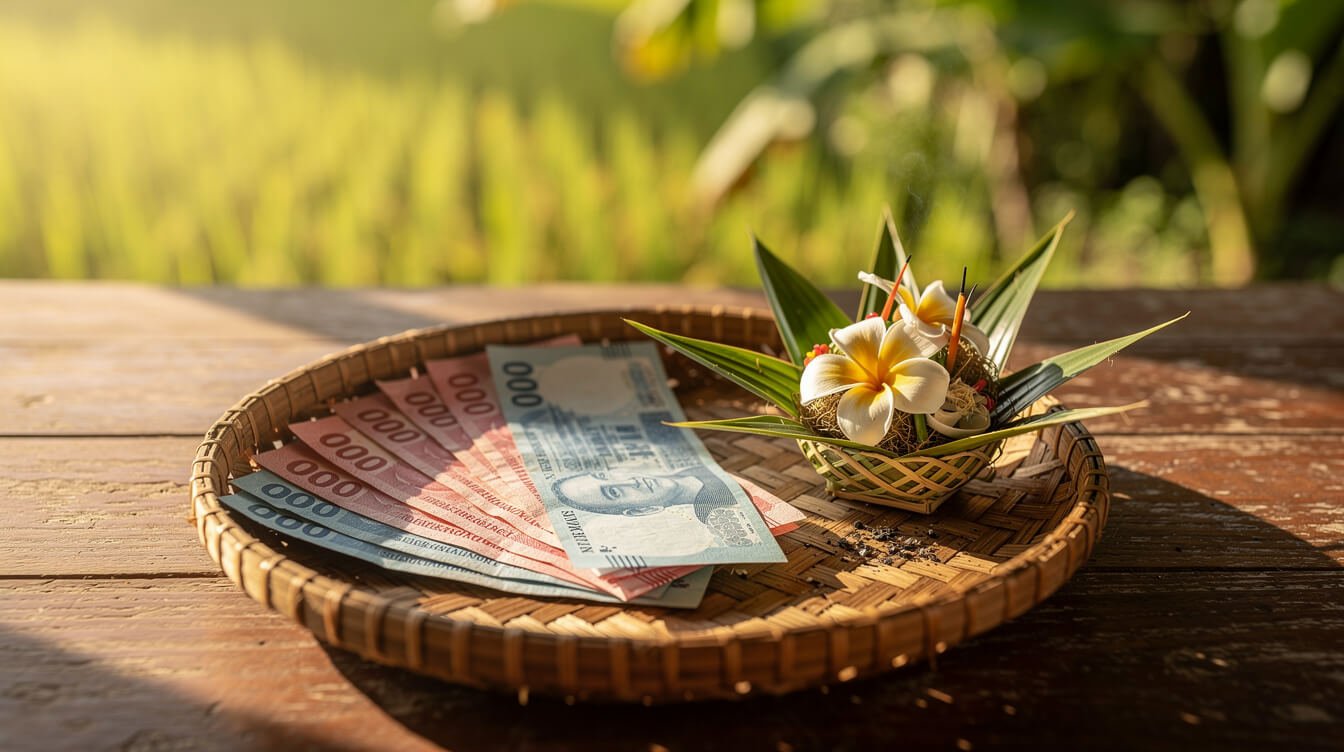
Bali doesn’t have its own money. The Balinese currency is the Indonesian rupiah (code IDR, written as Rp), the same currency used from Sumatra to Papua and issued by Bank Indonesia. Prices you’ll see around Ubud are written in a few different ways: Rp 50.000, 50,000, 50K, or simply 50 on a handwritten warung board, where everyone understands the thousands are implied. Indonesians use a dot where Americans use a comma, so Rp 1.500.000 is one and a half million rupiah, not a typo.
The notes you’ll actually use
Day to day, you’ll handle seven paper notes: 1,000, 2,000, 5,000, 10,000, 20,000, 50,000 and 100,000 rupiah. Coins come in 100, 200, 500 and 1,000, and honestly they mostly end up in a jar by the door, or as small change at a supermarket till. A few useful anchors:
- 100,000 (red): the big one. ATMs often dispense these. Lovely to have, slightly awkward to break at a tiny stall first thing in the morning.
- 50,000 (blue): the workhorse of Ubud. The front carries I Gusti Ngurah Rai, the Balinese independence hero the island’s airport is named after.
- 20,000 (green) and 10,000 (purple): perfect for parking, coconuts, small offerings and snacks.
- 5,000, 2,000 and 1,000: parking attendants, a bottle of water, rounding up.
You’ll also see newer 2022-series notes circulating alongside older designs. Both are valid. The colors stay close, so you’ll learn them quickly.
The extra-zeros moment, and a calm way to do the math
Everyone has it: that pause at a counter where you stare at 10,000 and 100,000 and can’t tell which you’re holding. The trick is to stop reading zeros and start reading colors. Red is the big one, blue is the everyday one, and a fan of greens and purples is pocket money.
For conversions, the rate moves, so we won’t quote one here. Check a live USD to IDR converter before you fly, work out roughly what a single 100,000 note is worth in your home currency, and use that one note as your mental anchor for the trip. A lunch is “about half a red note.” A massage is “a couple of red notes.” It’s far less tiring than dividing by thousands in your head while a smiling vendor waits.
Cash or Card in Ubud: Where Each One Works
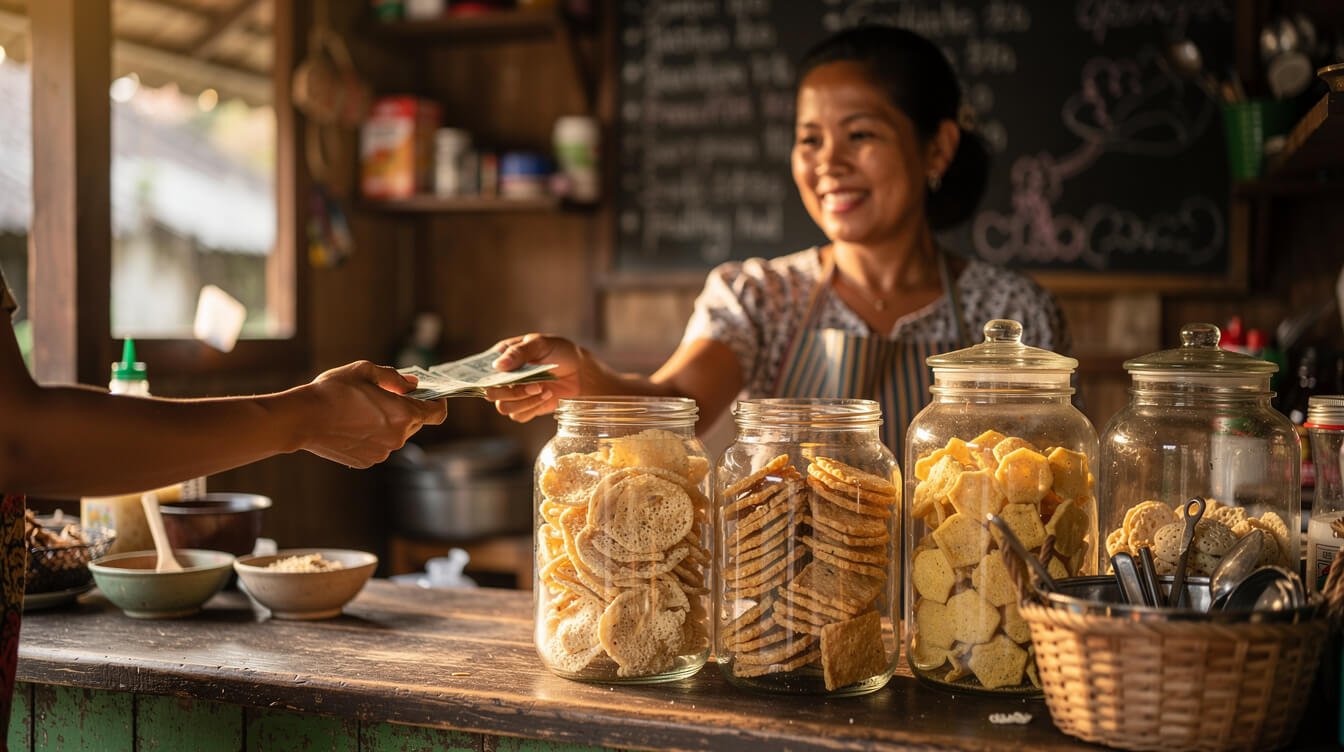
When it comes to Balinese currency in practice, Ubud runs on two economies side by side. Along Jalan Raya Ubud and the busier cafe streets, you can tap a card almost anywhere. Walk ten minutes into the village lanes and it’s cash, smiles and change counted out of a biscuit tin.
Where you’ll want cash
- Warungs and small family restaurants, especially the good ones. Our favorite local lunches rarely take cards. (Our list of the best warungs near Ubud is a cash-in-pocket kind of list.)
- Markets. The morning produce market and the stalls at the Ubud Art Market are cash-only, and bargaining is gentler when you can hand over exact notes.
- Temple donations, sarong rental and parking. Small notes only.
- Drivers and tips. Even when a driver’s fare is settled another way, tips are almost always cash.
- Village ceremonies, roadside fruit, coconuts, petrol in glass bottles. The beating heart of Bali is paid for in paper.
Where cards work well
- Most cafes, larger restaurants, yoga studios and boutiques in central Ubud.
- Established spas and wellness centers.
- Supermarkets, pharmacies and convenience stores.
Two small things to know. Some smaller businesses add a modest surcharge for card payments, usually signposted at the till, so ask if you’re unsure. And whenever a card terminal or ATM offers to charge you “in your home currency,” decline. Choose rupiah. That offer, called dynamic currency conversion, almost always comes with a worse rate baked in.
What about QR payments?
You’ll see small square QRIS codes taped to counters everywhere, even at the tiniest stalls. That’s Indonesia’s national QR payment system, and locals use it constantly. Some banking apps from neighboring countries can scan it, and options for international visitors keep growing, but most travelers still can’t rely on it. Treat it as a bonus if your app supports it, not your main plan.

Get a free 3-day sample itinerary
Markets, temples, a warung lunch and a slow afternoon by the pool. We will send you a 3-day sample itinerary for Ubud, with the small-notes moments already mapped out.
ATMs and Money Changers in Ubud: Staying Safe
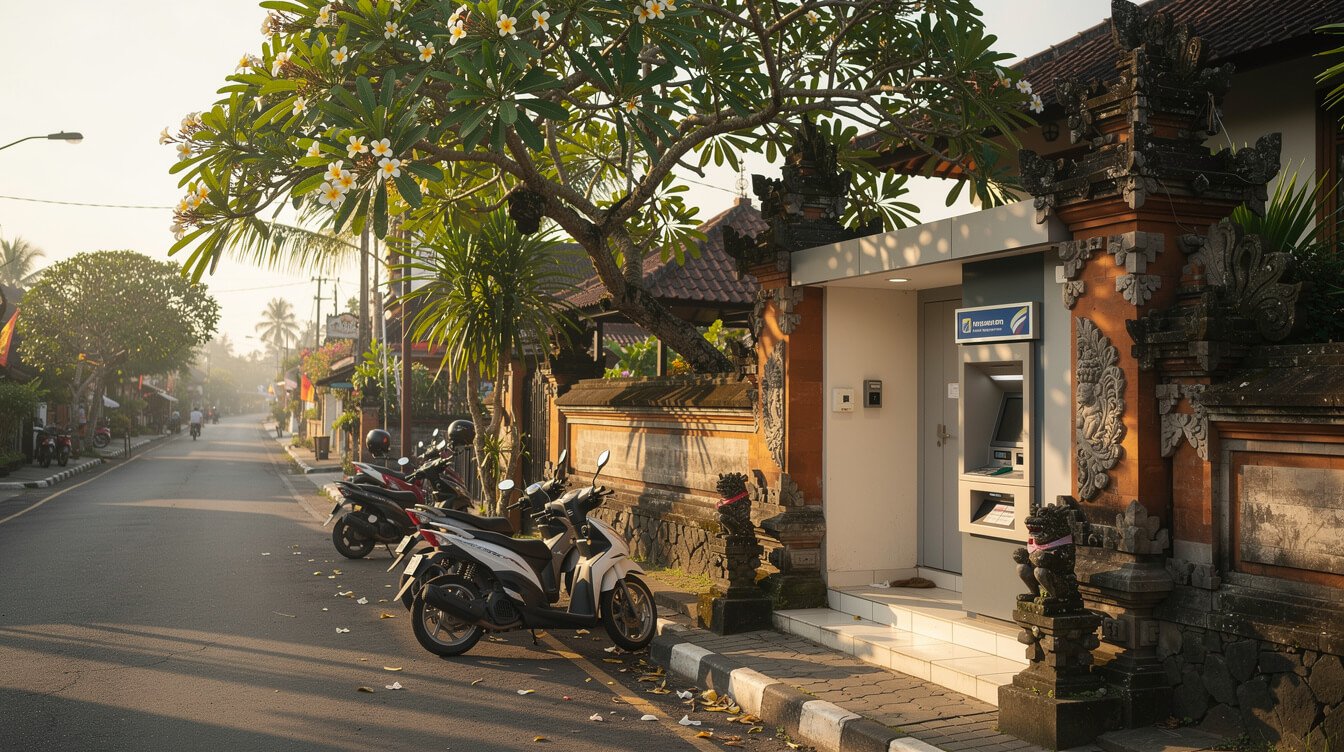
Getting your hands on Balinese currency in Ubud is easy. Getting it without losing a slice to bad rates or sleight of hand takes a few small habits.
Using ATMs
- Use ATMs attached to a bank branch or inside a well-lit store, rather than a lone booth on a dark corner. Machines connected to a branch are checked more often.
- Look before you insert. If the card slot or keypad feels loose, bulky or oddly fitted, walk away. Cover the keypad with your hand.
- Choose rupiah, decline conversion. If the machine offers to convert to your home currency, say no.
- Expect withdrawal caps. Many machines limit how much you can take out in one go, often a couple of million rupiah, so you may need two transactions. Your home bank may charge per withdrawal, so fewer, larger withdrawals usually make more sense.
- Take your card. It sounds obvious, but in the shuffle of a thick stack of notes, cards get left behind more often than you’d think.
- Tell your bank you’re traveling before you leave, and bring a backup card kept somewhere separate.
Using money changers
If you’d rather bring cash and exchange it, Ubud has plenty of changers. The trick is choosing the right ones.
- Look for an authorized changer. Licensed money changers display a Bank Indonesia authorization sign, issue a printed receipt, and usually operate from a proper storefront with a counter and a screen showing rates.
- Be wary of rates that look too good. A tiny kiosk advertising a rate noticeably better than everyone else, often with “no commission” in big letters, is the classic setup for a short count.
- Count it yourself, at the counter, before it leaves the counter. Then count it again. If the clerk takes the stack back “to check” after you’ve counted, start over.
- Do it in daylight, without a rush. A calm exchange is a safe exchange.
If you’re staying with us, ask the team. Ketut, our villa manager, is always happy to point you toward the changers locals actually use, and to tell you which ATMs nearby are the reliable ones. It’s the sort of hand-held advice that’s hard to find in a guidebook.
Bringing USD or AUD: What to Exchange and When
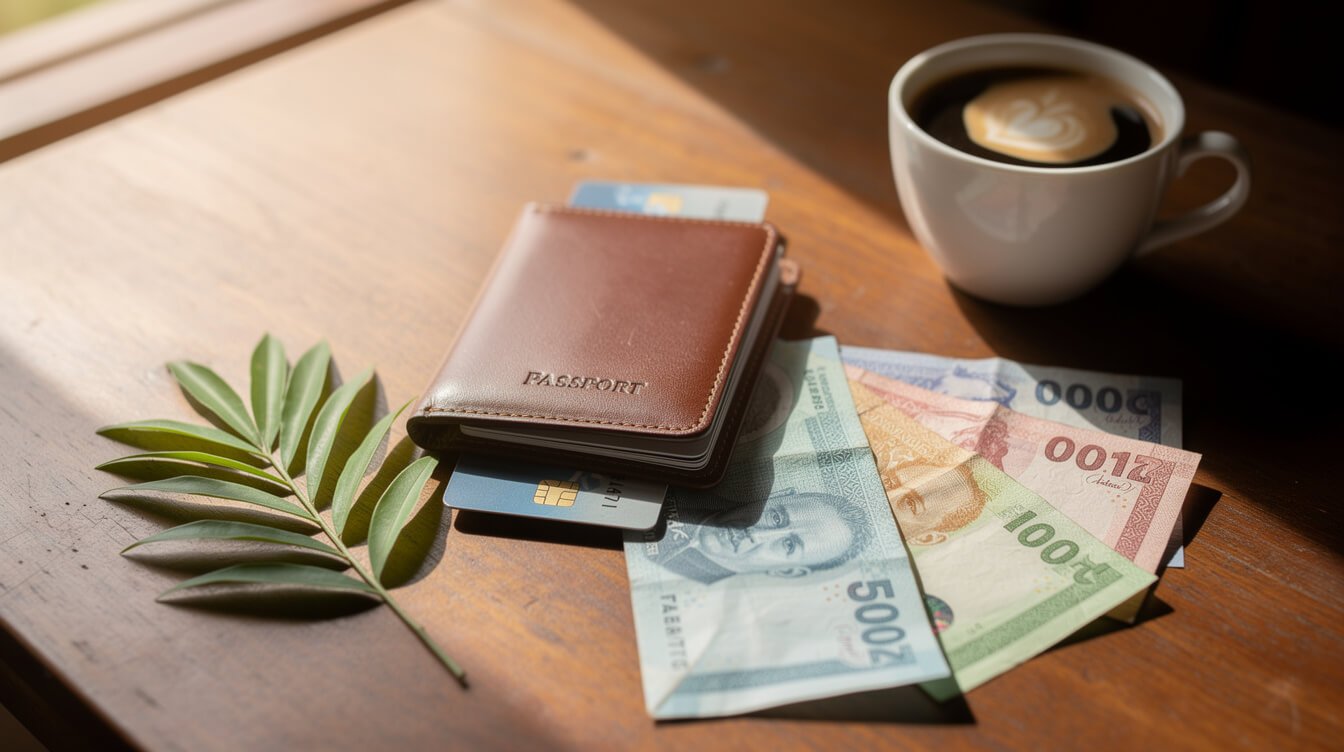
Plenty of travelers like to arrive with some home currency in hand and swap it for Balinese currency once they land. It’s a sensible backup, especially if a card gets blocked. A few things make it go much more smoothly.
Crisp notes matter
Money changers in Bali can be particular about foreign notes. Bills that are torn, written on, heavily creased, stained or from older print series are often refused or exchanged at a lower rate. Bring clean, recent-series notes. With US dollars, larger denominations such as 100s usually get a better rate than 10s and 20s, so if you’re bringing cash to exchange, bigger and newer is better.
Airport or town?
Exchange counters at the airport are convenient, but rates there tend to be weaker. A practical approach: change or withdraw just enough at the airport for your first evening (a driver tip, a snack, a bottle of water), then exchange the rest in town where rates are more competitive. If you’ve arranged an airport pickup, you won’t need much on landing at all. Our guide to getting from the airport to Ubud walks through that first drive.
A simple mix that works
- A main debit card with low foreign fees for ATM withdrawals.
- A credit card for cafes, spas and larger restaurants.
- A backup card stored separately from your wallet.
- A modest amount of clean home-currency cash as an emergency reserve.
For the rest of your packing list, our guide to what to pack for Bali covers everything from sarongs to rain layers. A small zip pouch for small notes earns its place in your day bag.
A Day of Spending in Ubud: Where Your Rupiah Goes
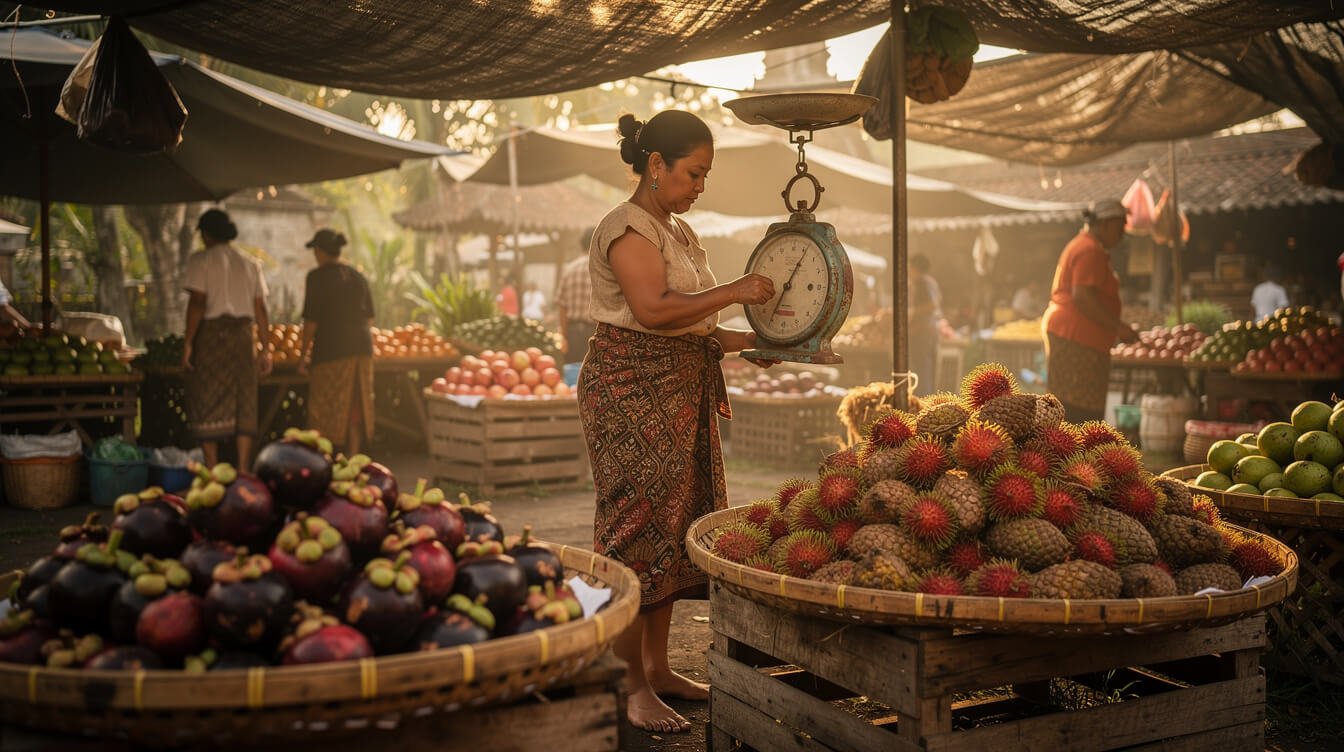
Numbers on a page only tell you so much. Here’s what money actually feels like on a gentle, ordinary day in Ubud. (For whole-trip budgets, from flights to accommodation, see our separate guide to Bali travel prices. This section is about the rhythm of the notes in your pocket.)
Morning
You wake to roosters, frogs and the soft swish of Nyoman’s broom on the garden path. Breakfast at the villa is already part of your stay, so the first rupiah of the day usually leaves your pocket at the morning market: a bag of mangosteen, a handful of snake fruit, a bunch of tiny sweet bananas. These are small-note purchases. Hand over a blue 50,000 note and you’ll get a satisfying fold of change back.
Midday
A walk to a temple means a small entrance fee or donation, plus sarong rental if you didn’t bring one (often included at the bigger temples). Lunch at a warung, perhaps nasi campur and an iced tea, is gloriously inexpensive by most visitors’ standards, and is cash only. Then a coconut from a roadside stall on the way home. Parking attendants, if you’re driving, take a couple of small notes.
Afternoon
A massage at a good local spa is often where a red note or two changes hands, and many spas accept cards. If you’re curious how Balinese massage differs from what you know at home, our piece on traditional spa rituals in Ubud is a lovely read before you book.
Evening
Dinner in town at a sit-down restaurant usually takes cards and adds tax and service to the bill. Or stay home and let Wayan cook, which many of our guests come to love most. If you’re wondering how private chef costs compare with eating out, we’ve written an honest guide to what a private chef costs in Bali.
The pattern you’ll notice: small notes in the morning and at midday, cards in the evening. Start each day with a mix of blues, greens and purples in an easy pocket, and keep the big reds in a separate, more secure spot.

Book the Villa
A team who knows which changers locals trust, a chef who saves you a dozen dinner bills, and a quiet pool at the end of every market morning. Check availability for Villa Amrita.
Tipping in Bali: Drivers, Spas, Restaurants and Villa Staff

Tipping in Bali, like most things involving Balinese currency, is relaxed. It isn’t obligatory, and no one will chase you for it. But it’s warmly appreciated, and for many people working in tourism it’s a meaningful part of their income. Think of it as a thank you, not a tax.
Restaurants and cafes
Many sit-down restaurants already add a service charge to the bill, usually listed near the tax line. If it’s there, you don’t need to add more, though leaving small change for great service is a kind touch. At warungs, rounding up or leaving a small note is common and always welcome.
Drivers
For a short ride, rounding up is plenty. For a full-day driver who has waited patiently at temples, recommended a lunch spot and navigated the rice-field lanes for you, a more generous cash tip at the end of the day is customary. Hand it over directly, with a thank you. In Bali, giving with your right hand (or both hands) is the polite way.
Spas and massage
Tipping your therapist directly is common and appreciated, especially at smaller local spas. Some higher-end spas include service in the price, so check the menu or ask at reception.
Villa staff
This is the one we get asked about most, so here’s our honest answer. There’s no set amount and no expectation from us. Whether and how you show thanks is entirely your choice. Many guests who have enjoyed being looked after leave an envelope for the whole team at the end of their stay, rather than tipping individuals day by day. That way it’s shared among everyone who made your days easy, including the people you saw less of, like the gardener who had the paths swept before you woke. For more on how the team looks after you during a stay, our Bali travel tips from the villa team are a good companion read.
Small cultural notes
- Pass money with your right hand, or with both hands for a little extra respect.
- Don’t wave notes around or leave them tucked under a plate where the wind can take them.
- Saying terima kasih (thank you) as you give is worth more than you’d guess.
Temple Donations, Ceremonies and Small Courtesies

This is the part of Balinese currency that no money-transfer guide covers, and it’s one of the most beautiful.
Punia: donations at temples
At many temples you’ll find a carved wooden box or a small table with a donation book near the entrance. A donation here is called punia, and it goes toward the upkeep of the temple and its ceremonies. At the well-known temples there’s usually a fixed entrance ticket. At smaller village temples, a modest donation is customary and gracious. Give with your right hand, sign the book if asked, and accept the sarong and sash offered to you. Our guide to temples to visit around Ubud covers dress and etiquette at each.
Money in the offerings
Look closely at some of the little palm-leaf offerings, the canang sari, placed on doorsteps and shrines each morning. Sometimes there’s a small coin or folded note tucked among the flowers. It’s called sesari, and it’s part of the offering itself, a symbolic gift. Please don’t touch it, and step around offerings on the ground rather than over them.
Ceremony days
Bali’s calendar is full of ceremonies, and during big festivals like Galungan, villages are at their most beautiful. If you’re invited to a family or village ceremony (it happens more than you’d think), it’s thoughtful to bring a small contribution in an envelope, presented quietly to your host. Ask the villa team how to do it gracefully. They’ll show you, and they’ll probably help you get your sarong tied correctly too.
Small courtesies that cost nothing
- Bargain with a smile at markets, never with frustration. The difference is often a few thousand rupiah, and the vendor’s good humor is worth more.
- Try to have small notes ready. Asking a tiny stall to break a red 100,000 note at 7 AM can empty their whole float.
- Count your change calmly and kindly. Most mistakes are honest ones.
Balinese Currency FAQ

What is the currency of Bali called?
The Indonesian rupiah (IDR, written Rp). Bali uses the same currency as the rest of Indonesia. There is no separate Balinese money.
How much is $100 US in Bali?
It converts to well over a million rupiah, which is why the zeros feel so dramatic at first. The exact amount changes daily, so check a live converter before you exchange. What it buys depends on how you travel: in a village warung it stretches a remarkably long way, while in a polished cafe on the main road it goes about as far as it would at home.
What’s the best currency to bring to Bali?
Most travelers do best with a low-fee debit card for ATM withdrawals in rupiah, plus a credit card for larger payments. If you’d like to bring cash to exchange, US dollars, Australian dollars and other major currencies are widely accepted at money changers. Bring clean, recent-series notes in larger denominations.
Can you pay in US dollars in Bali?
Generally, no. Indonesian law requires everyday transactions in Indonesia to be in rupiah. A few businesses may quote in dollars for convenience, but you’ll pay in rupiah, and accepting a “dollar price” usually means a poor rate.
Is there a tourist tax when visiting Bali?
Yes. At the time of writing, international visitors to Bali pay a one-time tourist levy, which can be paid online in advance through the official Love Bali portal. Check the current amount and rules before you travel, as these can change.
Should I exchange money before I arrive?
It’s not necessary. ATMs and money changers are easy to find in Ubud. Arriving with a small amount for your first few hours is handy, but most people get better value exchanging or withdrawing once they’re in town. For more planning advice, see our broader Bali travel tips.
Final Thoughts: Money as Part of the Rhythm
Give it a day and the Balinese currency stops being a puzzle. Your fingers learn the soft blues and greens. You start keeping small notes in one pocket for coconuts and parking, and the big reds tucked safely away. You notice the coin in the morning offering on the step, the donation book at the temple gate, the way a driver smiles when you hand him a thank you with both hands. Money in Bali isn’t only something you spend. It’s woven quietly into how the island gives and receives. Arrive with a good card, a little clean cash and an easy pocket of small notes, and you’ll spend your attention on what matters: the light on the rice fields, the smell of frangipani after rain, the next slow afternoon by the pool.

Join our newsletter — fun, new, exciting Bali news
Ceremony days worth knowing about, market finds, and small stories from the garden and kitchen. Delivered now and then, always worth opening.