Bali Religion: A Gentle Guide to Balinese Hinduism for Your Stay in Ubud
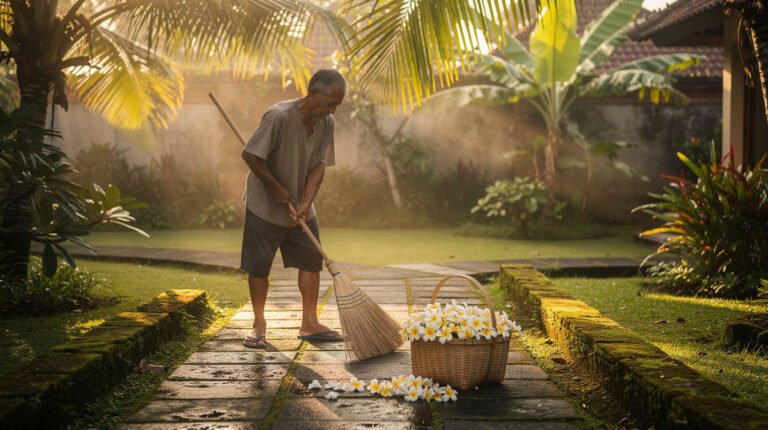
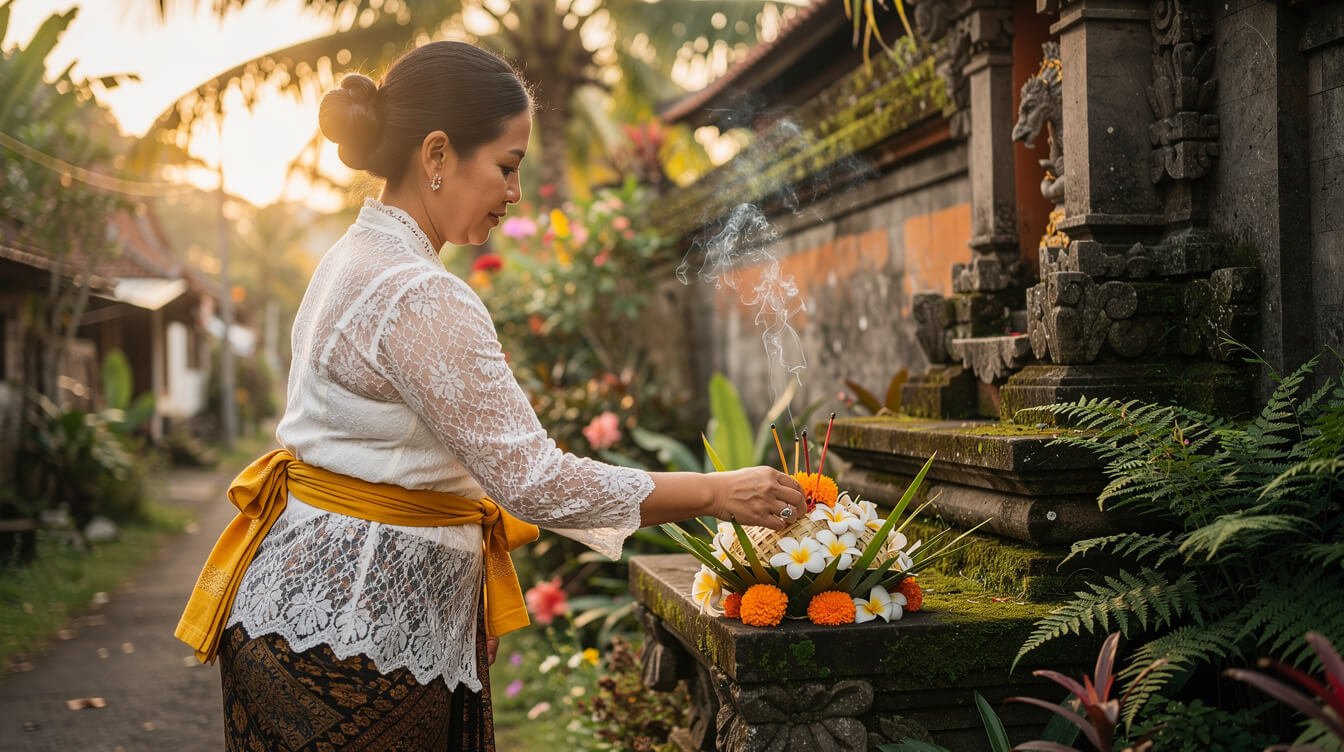
Your first morning in Ubud usually begins with a small surprise. On the step outside your door sits a palm-leaf tray no bigger than your hand, holding a few petals of marigold and frangipani, a pinch of rice and a stick of incense already half burned. Someone set it there before you woke. That tiny tray is your introduction to Bali religion, a living form of Hinduism that shapes how the island cooks, builds, farms, celebrates and even how it plans traffic. You don’t need to study it to enjoy your stay. But knowing a little turns what you see from pretty scenery into something you can actually read.
We’re the in-villa team at Villa Amrita, a staffed three-bedroom pool villa in the rice fields outside Ubud. Guests ask us about the offerings, the drums and the road closures almost every day, so this is the gentle version we share with them. We’ll cover how Bali became a Hindu island in a mostly Muslim country, what a day of devotion looks and sounds like around you, the philosophy behind the rice terraces, the calendar that decides when Ubud celebrates, the gods and spirits you’ll hear named, and how to be a welcome guest at temples and ceremonies. No lecture, no catalogue of deities. Just enough to help you feel at home among it.
Bali Religion in One Page: How a Hindu Island Endured in Indonesia
Indonesia is home to more Muslims than any other country, yet roughly 87 percent of Bali’s 4.3 million people are Hindu. Across the whole of Indonesia, Hindus make up under 2 percent of the population. That makes Bali an island apart, and the reason is a story about refuge.
Hindu and Buddhist ideas reached the Indonesian archipelago from India more than a thousand years ago, carried by traders, priests and scholars. On Java they flowered into great kingdoms, the last and largest being Majapahit, whose general Gajah Mada brought Bali under its rule in 1343. As Islam spread along Java’s trading coasts through the 15th and 16th centuries, Majapahit declined, and many of its nobles, priests, dancers and artists crossed the narrow strait to Bali. They brought their temples, their manuscripts written on palm leaf (lontar), their music and their rituals. Bali kept them.
What grew here is not a copy of Indian Hinduism. It is Agama Hindu Dharma, a blend of Shaivite Hinduism, Mahayana Buddhist threads and much older Balinese beliefs about ancestors, spirits and sacred places. You’ll still find two kinds of high priest (pedanda): one Shaivite, one Buddhist, often officiating side by side at major ceremonies.
One God, many faces
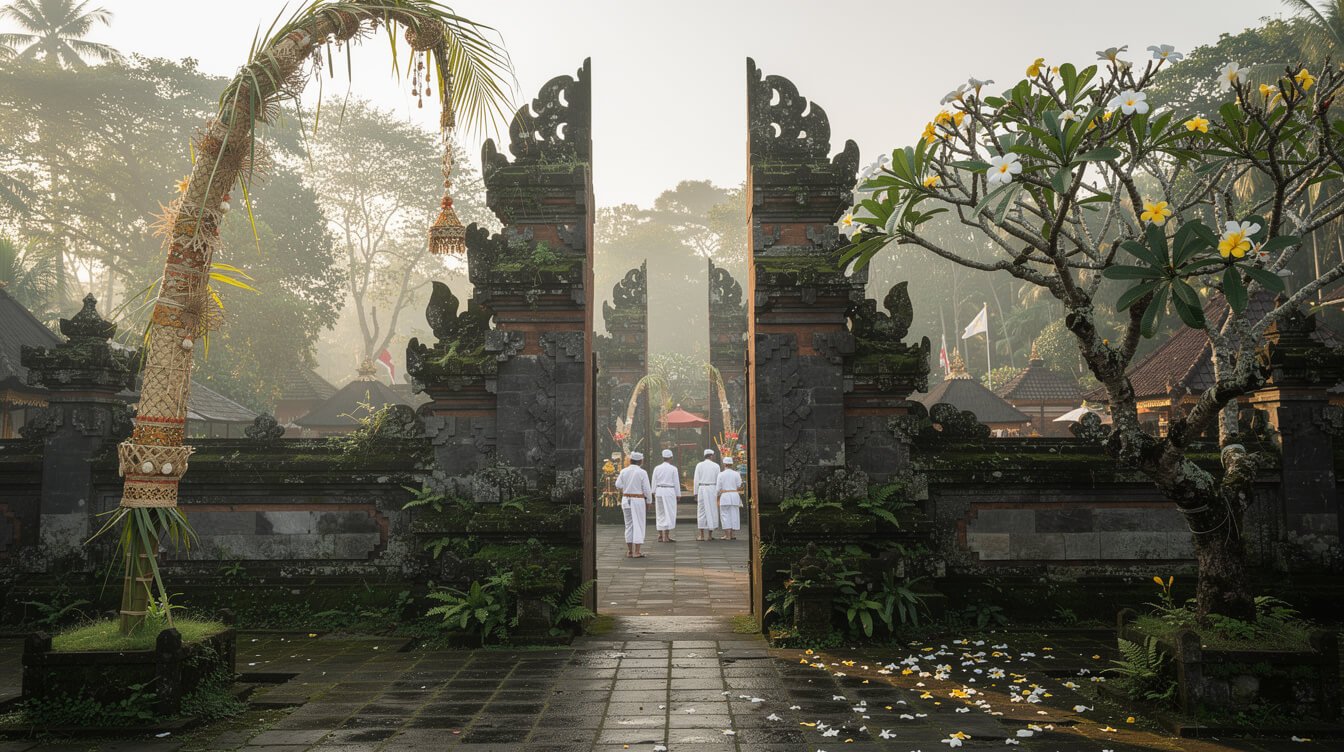
Indonesia’s founding philosophy, Pancasila, asks every citizen to believe in one supreme God. Balinese Hinduism answers that with Sang Hyang Widhi Wasa, the single divine source, whose many aspects appear as the gods you’ll see in temples. Bali’s Hindu council was formed in 1959, and the faith gained official recognition from the state in the early 1960s. Look closely in any temple and you’ll find a tall stone shrine topped by an empty throne, the padmasana. The seat is empty on purpose. It is for the God who cannot be pictured.
If you’d like to understand the people behind the faith, our guide to the Balinese people and their way of life goes deeper into family, village and naming traditions.
A Day of Devotion, Seen and Heard from Your Villa
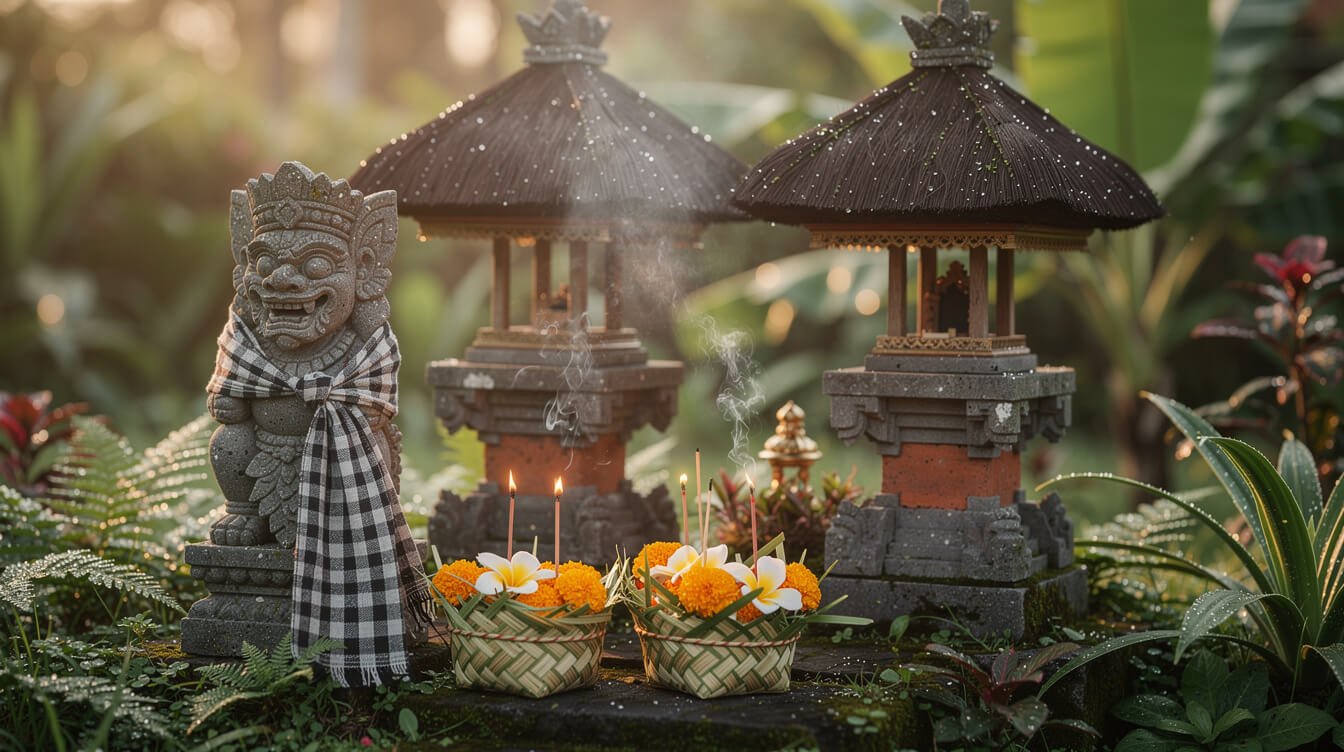
Balinese Hinduism is less about belief statements and more about practice. It is something people do, many times a day, with their hands. Spend a single day in Ubud and you’ll see the whole rhythm without leaving the garden.
Dawn: canang sari
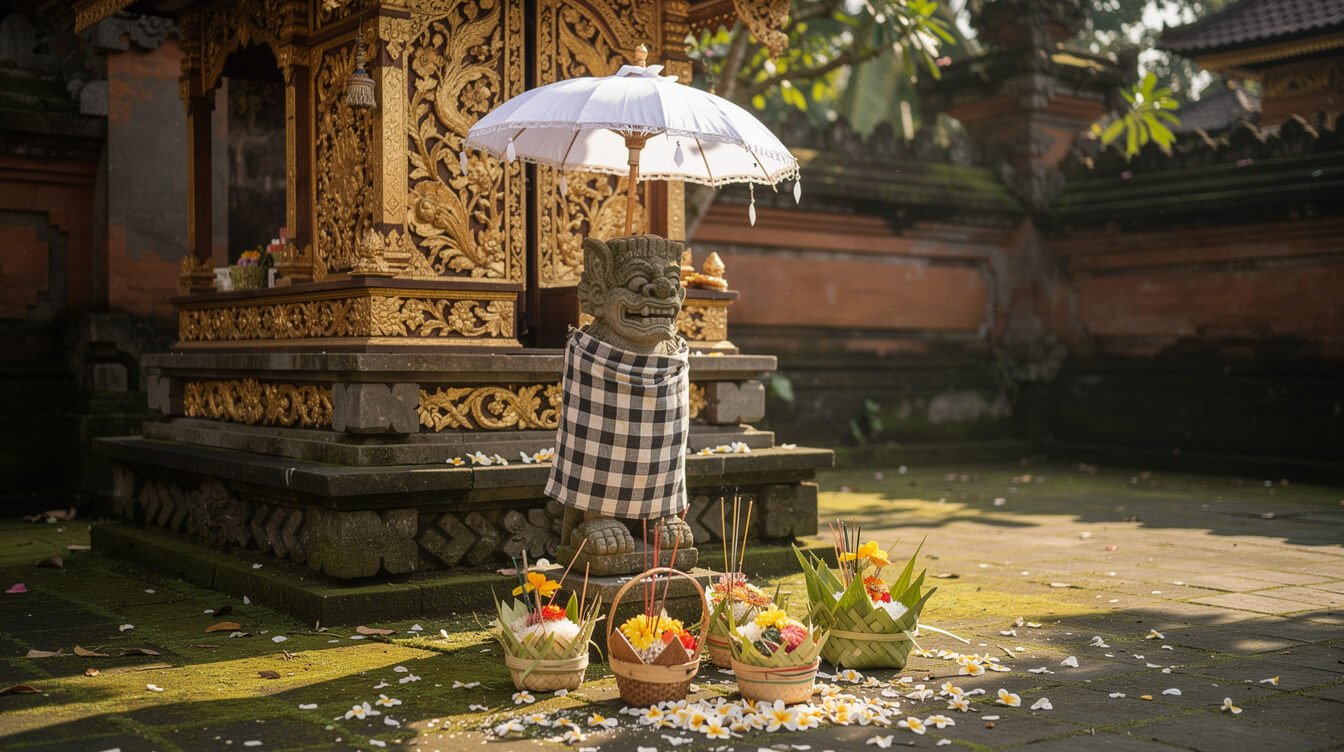
The small trays you’ll spot on steps, car dashboards, shop counters and scooter seats are canang sari. Each is a square or round tray of folded young coconut leaf filled with flowers set to the four directions, usually white, red, yellow and blue or green, each tied to a different aspect of the divine. A pinch of rice, sometimes a coin or a sweet, and a stick of incense finish it. The offering is presented with a flick of water and a flower held between the fingertips, then left. By afternoon it may be scattered by wind, rain or a passing dog. That’s fine. The giving was the point, not the keeping. If you’d like to linger on this ritual, we wrote a quiet morning piece on the canang sari that greets the day.
The family shrine
Every Balinese home has its own temple, the sanggah or merajan, usually set in the corner closest to the sacred mountain. Balinese orientation runs not by north and south but by kaja (toward the mountains, the holy direction) and kelod (toward the sea). Offerings on the shrine honor the gods and the family’s deified ancestors. Offerings on the ground, called segehan, are for the restless lower spirits. They’re often a little rice on a banana leaf with a dash of arak or salt, left by gates and crossroads to keep those energies content and outside.
Noon and dusk: prayers and drums
Three times a day, around 6 AM, noon and 6 PM, you may hear the Puja Trisandhya prayer drifting from a radio or a temple loudspeaker. Later, a hollow wooden knocking might roll across the fields. That’s the kulkul, a slit drum hung in the village banjar tower, calling neighbors to a meeting, a work party or a ceremony. Different rhythms carry different messages. We once wrote a whole morning around what the kulkul is saying.
Get a free 3-day sample itinerary
Rice-field walks at dawn, a temple visit timed with care, warungs our own team loves and plenty of slow time by the pool. We’ll send you a free 3-day sample itinerary for Ubud, paced gently for your first days on the island.
Tri Hita Karana: The Three Harmonies Behind the Rice Terraces
If one idea explains why Ubud looks and feels the way it does, it’s Tri Hita Karana, literally “three causes of well-being.” Balinese philosophy holds that a good life rests on harmony in three relationships:
- Parahyangan: harmony between people and the divine, kept through temples, offerings and ceremony.
- Pawongan: harmony among people, kept through the banjar, shared work and mutual help.
- Palemahan: harmony between people and nature, kept through care for land, water and living things.
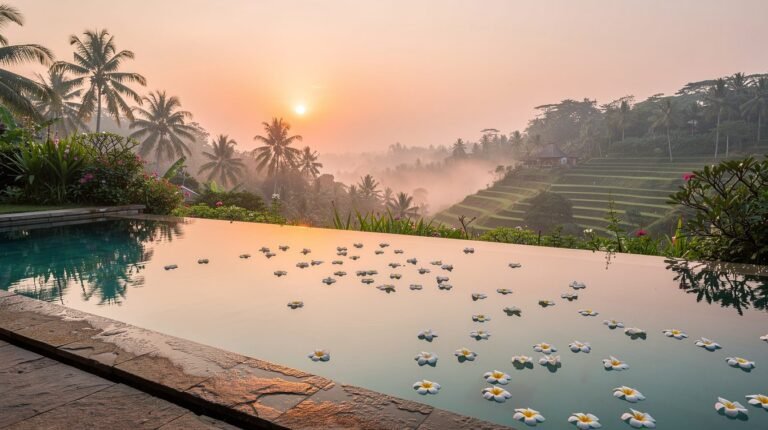
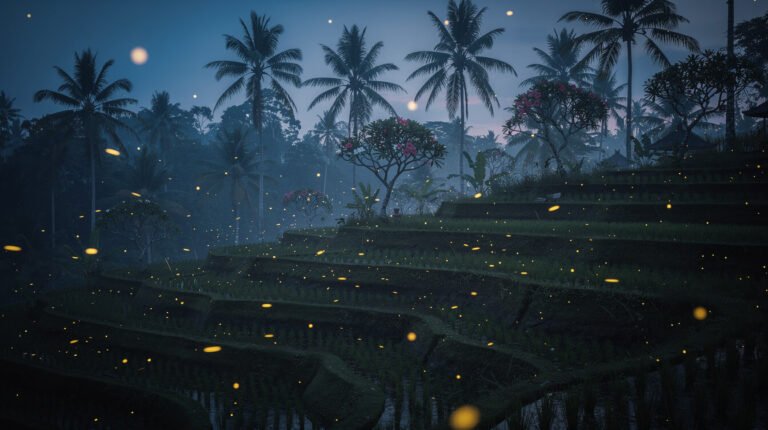
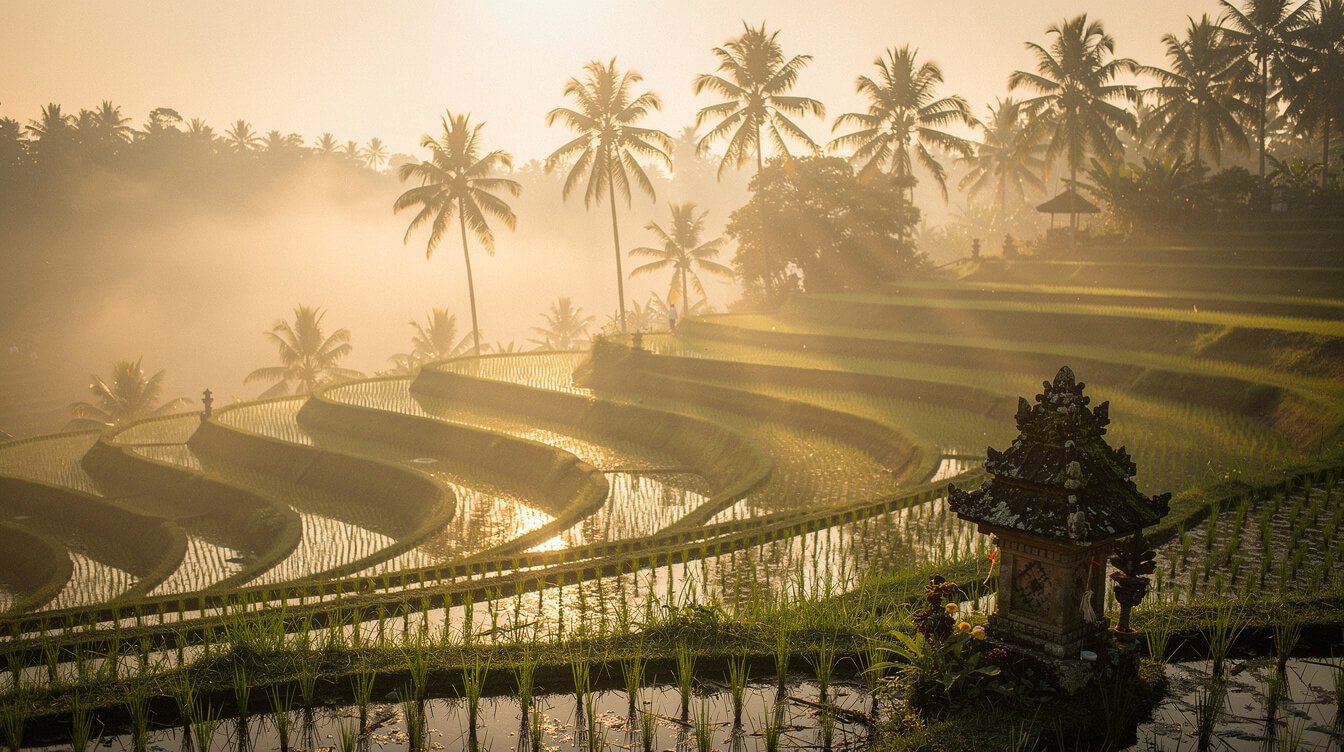
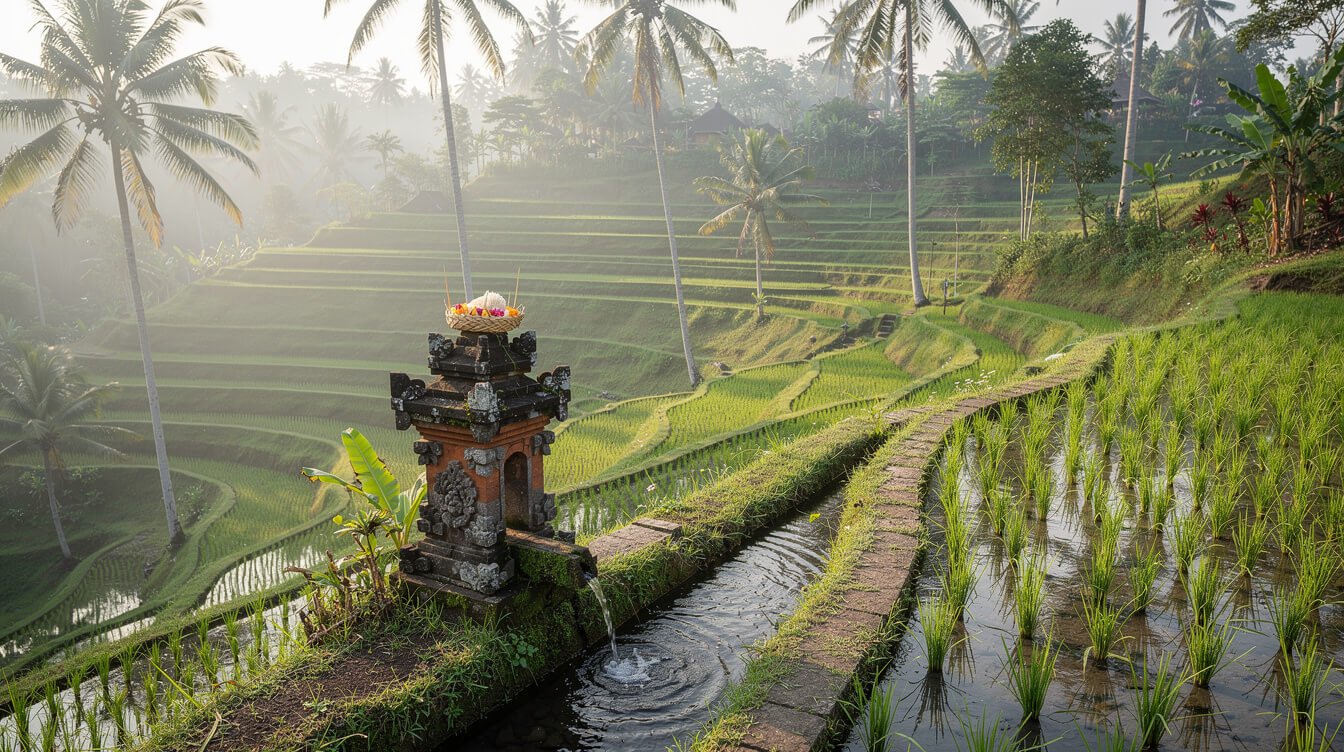
You can see all three at once in a rice field. Bali’s subak system is a cooperative of farmers who share water from a common source. Its channels run past small water temples, where farmers make offerings to Dewi Sri, the goddess of rice and fertility, before planting and harvest. Decisions about when to flood and when to plant are made together, often guided by temple priests and the ritual calendar. In 2012 UNESCO listed the subak landscape as a World Heritage Site, specifically naming it as an expression of Tri Hita Karana.
Next time you walk the terraces, look for the little shrine at the top of a field or where a channel divides. There will usually be a fresh offering on it. Our guide to Bali’s rice terraces points you to the best walks from Ubud, and the Campuhan Ridge Walk is an easy dawn introduction.
The same logic explains why Balinese compounds, villages and temples are laid out as they are, with sacred spaces toward the mountain and everyday or impure spaces toward the sea. Once you know this, you start to notice it everywhere.
The Calendar That Runs Ubud: Pawukon, Galungan, Saraswati and Nyepi
Ask a Balinese friend when the next big ceremony is and they may check two calendars. Bali religion runs on both at once, which is why holy days fall on different Western dates every year.
The 210-day pawukon
The pawukon is a cycle of 210 days, made of 30 weeks (wuku) of seven days, overlapping with shorter cycles of three and five days. Many festivals, temple anniversaries (odalan) and even each person’s ritual birthday (otonan) come around every 210 days. So a temple near you may celebrate its odalan twice in one calendar year.
The lunar Saka calendar
Alongside it runs the lunar Saka calendar. Every full moon (Purnama) and new moon (Tilem) brings temple prayers, and the Saka new year brings Nyepi.
Holy days coming up
Here’s what’s on the horizon from late October 2026. Dates come from the Balinese calendar; local timing of processions can vary by village, so check with your hosts on the day.
- Saraswati: Saturday, October 31, 2026. A day honoring the goddess of knowledge, when books and palm-leaf manuscripts are blessed and, by custom, not read. The next morning, Sunday, November 1, is Banyu Pinaruh, when many people bathe at springs and rivers at dawn. We wrote about the day the books in Ubud are left unopened.
- Pagerwesi: Wednesday, November 4, 2026. The “iron fence,” a day for strengthening the mind and spirit.
- Tumpek Landep: Saturday, November 14, 2026. Metal objects are blessed, from kris daggers to cars and motorbikes, which you’ll see decorated with offerings and palm-leaf ornaments.
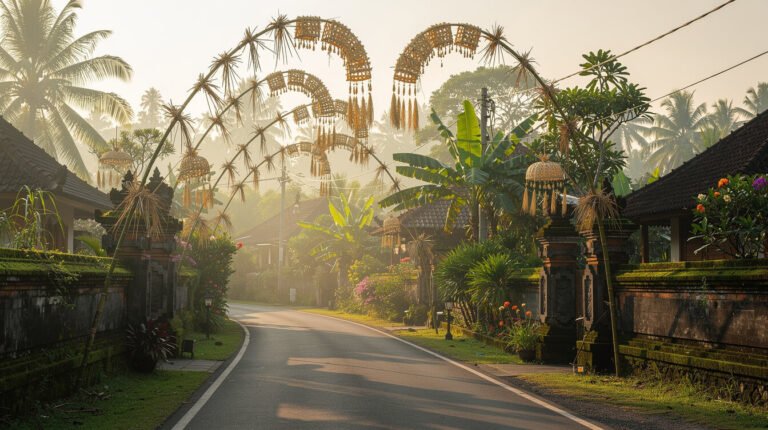
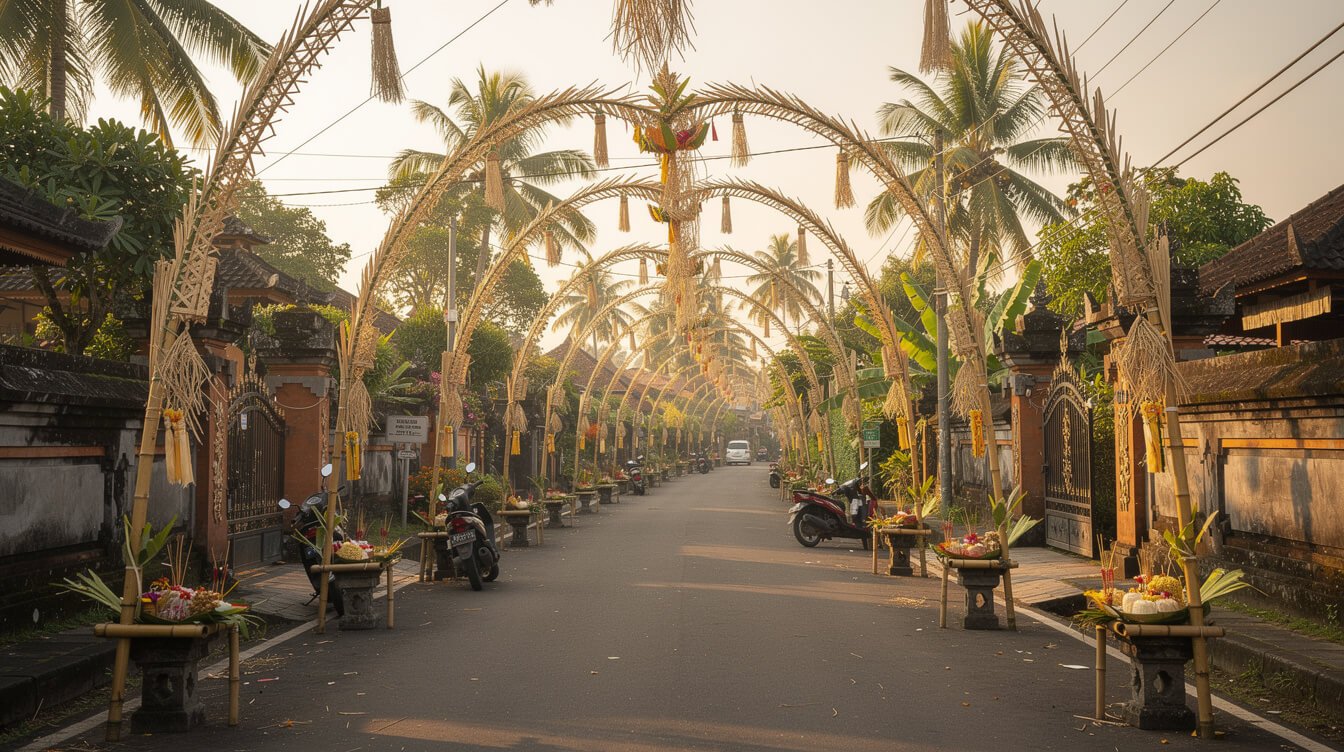
- Galungan: Wednesday, January 13, 2027, and Kuningan ten days later on Saturday, January 23, 2027. Galungan celebrates the victory of dharma over adharma, when ancestral spirits return home. Tall bamboo penjor arch over every road. See our guide to what Galungan feels like from inside an Ubud villa.
- Nyepi: Monday, March 8, 2027, with the ogoh-ogoh monster parades the evening before. On the Day of Silence the whole island stops, including the airport. Plan ahead with our complete guide to Nyepi.
Every full moon, temples fill with families in white and gold. The village scene on one of those evenings is captured in our note on a Purnama night in Ubud.
Life-cycle ceremonies
Beyond the calendar, each Balinese life is marked by rites: the first time a baby’s feet touch the ground at three Balinese months, the metatah tooth-filing ceremony that softens the “six enemies” of desire, anger, greed, confusion, intoxication and jealousy, and finally ngaben, the cremation that releases the soul. A cremation procession can look joyful to outsiders, with music and a tall decorated tower. To the family it’s a sacred duty, and visitors should keep a respectful distance unless invited closer.
Gods and Spirits You’ll Hear Named (Without the Catalogue)
Some guides list dozens of deities. You don’t need them. These are the names you’re most likely to hear during your stay, and what they mean in daily life.
- Sang Hyang Widhi Wasa: the one supreme God, honored at the empty-throne padmasana.
- The Trimurti: Brahma the creator, Wisnu (Vishnu) the preserver and Siwa (Shiva) the dissolver. Many villages have three core temples dedicated to these roles, the Kahyangan Tiga: the village origin temple, the main village temple and the temple of the dead near the cemetery. Some Balinese say even a canang sari tells the story: made with care, kept for the day, then let go.
- Dewi Sri: goddess of rice and prosperity, with shrines in the fields and granaries.
- Saraswati: goddess of knowledge, learning and the arts.
- Barong and Rangda: the lion-like protector and the fearsome widow-witch, eternal opponents in temple dramas. Their struggle never ends with a winner, because both forces are part of the world.
- Bhuta kala: the lower spirits of chaos and disorder. They aren’t evil to be destroyed so much as energies to be fed and kept in balance. That’s what the ground offerings are for.
Why statues wear checked sarongs
You’ll see black-and-white checked cloth, poleng, wrapped around statues, shrines and even sacred trees. It expresses rwa bhineda, the balance of opposites: light and dark, good and bad, day and night. Balinese thinking doesn’t aim to erase the dark squares. It aims to keep both in harmony. The yellow or white parasols (tedung) shading shrines are a sign of honor.
For a feel of these ideas in performance, the kecak fire dance in Ubud retells the Ramayana in a temple courtyard at dusk, and many Barong performances run in the mornings around Batubulan.
Book the Villa
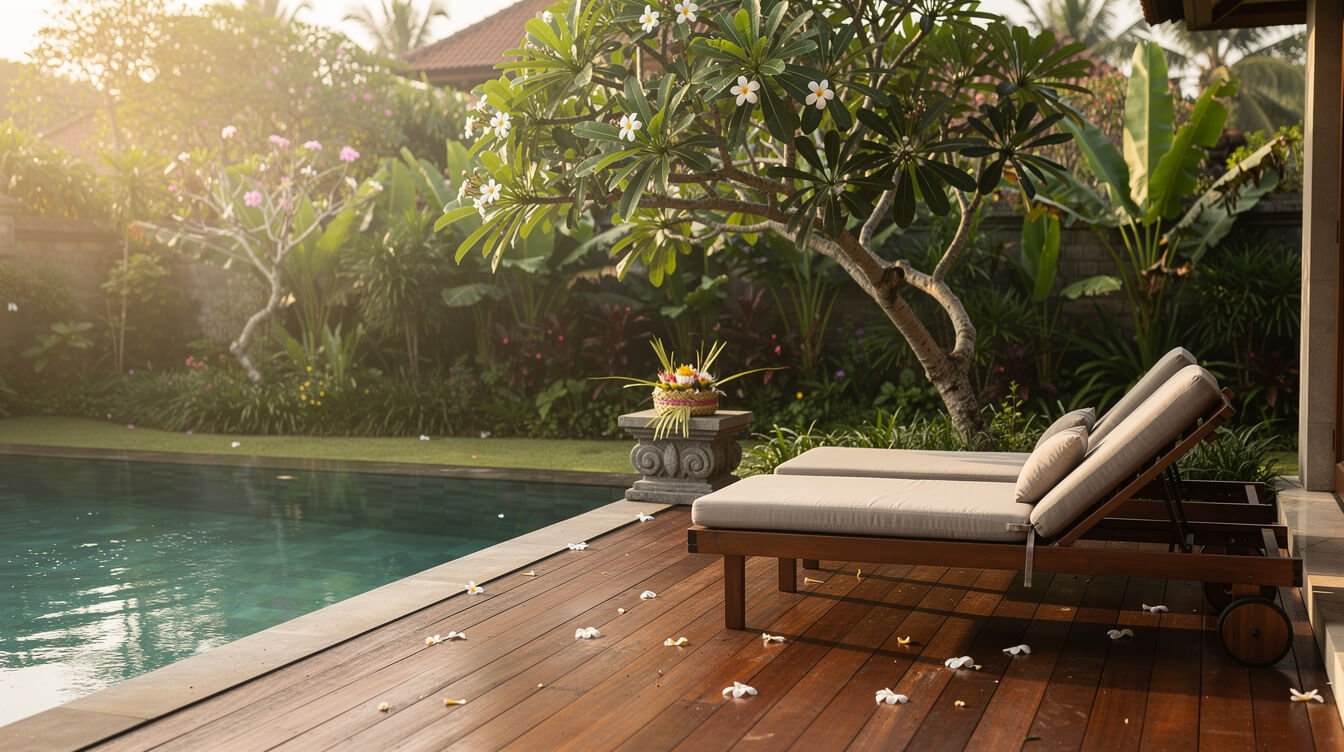
Three bedrooms, a private pool deck, tropical gardens and a team of manager, chef, housekeeper and gardener who look after the details. You get to watch Ubud’s rhythm unfold. We’ll take care of the rest. Check availability for your dates.
How to Be a Respectful Guest at Temples and Ceremonies
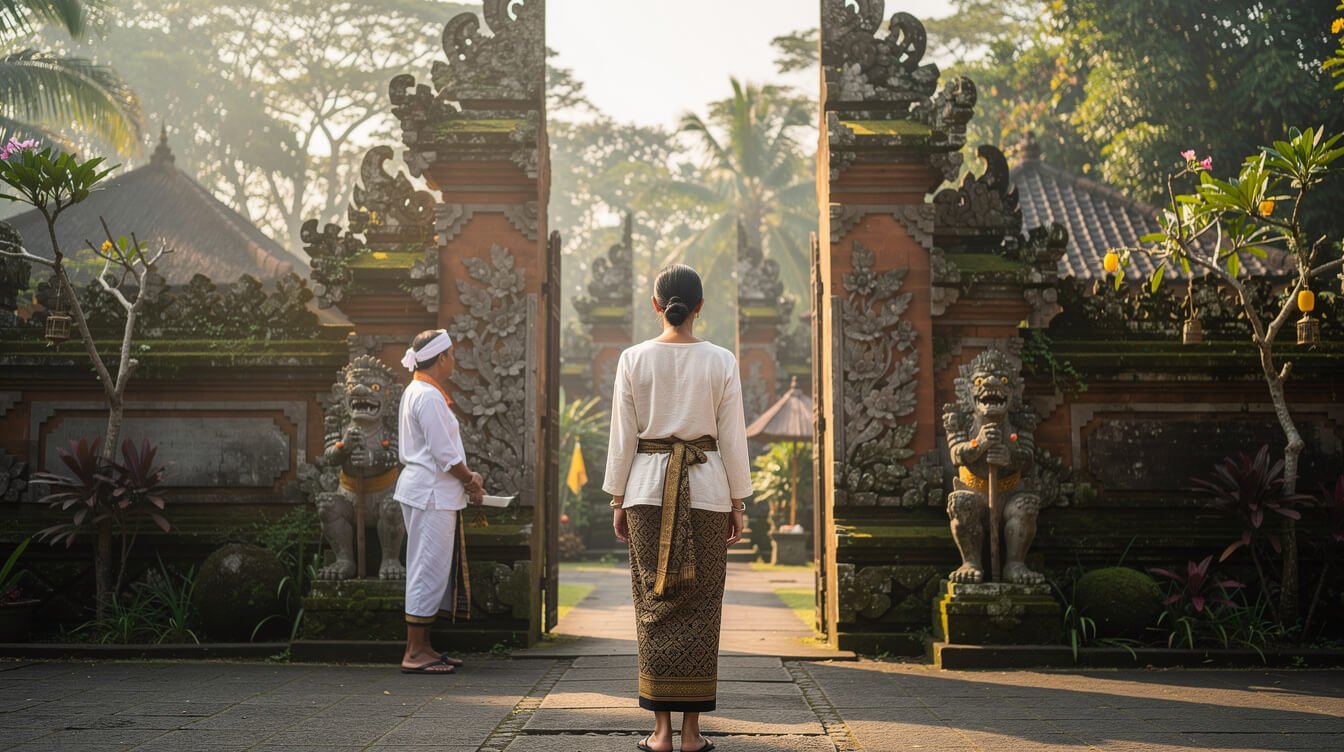
Balinese people are famously welcoming to curious visitors. A little care goes a long way, and nobody expects you to get everything right. These are the guidelines we share with every guest.
Dress for the temple
- Wear a sarong (kamen) that covers your legs and a sash (selendang) tied at the waist. Many temples lend or rent them at the gate. Buying your own costs little and makes a lovely souvenir.
- Cover your shoulders and upper arms. A simple T-shirt or light shirt works.
- Keep it modest and simple. Ceremonies are not a photo-shoot backdrop.
Who should not enter
By Balinese custom, women who are menstruating are asked not to enter temple grounds, as are people with open, bleeding wounds and those in mourning shortly after a death in the family. Signs at temple gates often say this in English. It’s about ritual purity, not judgment, and the honor system applies.
Inside the temple
- Don’t climb on shrines, walls or statues, and never sit higher than a priest or the offerings.
- Don’t point your feet toward shrines, and don’t touch anyone’s head.
- Stay out of the inner courtyard if it’s marked for worshippers only.
- Ask before photographing people at prayer, and never use flash during a ceremony.
- Keep your voice low, especially when people are praying.
Offerings underfoot
Try to step around the canang sari on pavements and doorsteps. If you accidentally brush one, don’t panic. Once an offering has been presented, its spiritual work is done. Locals step over them all day. Just don’t kick them aside or pick them up as souvenirs.
When a procession closes the road
Ceremony processions, with gamelan, women balancing tall fruit-and-flower offerings on their heads and men carrying parasols, often close a stretch of road for 15 to 30 minutes. Your driver will simply pull over and wait. It’s one of the most beautiful things you’ll see in Bali, and it’s worth building a little slack into your day for it. Bali’s government has also published a short list of do’s and don’ts for visitors that covers respecting sacred places and dressing modestly, so these habits are both courteous and expected.
Ready to visit? Our complete guide to Ubud temples and their ceremonies and our list of Ubud temples to visit will help you choose. Further afield, Pura Luhur Uluwatu sits on a cliff above the Indian Ocean, and the Ubud Palace still hosts ceremonies for the royal family. If you’d like to experience a gentle purification ritual yourself, the Balinese flower bath is a lovely place to start.
Bali Religion FAQ: Beef, Buddhism and the “Island of the Gods”
Can Balinese Hindus eat beef?
Most Balinese Hindus avoid beef, because the cow is regarded as sacred, linked to Shiva’s mount Nandi. Practice varies from family to family, and beef is easy to find in tourist restaurants. Pork, duck and chicken are the ceremonial staples, which is why babi guling (spit-roasted pig) and bebek betutu (slow-cooked duck) are so tied to feast days.
Is Bali Hindu or Buddhist?
Bali is overwhelmingly Hindu, but its Hinduism carries Buddhist threads from the Majapahit era. Buddhist priests still officiate at some major ceremonies, and you’ll find small Buddhist communities and temples in the north of the island. Bali also has Muslim, Christian and Confucian communities, especially in Denpasar and coastal towns.
Why is Bali called the “Island of the Gods”?
Because the sacred is everywhere you look. Estimates of the number of temples on the island run into the tens of thousands, counting village, clan and family temples. Every home has a shrine, every field has a water altar, every crossroads gets an offering. The nickname isn’t marketing. It’s simply description.
Can non-Hindus visit temples?
Yes. Most temples welcome respectful visitors to the outer and middle courtyards. Some inner sanctums are reserved for worshippers, and certain temples close to visitors during ceremonies.
What is the prayer people say three times a day?
The Puja Trisandhya, recited at sunrise, noon and sunset. It opens with the ancient Gayatri mantra and is often broadcast on local radio.
Can I join a ceremony?
Sometimes, if you’re invited, and it’s a real privilege. Dress in temple clothes, follow your host’s lead and sit quietly. If you’re curious, ask the people around you. Balinese are often happy to explain what’s happening.
Living Alongside Bali Religion: Final Thoughts
The most beautiful thing about Bali religion isn’t any single temple or festival. It’s how quietly it fills an ordinary day. Petals on a step at dawn. A drum across the fields at noon. A road gently closed for a procession. Incense curling past the pool at sunset. You don’t have to share the faith to feel its care. You only need to slow down enough to notice.
That’s what we hope your stay in Ubud gives you: room to watch, ask, and be welcomed into a rhythm that has carried this island for centuries. If you’d like help timing your trip around a holy day, or simply want to know what the drums are saying tonight, just ask us. We love these questions.
Join our newsletter — fun, new, exciting Bali news
Seasonal notes from Ubud, ceremony days worth planning around, warungs worth the detour, and small stories from our garden and kitchen. Delivered now and then, always worth opening.