Frangipani Flower: Bali’s Jepun, Its Scent, Meaning and Place in Every Offering
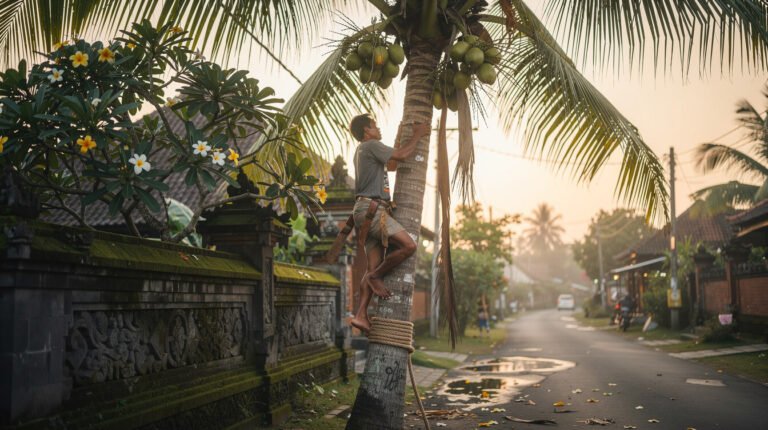
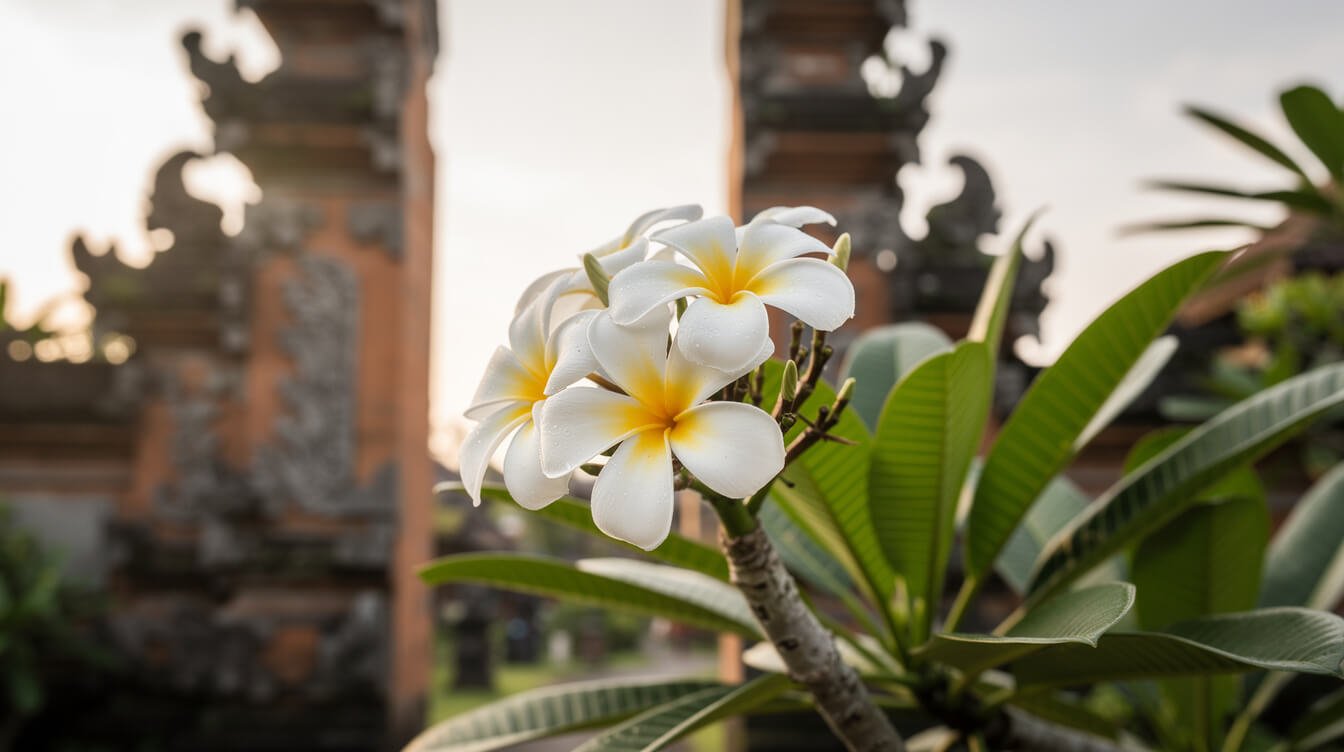
You will probably smell it before you see it. You’ll be walking a lane in Ubud just after dawn, the air still cool, and a sweet scent drifts over a family compound wall. Then you look down and there it is: a frangipani flower on the path, five thick petals, white with a yolk-yellow heart. In Bali people call it jepun. It sits in the offerings at every gate, gets tucked into hair on ceremony days, floats in bowls of water, and fills the evening air around every temple.
This guide is for travelers who want to understand the flower, not just photograph it. You’ll learn where the frangipani comes from (not Bali, it turns out), what it actually smells like and why that scent gets stronger after dark, how it works in Balinese offerings and ceremony, what it means here compared with other parts of Asia, when the trees bloom, and the gentle rules for picking one up. We finish with honest advice on taking the scent home, and a short FAQ.
What Is the Frangipani Flower? Bali’s Jepun, Explained
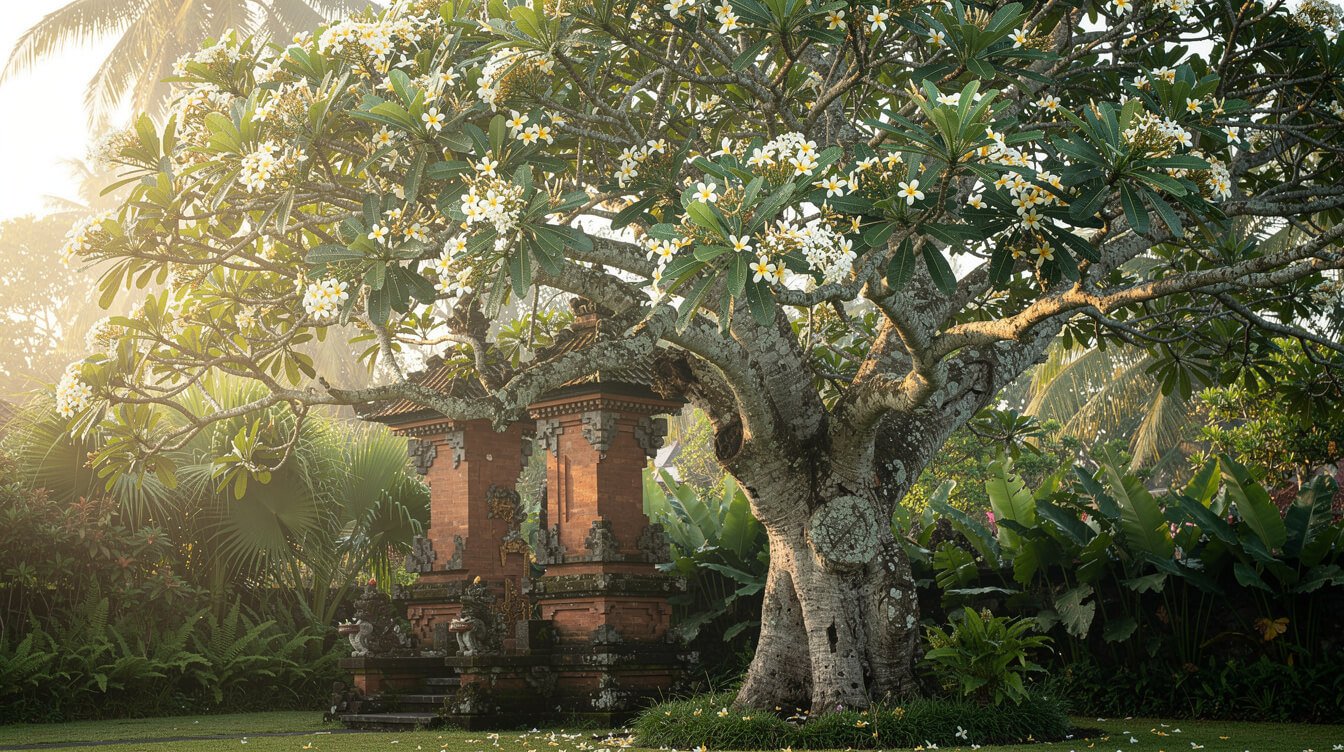
The frangipani is a small tree in the genus Plumeria, part of the dogbane family (Apocynaceae), the same family as oleander. Its branches are thick, gray and a little succulent, and they fork into a candelabra shape. Long leaves gather at the tips, and the flowers come out in loose clusters at the very ends of the branches. Snap a twig and a milky white sap beads up. That sap irritates skin and eyes, which is worth remembering later.
Here is the surprise. The flower that looks so completely Balinese is not from Asia at all. Plumeria is native to Mexico, Central America, the Caribbean and the north of South America. Botanists today accept around 18 species. The ones you will meet most in Bali are forms of Plumeria rubra (the white-and-yellow, pink and deep red flowers) and Plumeria obtusa, the glossy-leaved white kind that keeps more of its leaves through the dry months.
How it traveled to Bali
Most historians link the frangipani’s arrival in Asia to the Spanish galleons that sailed between Mexico and Manila from the 16th century. Philippine records from the 1600s already call it calachuche, a word borrowed from Nahuatl, the Aztec language. From the Philippines it spread through the islands that are now Indonesia and Malaysia. Nobody can give you the year it reached Bali, but it has been here long enough to feel like it grew from the island’s own soil.
Why so many names?
You’ll hear the flower called several things on one walk. In Balinese it is jepun (also bunga jepun). Across the rest of Indonesia it is kamboja. English speakers say frangipani or plumeria. “Plumeria” honors Charles Plumier, a 17th-century French botanist who catalogued plants in the Caribbean. “Frangipani” is usually traced to a perfume made by an Italian noble family, the Frangipani, whose almond-scented gloves were fashionable in 17th-century Europe. A tale about a sailor named Frangipani smelling the flowers from Columbus’s ship? Invented by a London perfumer in 1867 to sell scent. If you like learning a few local words, our guide to the Balinese language is a good next stop.
What Does a Frangipani Flower Smell Like?
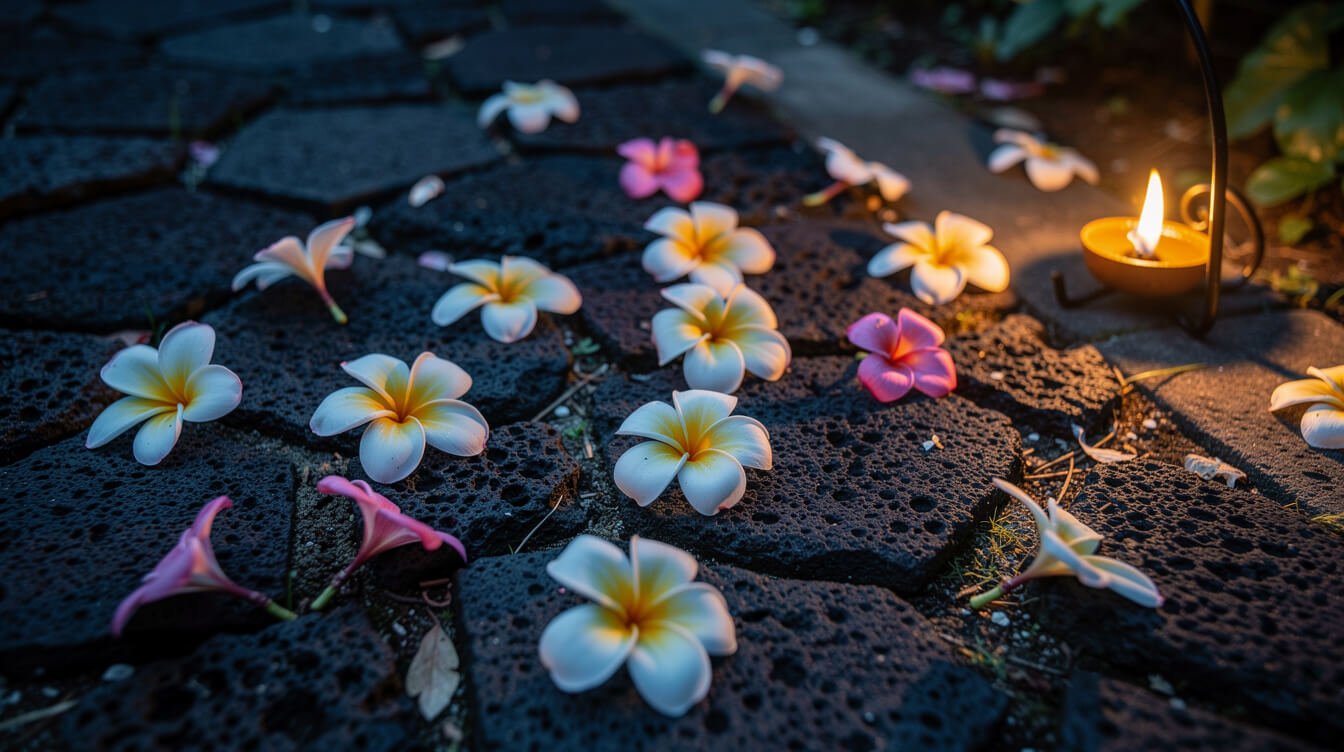
Ask five people and you will get five answers, because the scent has layers. Up close, a white-and-yellow frangipani smells sweet and creamy, a little like jasmine and gardenia, with a bright citrus edge. Breathe again and you may notice coconut, ripe peach or apricot, even a hint of vanilla. Underneath sits something soft and slightly woody that keeps it from being cloying. Perfumers describe it with words like “lactonic,” meaning milky and smooth.
Dawn, dusk and the moths at night
The scent changes through the day. In the late morning heat it fades a little. As the light drops it builds again, and after dark a single tree can scent an entire garden. That timing is the whole point. The frangipani is pollinated by sphinx moths, large night fliers that follow scent. Here is the twist: the flowers hold no nectar at all. The moths go from bloom to bloom searching for a reward that isn’t there, carrying pollen as they go. Botanists call it pollination by deceit. You’re simply enjoying the perfume the tree uses to trick them.
So if you want the full experience, step out after dinner. Sit near a frangipani tree around 8 or 9 in the evening, when the air is still and warm, and you will understand why Bali smells the way it does in so many travelers’ memories. One of our daily notes, the frangipani that fall while you sleep, captures exactly this.
Do the colors smell different?
They do, though gently. The classic white flower with a yellow center tends to have the sweetest, most citrus-and-coconut scent. Pink and deep red forms often smell spicier, sometimes with a rose or raspberry note, and some are lighter overall. The glossy white obtusa type is often fresher and cleaner. Scent also varies tree to tree and hour to hour, so the best test is your own nose: pick up a few fallen flowers of different colors and compare.
The Frangipani Flower in Balinese Offerings and Ceremony
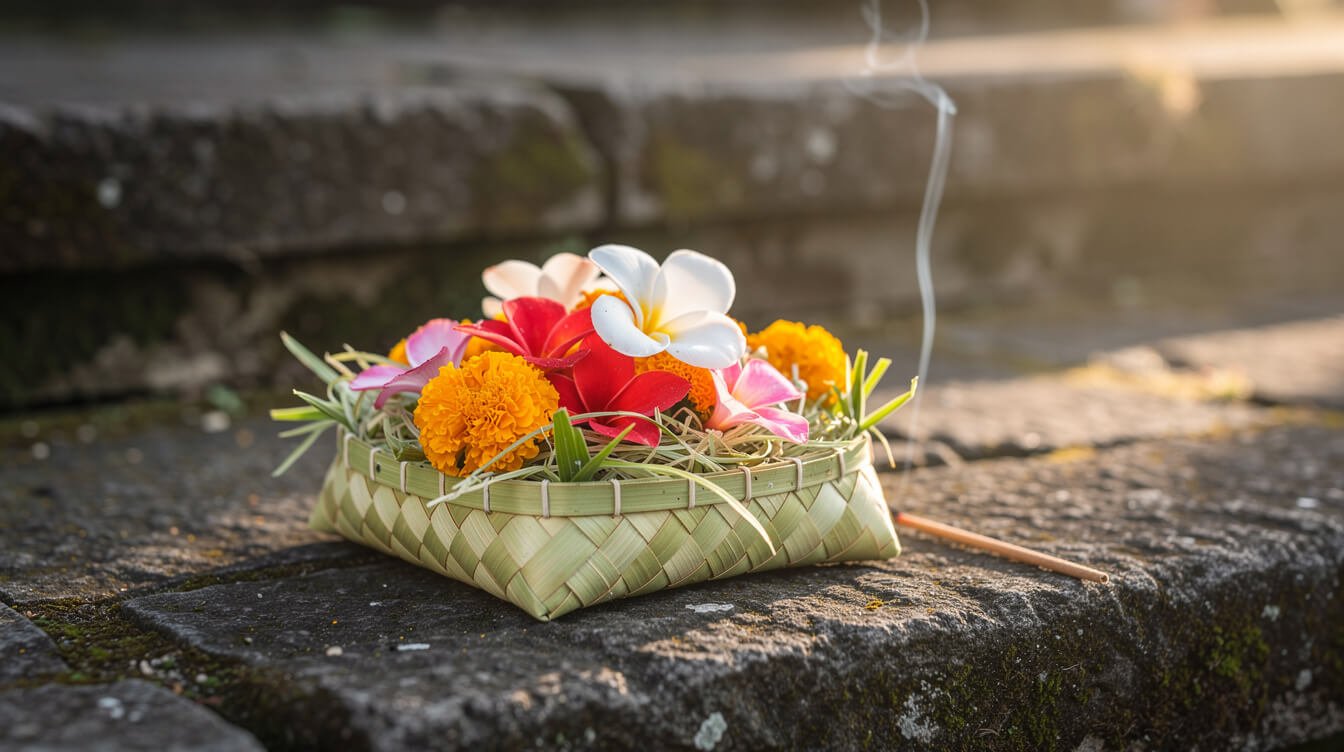
If the frangipani is everywhere in Bali, that’s because Balinese Hindu life runs on flowers. Every morning, small offerings called canang sari appear at gates, shrines, shop thresholds, on car dashboards and at crossroads. Each is a little tray folded from young coconut leaf and filled with flowers, shredded pandan, a pinch of rice, sometimes a sweet, and a stick of incense. Jepun is one of the most common flowers in them, partly because the trees bloom so generously and partly because of its clean white color and scent.
Flowers arranged by direction
The flowers in a canang aren’t placed at random. Balinese Hinduism links each direction to a deity and a color, a system called nawa sanga. In the simplest form you’ll see white facing east for Iswara, red to the south for Brahma, yellow to the west for Mahadewa, and dark blue or green to the north for Wisnu, with mixed petals in the middle for Siwa. White frangipani often takes the eastern place, so a single offering can hold a small map of the cosmos. If you’d like to understand the bigger picture, our guide to religion in Bali walks through it.
Flowers in prayer and in hair
Watch a temple ceremony and you’ll see flowers in people’s hands. During prayer, worshippers hold a flower between their fingertips, raised above the forehead, and then offer it. After praying, many tuck a flower behind the ear or into their hair. Women at ceremonies often wear jepun pinned into a neat bun, and men sometimes slip one into the folds of the udeng head cloth. On big days like Galungan, when the next one falls on Wednesday 13 January 2027, the lanes of Ubud are full of people dressed in white and gold with frangipani in their hair.
Who supplies all those flowers?
A household might make dozens of offerings a day, and the flowers have to come from somewhere. Some are gathered from home gardens. Many more are bought each morning from flower sellers at the market, sold by the plastic bag or the woven basket. Our daily note the woman who sells the color for every offering follows one of those morning sellers. Head to Ubud Market before 7 a.m. and you’ll see heaps of jepun, marigold and pink petals changing hands.
Get a free 3-day sample itinerary
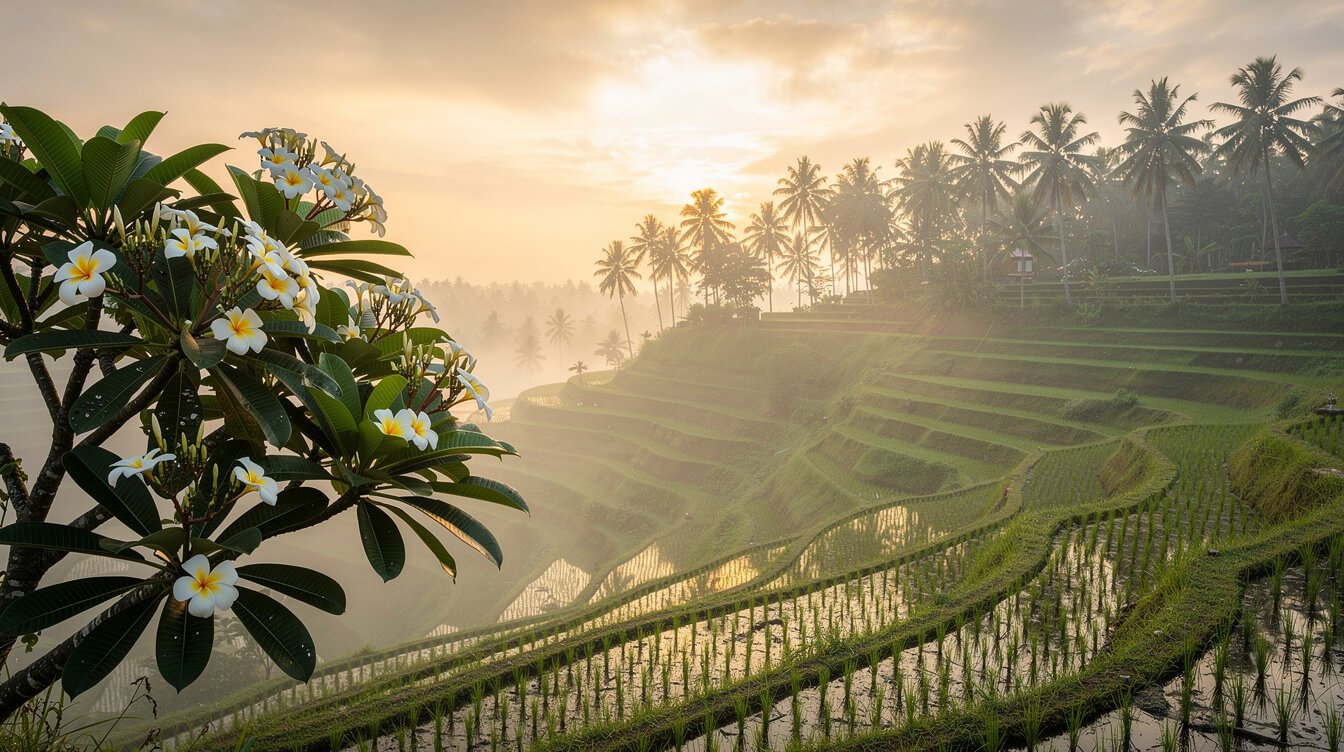
Want to follow the jepun from the morning market to the temple? See how three easy days from Ubud can unfold: an early market walk, a temple visit with flowers in your hair, a spa afternoon and slow evenings in the garden. We will send you a free 3-day sample itinerary.
What Does the Frangipani Flower Symbolize?
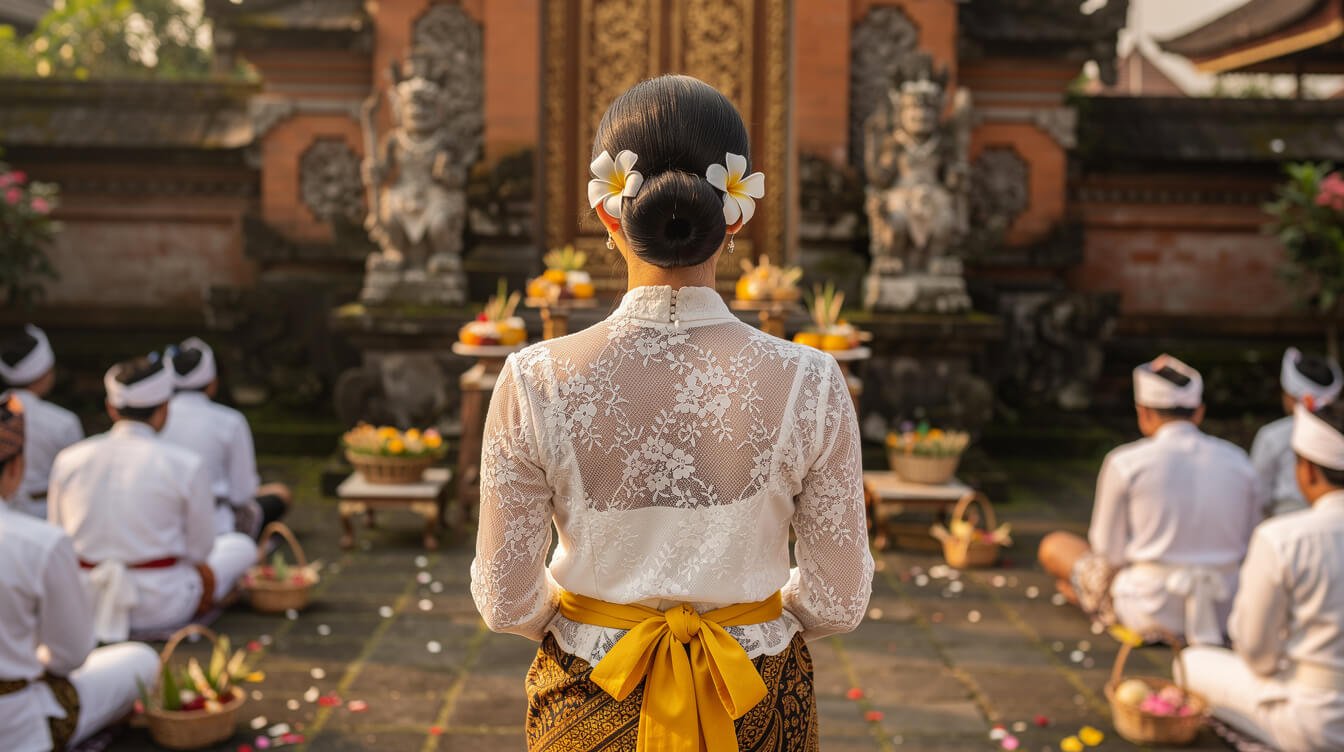
In Bali, the meanings people give you are warm and simple. The frangipani stands for purity and sincerity: a clean, white, fragrant gift that is easy to give with an open heart. It is linked with devotion, because it is in so many daily offerings. And many people connect it with continuity, even immortality, because the trees keep flowering on branches that can look bare and dead in the dry season. Temple courtyards are often shaded by old frangipani trees, and some Balinese say the flowers help keep a sacred space clean of bad energy.
How the meaning shifts across Asia
Here is where travelers sometimes get confused. Outside Bali, the same flower carries different stories:
- Java and Malaysia: the kamboja is planted in cemeteries and is often called the graveyard flower (bunga kubur). Folklore links its night scent to the kuntilanak, a female ghost. Many Javanese families would not plant one at home.
- Laos: as dok champa, it is the national flower and a symbol of welcome and sincerity.
- India and Sri Lanka: it grows by temples and is sometimes called the temple tree. Its scent goes into champa incense.
- Hawaii and Polynesia: it is strung into leis. A popular modern custom says a flower over the right ear means you are single, over the left means taken.
None of these cancel the others out. In Bali the frangipani’s place is in the offerings and the temple, and its tone is devotional and joyful. You don’t have to worry that wearing one is a faux pas here. Locals do it every ceremony day.
A note on color meanings
You may read online that pink frangipani means romance and yellow means friendship. Those are Western flower-language ideas and you’ll rarely hear them from a Balinese person. In Bali, color matters through the direction-and-deity system above, not through romance. If you ask a Balinese friend what a flower means, they are likelier to tell you which direction it faces in a canang.
Where Frangipani Grows Best: Ubud Gardens Through the Seasons
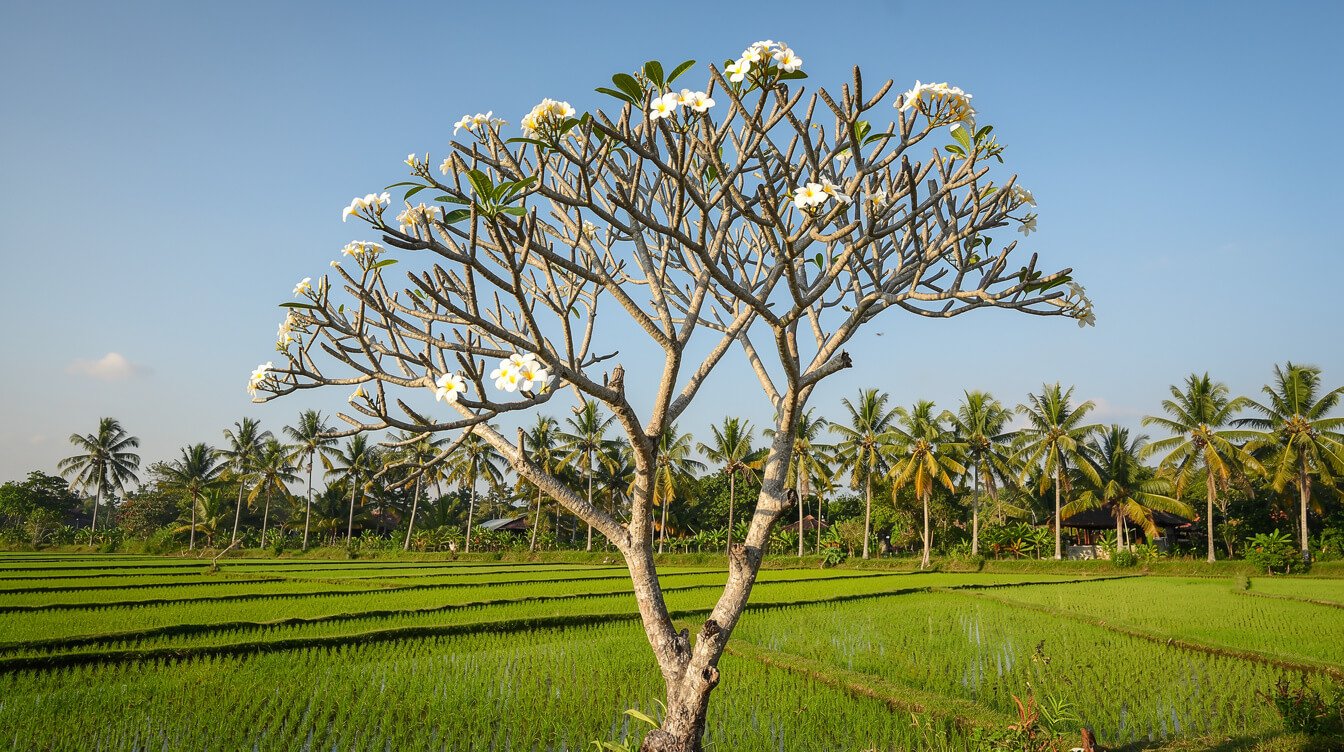
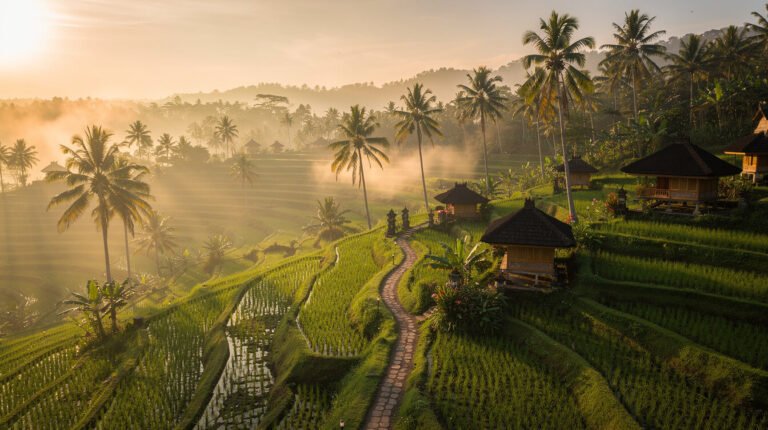
Frangipani loves heat, sun and soil that drains fast, and it hates sitting in wet ground. That is why it does so well on Bali’s volcanic slopes and in Ubud’s gardens, where the soil is rich but rain runs off quickly. You will see trees by temple gates, in family compounds, along rice field paths and leaning over garden walls in every village around Ubud.
When does frangipani bloom in Bali?
You can find a frangipani flower somewhere in Bali in every month of the year, which is part of why it is used so freely in offerings. But the rhythm of each tree follows the seasons:
- Dry season (roughly April to October): many Plumeria rubra trees drop most of their leaves. The branches look gray and bare, then the flowers appear at the tips anyway. It’s an odd and lovely sight, and it is the reason Balinese link the tree with life that keeps going. If you’re visiting in August, look for these bare branches studded with white.
- Rainy season (roughly November to March): the leaves come back thick and green, and the flowers keep coming between showers. Rain knocks plenty to the ground, so paths and pool decks are scattered with blooms in the morning. Our rainy season guide covers what else to expect.
The nursery trade
Drive the roads around Ubud and you’ll pass small nurseries selling potted jepun in every color, from pure white to peach, magenta and near-black red, including fancy double-petaled forms. Bali grows and grafts a great many frangipani for gardens across Indonesia. If you’re curious, stop and ask. Growers are usually happy to show you their newest colors. In a villa garden, notice which tree flowers at which hour: it’s a quiet way to learn the rhythm of the day.
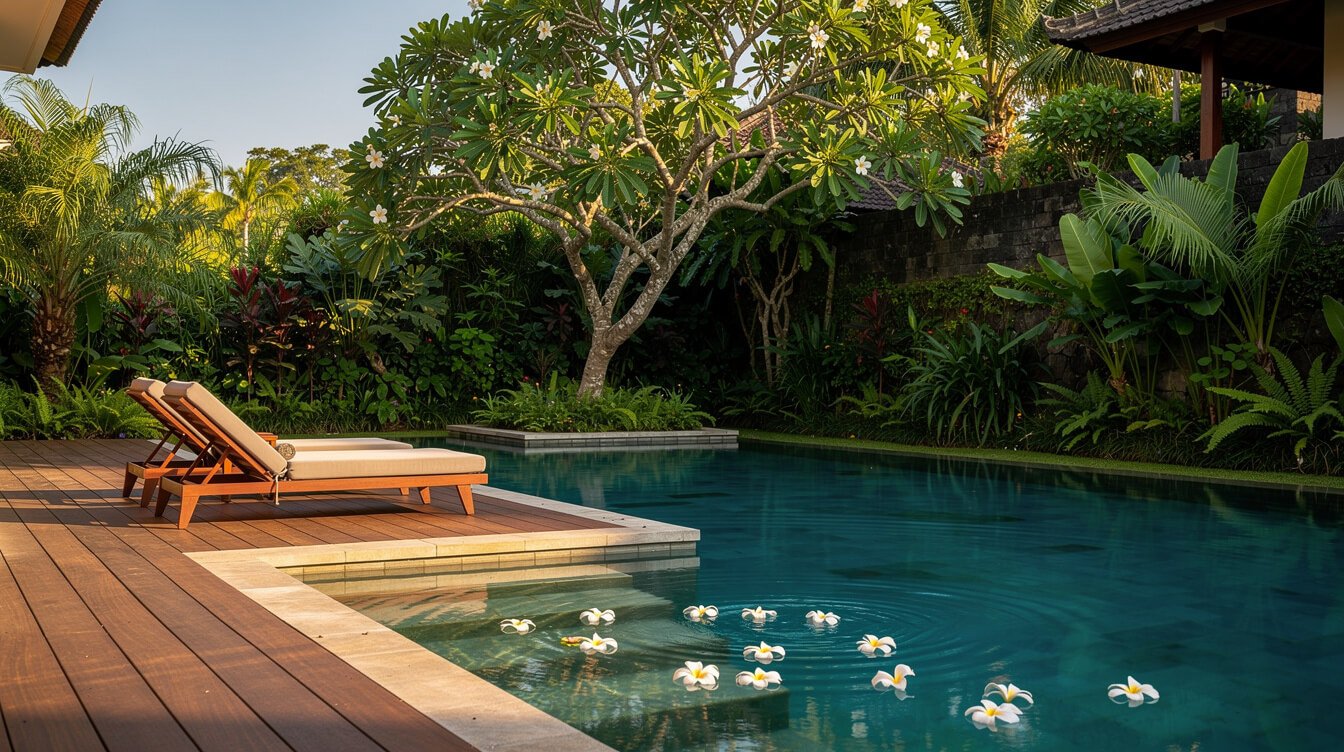
Book the Villa
Wake up to fallen frangipani on the pool deck and fall asleep with the scent drifting in from the garden. Three bedrooms, a private pool and a tropical garden in Ubud, with a team on hand to help plan your days and cook your dinners. Check availability for your dates.
Frangipani Etiquette for Visitors: What to Pick Up, What to Leave
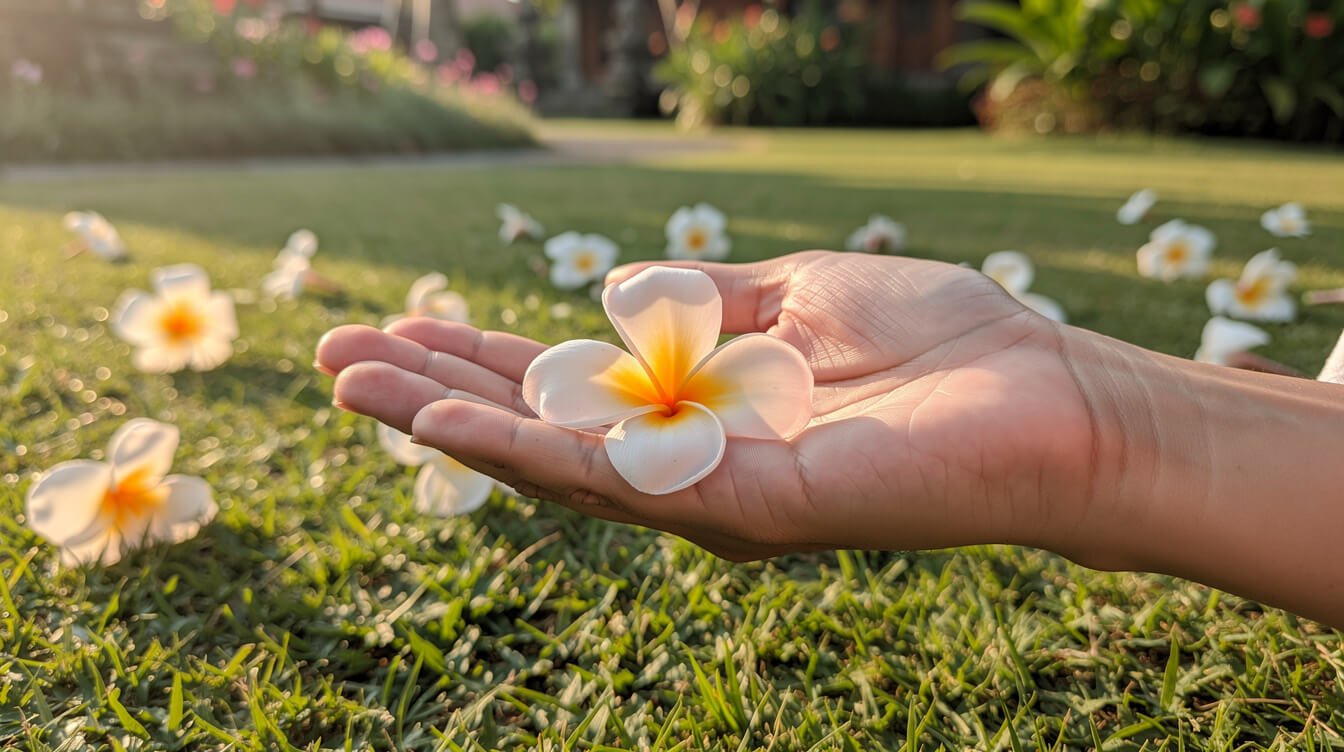
The frangipani is generous, and Balinese people are generous with it too. A few simple habits will keep you on the right side of local custom:
- Fallen flowers are yours to enjoy. A frangipani on the grass or the path is free to pick up, smell and tuck behind your ear. Nobody minds.
- Never take a flower from an offering. Once a flower is in a canang it has been given. Even if it looks forgotten on a step, leave it. The same goes for flowers in a shrine.
- Don’t pick from temple trees. The frangipani in a temple courtyard grows for the temple. Admire it, photograph it, and let it be.
- Step around offerings. You will find canang on pavements everywhere. Try not to step on a fresh one. If you do by accident, don’t panic. Once it has been presented, its job is done, but care is always appreciated.
- Ask before picking from a private tree. In someone’s garden or compound, a quick “boleh?” (“may I?”) with a smile goes a long way.
- Mind the sap. If you snap a flower from a branch, the milky sap can sting your skin and eyes. Wash your hands before rubbing your face.
Wearing a frangipani at a temple
When you visit a temple with a sarong and sash, a fallen jepun behind your ear is a lovely touch and a common one. Many visitors first wear one after a temple blessing or a Balinese flower bath. If you’d like to see ceremonies done properly, our guide to temples to visit around Ubud covers dress codes and timings. The great mother temple, Besakih, is full of flowers on its festival days.
Bringing the Frangipani Flower Scent Home
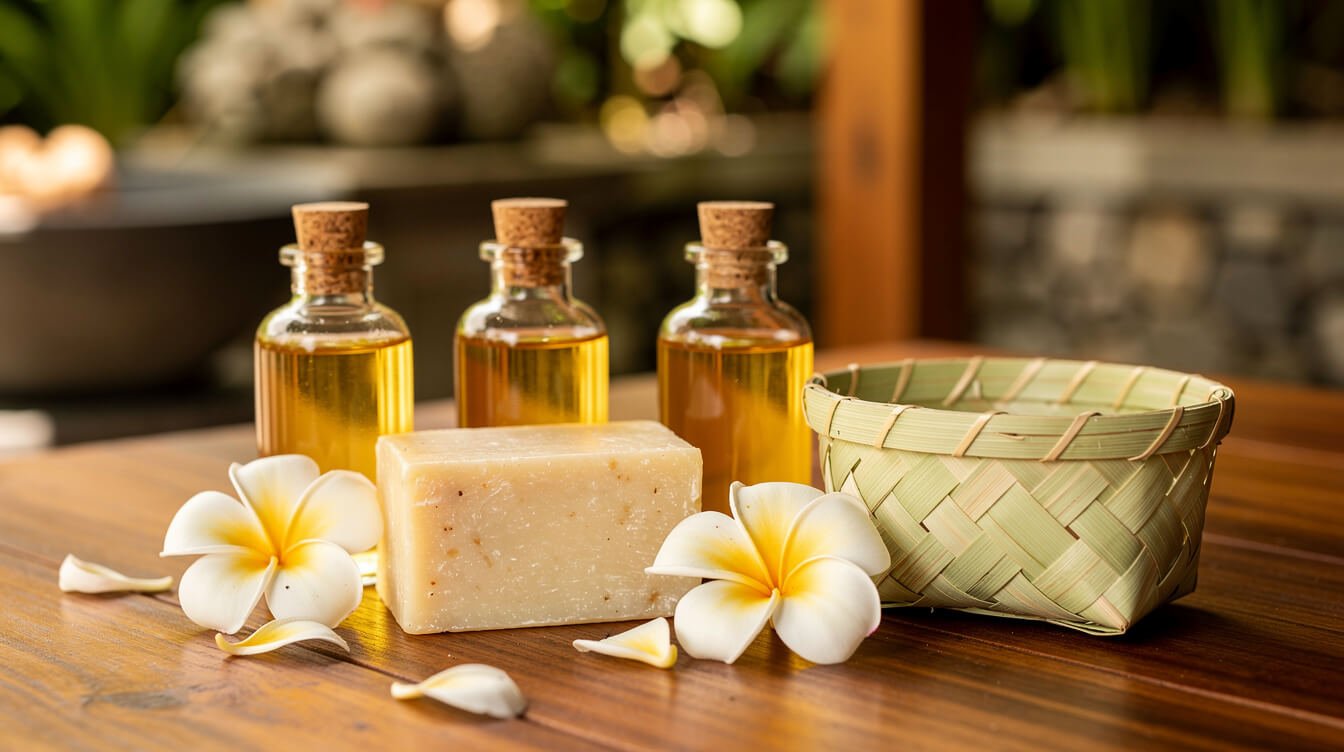
You will want to take the scent with you. Here’s what travels well and what doesn’t.
What travels
- Frangipani oil and fragrance. Sold in markets, spa shops and pharmacies. Quality varies a lot. Many cheap bottles are synthetic, which is fine for a room spray but not the same as the real flower. Smell before you buy, and look for a scent that changes on your skin over an hour rather than staying flat.
- Soap, candles and incense. Easy to pack and lovely gifts. Our Ubud shopping guide points you to the markets.
- A frangipani massage. Many spas in Ubud use frangipani oil in their treatments, which is perhaps the nicest way to carry the scent for the rest of the day. See our guide to traditional spa rituals in Ubud.
What doesn’t travel
Fresh flowers, cuttings and seeds are a different matter. Many countries, including Australia, New Zealand and the United States, strictly control plant material at the border. Fresh frangipani will usually be seized, and undeclared plant material can bring fines. Rules change and differ by country, so check your own country’s biosecurity guidance before you fly. If in doubt, declare it or leave it behind. Honestly, the flower looks best where it grows: falling onto warm stone at the end of a Bali day.
And if you’d like to bring home a memory instead of a bottle, spend an evening near a flowering tree. It may well be the moment you remember most. Our list of romantic things to do in Ubud has more ideas like it.
Frangipani Flower FAQ
What is special about the frangipani flower?
Its scent, its staying power and its role in daily life. The frangipani flowers almost all year, survives drought on bare branches and fills the night air with perfume. In Bali it is part of every day: offerings at dawn, flowers in hair on ceremony days, petals on the ground by evening.
Is the frangipani native to Bali?
No. Plumeria is native to tropical America, from Mexico through Central America and the Caribbean. It most likely reached Southeast Asia on Spanish ships via the Philippines, then spread to the islands of Indonesia, including Bali.
What does a frangipani flower smell like?
Sweet and creamy, with notes of jasmine, gardenia, citrus, coconut and ripe stone fruit. It’s strongest in the evening and at night, when it attracts the sphinx moths that pollinate it.
What do frangipani flowers symbolize in Bali?
Purity, sincerity, devotion and the continuity of life. In other places the meaning differs: in Java and Malaysia it is linked with cemeteries, and in Laos it is the national flower.
What is the frangipani flower called in Bali?
Jepun in Balinese, or kamboja in Indonesian. You’ll hear both, along with “frangipani” and “plumeria.”
Can I pick frangipani flowers in Bali?
Pick up fallen ones freely. Never take flowers from offerings or temple trees, and ask before picking from a private garden.
Is the frangipani poisonous?
The milky sap in the branches and leaves irritates skin and eyes, and the plant shouldn’t be eaten. Handling a fallen flower is fine. Just wash your hands afterwards and keep the sap away from your face.
When is the best time to see frangipani in Bali?
Any month. For the most fragrant experience, go out in the early evening. For the striking bare-branch blooms, visit in the dry season, roughly April to October.
A Flower You’ll Remember by Its Scent
Most travelers come home from Bali with photos of rice terraces and temple gates. What stays longest is often the smell: a warm night, a garden wall, a tree you can’t quite see. That is the frangipani flower doing what it has done for centuries: perfuming the dark for moths that never get their nectar, and for the rest of us who are simply grateful to be there.
When you’re in Ubud, give the jepun a moment of your attention. Pick up a fallen one on your morning walk. Watch where it ends up in the offerings. Sit near a tree after dinner. Then ask the team where their favorite frangipani tree is. Everyone in Bali seems to have one.
Join our newsletter — fun, new, exciting Bali news
Ceremony dates like Galungan and the full moons, culture stories, entry-rule changes and small moments from Ubud. Delivered now and then, always worth opening.