Gates of Heaven Bali: How to Visit Lempuyang Temple From Ubud
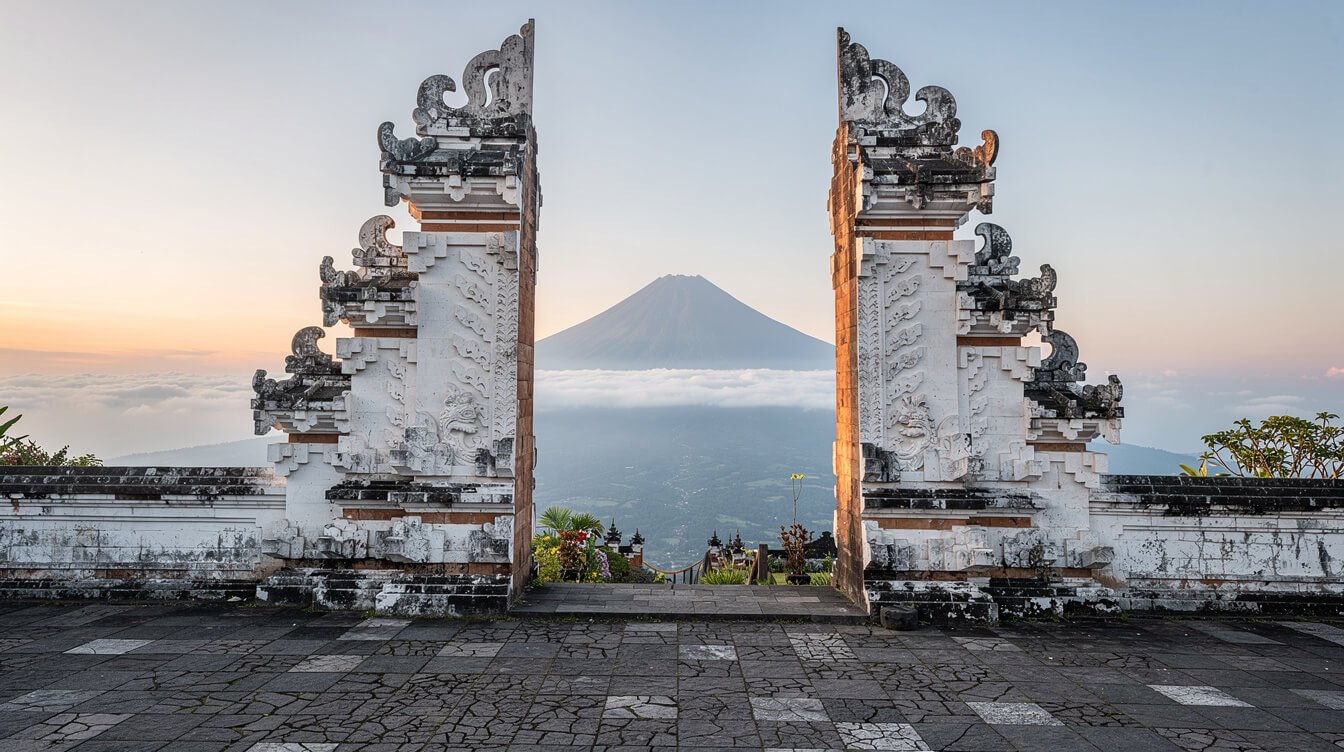
The photo you have seen is real, mostly. A white stone gate, split clean down the middle, and Mount Agung standing in the gap like it was placed there on purpose. That is the Gates of Heaven Bali image, and it comes from Pura Lempuyang, a hillside temple complex in Karangasem, about two hours east of our villa in Ubud. What the photo leaves out is the 3:30 am alarm, the numbered queue, the small mirror, and the quiet forest stairway that most visitors never start.
We send guests to Lempuyang often, and the ones who come back glowing are the ones who knew what to expect. So here is the whole picture: how to get there from Ubud, what it costs in 2026, how the queue and the photo really work, what to wear, the 1,700-step climb above the gate, the ceremony days when tourists are turned away, and how to turn a long drive into one of the best days of your trip.
Gates of Heaven Bali: What You Are Actually Looking At
Pura Lempuyang is not one temple. It is a chain of seven, strung up the slopes of Mount Lempuyang (also called Bukit Bisbis or Gamongan) in the village of Purwayu, Abang district. The famous gate belongs to the lowest of the seven, Pura Penataran Agung Lempuyang, at roughly 600 meters. The highest, Pura Lempuyang Luhur, sits around 1,000 to 1,175 meters up, depending on whose measurement you trust.
Lempuyang Luhur is one of the Sad Kahyangan Jagat, the great sanctuaries that Balinese Hindus believe hold the island in balance. It guards the east. Indonesia’s tourism board dates the complex to around the 11th century, and the name is often read as lampu (light) and hyang (god): the light of God. For the families who climb here with offerings on their heads, this is a pilgrimage first and a view second.
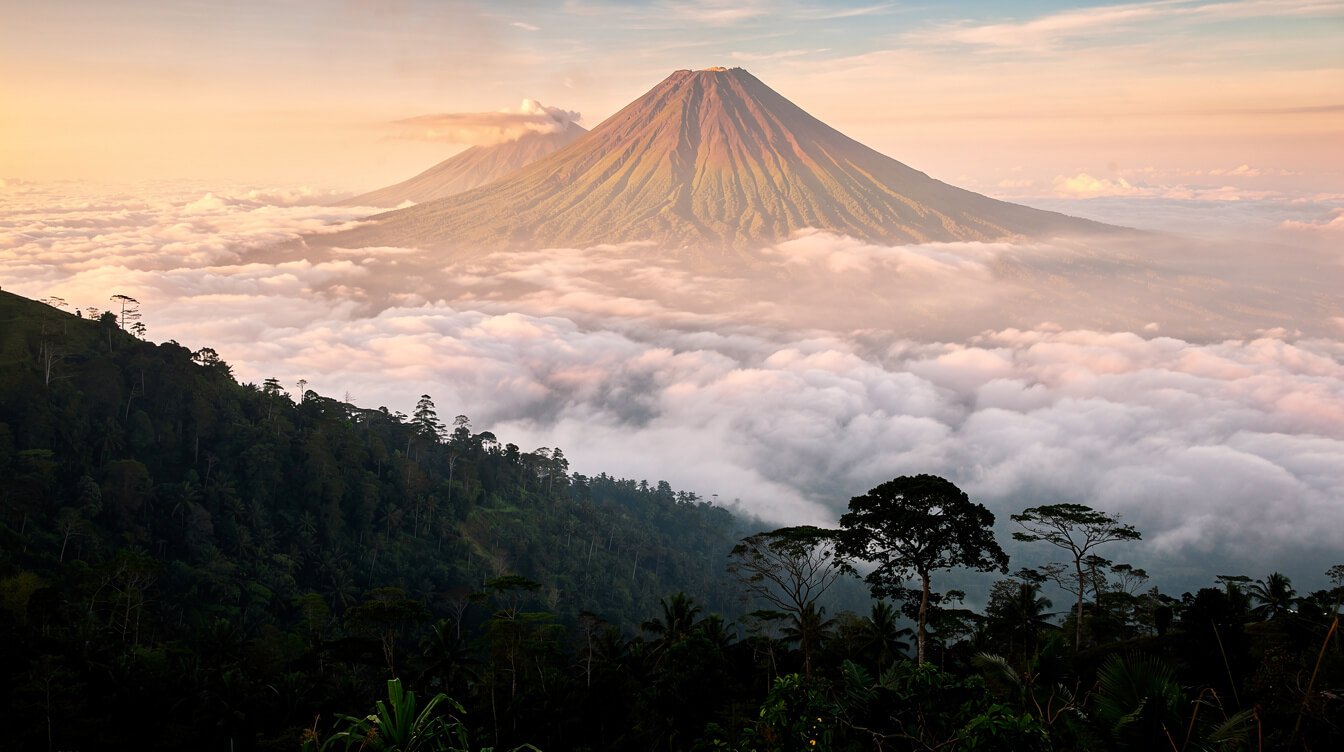
The gate itself is a candi bentar, the split gate that marks the outer entrance of many Balinese temples. You will walk through dozens of them on any day around Ubud. What makes this one different is the frame: Mount Agung, Bali’s highest and most sacred volcano at 3,031 meters, stands roughly 14 to 19 kilometers away and fills the gap perfectly on a clear morning. If you have read our guide to Mount Agung, you already know how much that mountain means here. Seeing it framed by a temple gate makes the meaning visible.
So what you are looking at is a working temple, an outer courtyard, and a sacred mountain lining up for a few hours after dawn. Hold onto that, and everything else about the visit makes more sense.
Getting There From Ubud: The 3:30 AM Question
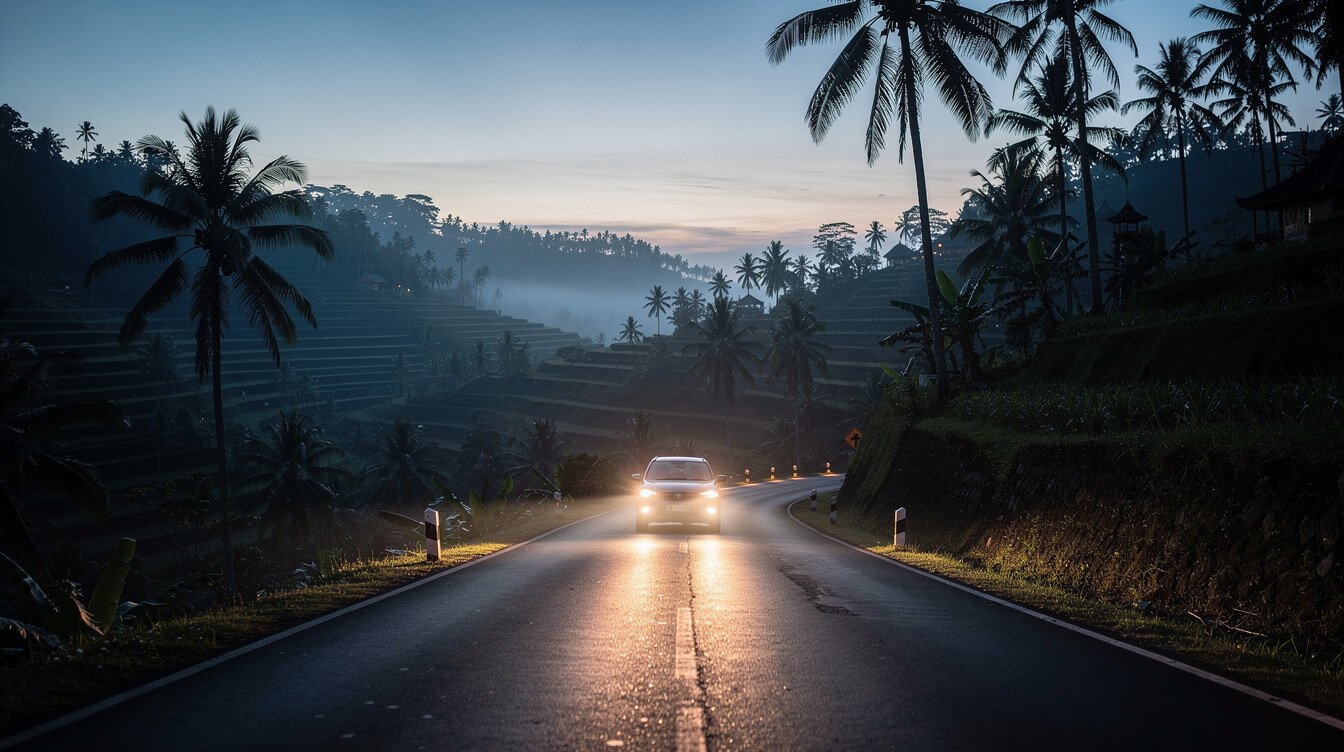
Lempuyang is about 75 kilometers from Ubud, and the drive takes around two hours in the dark, a little longer on the way home when the day’s traffic builds. There is no public transport, and the last stretch climbs steep, narrow and unlit. Almost everyone goes with a private driver, and we would suggest the same.
The timing question is the one that shapes your whole day. The clearest view of Agung and the shortest queue both come at first light. The shuttle from the lower car park is reported to start around 5 to 5:30 am, and Indonesia’s Ministry of Tourism suggests arriving before 7 am. To be at the car park around 6 am, you leave Ubud at about 3:30 to 4 am.
That sounds brutal. In practice, it is a quiet, strangely lovely drive. You doze in the back seat while villages pass in the dark, and somewhere past Klungkung the sky starts to turn grey-blue behind the hills. Pack a thermos of coffee and something small to eat the night before, so you are not hunting for breakfast at 4 am.
The softer option: spend a night in East Bali. From Amed on the coast, Lempuyang is about 30 to 40 minutes away, and from the Sidemen valley around an hour to an hour and a half. Some guests do Lempuyang on the way to Amed, then come back to us for the slower days.
Tickets, the Shuttle and the Numbered Queue in 2026
Lempuyang’s prices have changed several times since entry was by donation before 2022, and sources still disagree. Here is what recent October 2026 reports and the tourism ministry listing say, so you can budget with some margin:
- Entrance, foreign adult: about IDR 100,000 (some local sources still quote IDR 55,000 to 75,000)
- Shuttle from the main car park: about IDR 50,000 return
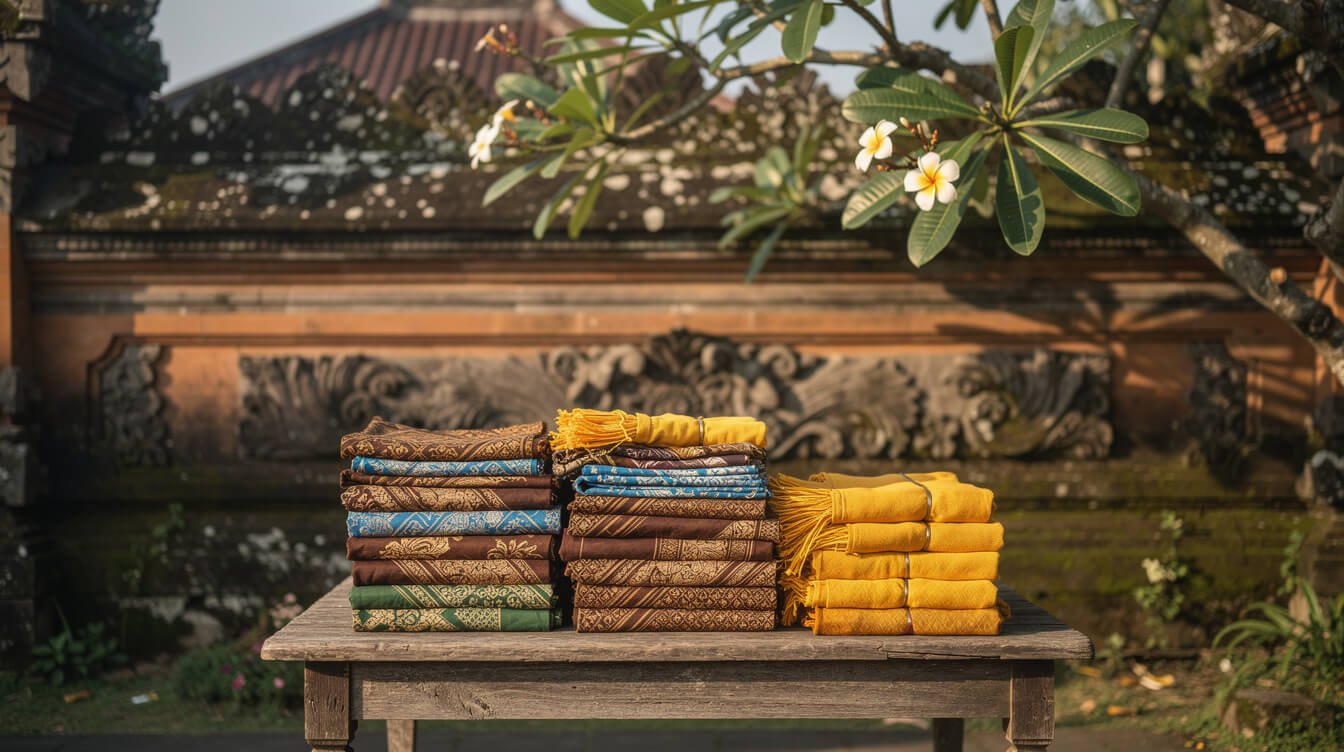
- Sarong and sash: usually included with the ticket, or IDR 10,000 to 20,000 to rent
- Photographer at the gate: no fixed price; a tip of IDR 10,000 to 20,000 is customary
- Parking: about IDR 5,000 to 10,000
Budget roughly IDR 150,000 to 200,000 per person, and bring it in cash. Card payment is unreliable on site and visitors report no ATM. Your driver will handle parking and point you to the shuttle.
Get a free 3-day sample itinerary
Three easy days from Ubud: rice field walks at first light, a temple morning, a market, and one big East Bali day trip done the gentle way. We will send you a free 3-day sample itinerary.
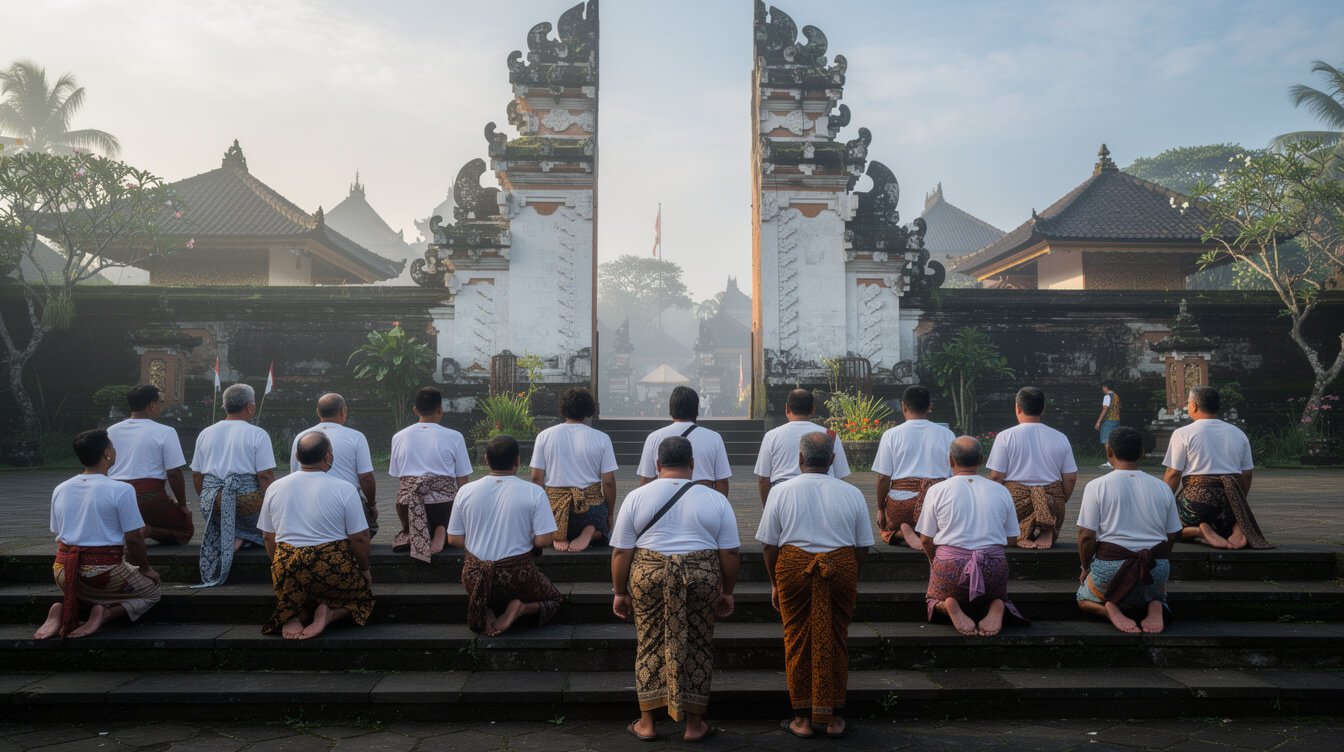
How the queue works. When you buy your ticket, you get a number. You wait in the courtyard below the gate until staff call your number, often by megaphone, in groups. When your turn comes, you hand your phone to the photographer, step into the gap, and get about a minute for three poses. Yoga poses, leg-raised poses and kissing are not allowed. This is the entrance to a temple, and the rules are there to keep it one.
Wait times vary wildly. A temple guide told the Bali news site detikBali in 2023 that busy days reached 3.5 hours and quiet days about one hour. Visitor reports from 2026 still describe 2 to 4 hours at midday. At first shuttle, you might wait 30 minutes to an hour. Late morning, you may wait hours to stand in front of white cloud.
The Mirror Trick and Your Minute at the Gate
There is no lake at the Gates of Heaven Bali made famous. There never was. The glassy reflection in nearly every photo you have seen comes from a small piece of mirror, or sometimes a second phone screen, that the photographer holds flat just under your phone’s lens. It bounces the gate and the sky back into the bottom of the frame, and the result looks like still water.
We don’t think of it as a scam. It is done openly and the photographers are locals who work the gate every day. The disappointment only comes when people arrive expecting a pond. So go in knowing, enjoy the trick for what it is, and ask for a couple of frames without the mirror. Those are the ones that show the place as it really is, and on a clear morning, Agung through the gate needs no help at all.
A few small things make your minute count:
- Decide your three poses while you wait. Standing, seated on the step, walking through. Simple and still is best.
- Wear a color that stands out from pale stone. Deep red, green or blue reads beautifully against the gate.
- Turn around. The back of the gate draws far fewer people and still makes a lovely frame, with or without the volcano.
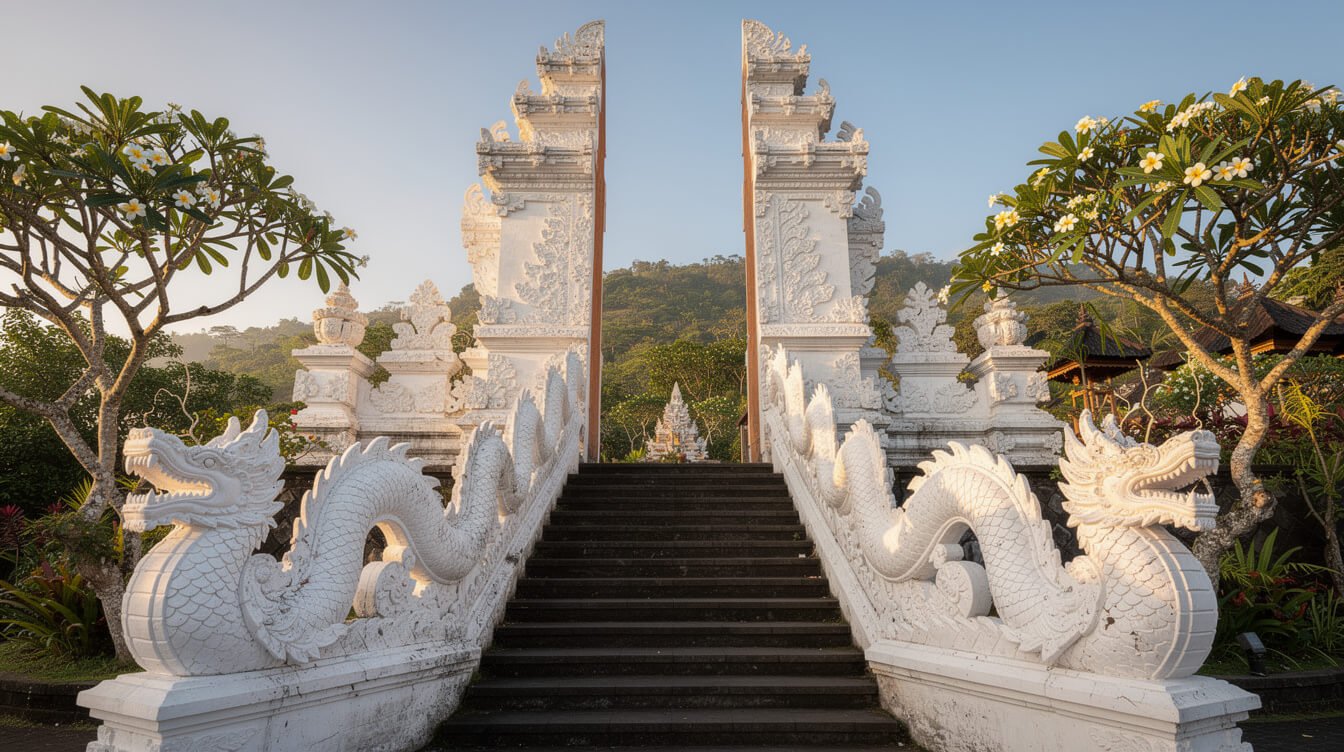
- Use the wait. Behind you, three white portals rise above staircases lined with carved naga serpents. There is no queue to look at them, and they are the finest architecture in the temple.
What to Wear, and Who Is Asked Not to Enter
Lempuyang is an active Hindu temple, and the dress code applies to everyone, men included:
- Sarong and sash (selendang) for every visitor, provided or rented at the entrance. If you have your own from a temple day in Ubud, bring it.
- Shoulders covered. A t-shirt is fine. A tank top is not.
- Shoes with grip if you plan to climb beyond the gate.
- A light layer. At 600 meters and higher, dawn is noticeably cooler than Ubud, and the upper temples are cooler still.
- No pork in the temple area, and that includes the snack in your bag.
As in most Balinese temples, and as the tourism ministry states for Lempuyang specifically, some people are asked not to enter the main temple area: women who are menstruating, people in cuntaka (a period of ritual impurity, for example after a death in the family), breastfeeding mothers, and young children who still have their milk teeth. It is a matter of respect rather than enforcement. We mention it so you can decide for yourself before a two-hour drive. If the Balinese way of seeing the sacred interests you, our guide to religion in Bali goes deeper.
Keep your voice low near shrines, never sit or stand higher than a priest or an offering, and give pilgrims the right of way. Locals ask one more thing of visitors who climb: don’t complain on the way up.
Beyond the Gate: The 1,700 Steps to Lempuyang Luhur
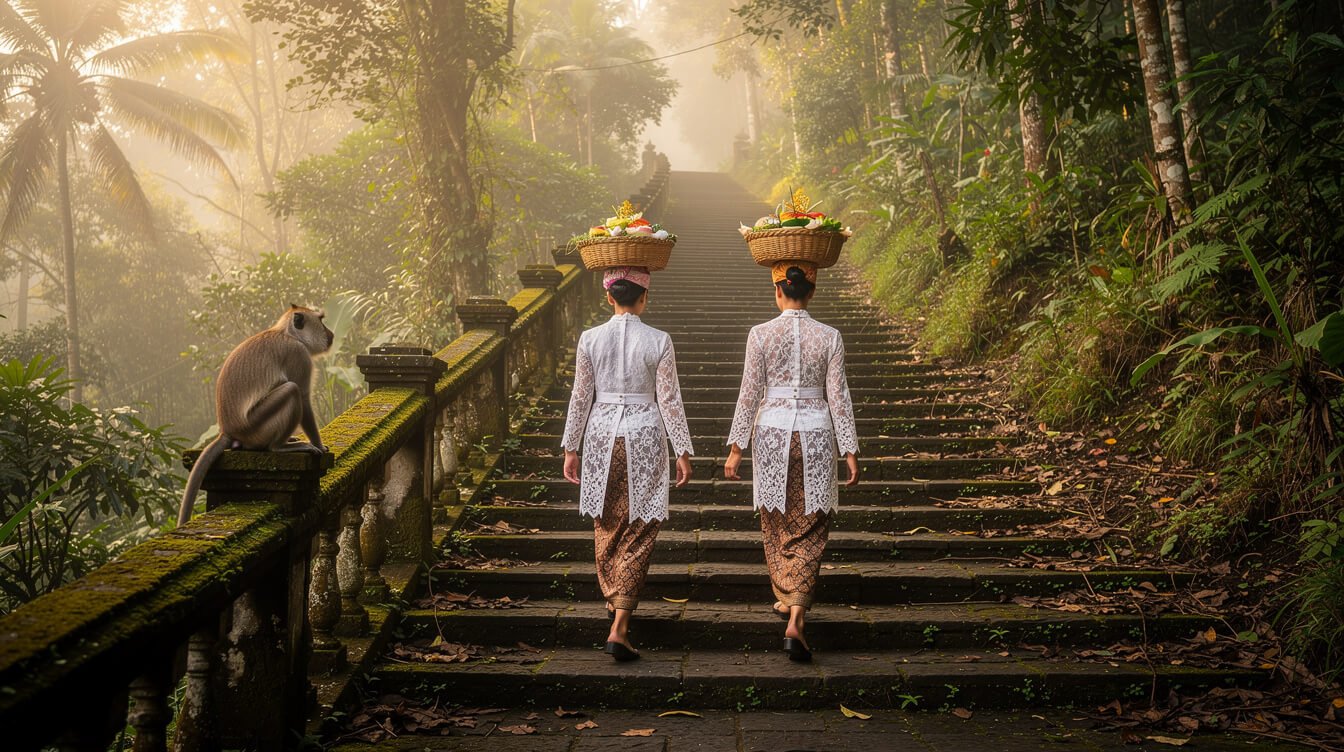
This is the part of Lempuyang almost nobody talks about, and the part many of our guests remember longest. Past the gate, a steep lane and then a stone stairway of roughly 1,700 steps climb about 2.5 kilometers through forest to Pura Lempuyang Luhur, nearly 460 meters higher. Along the way you pass the smaller temples of the complex: Telaga Mas, Telaga Sawang, Lempuyang Madya, Puncak Bisbis and Pasar Agung.
The queue noise falls away within a few minutes. You hear your own breath, birds, the scuff of sandals on mossy stone. Balinese families pass you in white temple dress, baskets of offerings balanced on their heads, sometimes grandmothers climbing faster than you are. At the top, there are few tourists, cool air, incense, and on a clear morning a view across all of Karangasem.
Plan honestly for it:
- Time: 1.5 to 2 hours up for a fit walker. Allow 3 to 4 hours for the round trip from the gate, with stops.
- Terrain: steep, uneven, and slippery after rain. In November’s wet season, take that seriously.
- Water: carry at least 1.5 liters. Stalls along the way sell drinks and snacks, and prices rise as you climb.
- Monkeys: long-tailed macaques live along the upper path and snatch drinks, snacks, sunglasses and hats. Zip everything away and never feed them.
- Guides: village guides offer to accompany the climb. We found no 2026 source that makes one compulsory, so ask at the ticket desk on the day.
If your knees dislike stairs or your time is short, the gate alone is a full visit. If you love a dawn effort, you might also enjoy our guide to the Mount Batur sunrise trek, which is the other great early start from Ubud.
Book the Villa
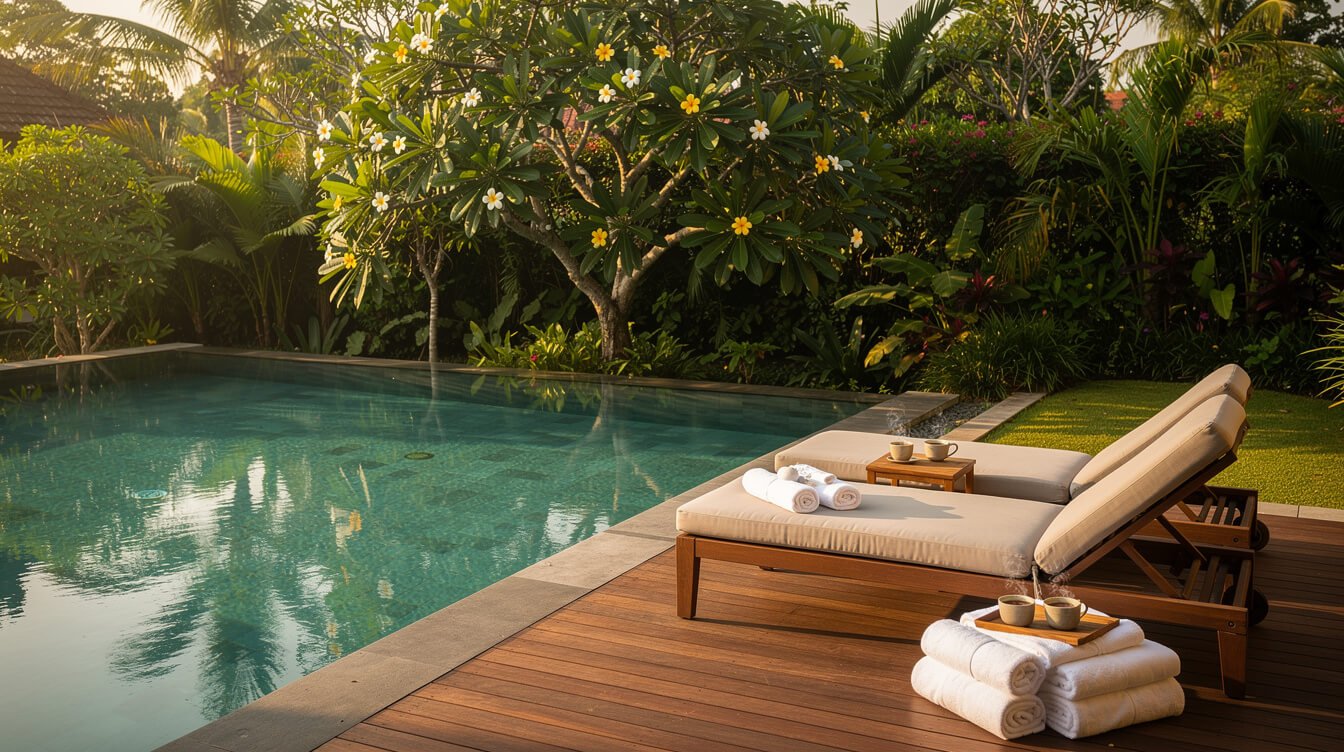
After a 3:30 am start, come home to three bedrooms, a private pool and a quiet tropical garden in Ubud, with a team on hand so the rest of your day stays unhurried. Check availability for your dates.
When to Go: Seasons, Ceremonies and Closure Days
Season. The dry season, roughly April to October, gives you the best chance of a clear Agung. In the wet season, which runs November to March, dawn can still be beautiful, but clouds often cover the summit by mid-morning and sometimes all day. If you are visiting now, read our guides to Bali weather in November and December and keep Lempuyang flexible. Pick a morning after a dry evening, and be ready to swap days.
Time of day. Dawn, without question. Late afternoon can have shorter queues, but Agung is more often hidden, and tourist hours are listed as 7 am to 5 pm, so you will not stay for sunset.
Ceremony closures. This is the detail that catches people out. The temple closes to tourists for about five days around each pujawali, its anniversary ceremony, which comes around every 210 days on the Balinese pawukon calendar and lines up with Galungan. It was closed 19 to 23 November 2025 and 17 to 21 June 2026. By the same 210-day count, the next closure should fall around 13 to 17 January 2027, beginning on Galungan. Worshippers are still welcome; tourists are turned back at the gate by the village security. If your trip lands that week, check with us before you plan the drive, and enjoy Galungan’s bamboo penjor in Ubud instead.
Building the Day: Tirta Gangga, Sidemen and the Slow Road Home
Two hours each way is a lot for one photo, even the Gates of Heaven Bali photo. It is not a lot for a whole day in East Bali, which feels completely different from Ubud: drier hills, wider views, fewer cafes, more open sky. Here is the order we usually suggest to guests:
- Lempuyang at dawn, for the clearest view and the shortest queue. Add the climb if you have the legs.
- Tirta Gangga mid-morning, about 30 to 40 minutes away. Stepping stones, koi, fountains, and a spring-fed pool you can swim in. Our Tirta Gangga guide covers tickets and timing.
- Lunch in Sidemen, a rice valley with Agung rising above the terraces, or by the sea toward Amed or Candidasa.
- Taman Ujung, the seaside water palace, if you still have energy, or straight home for an afternoon swim.
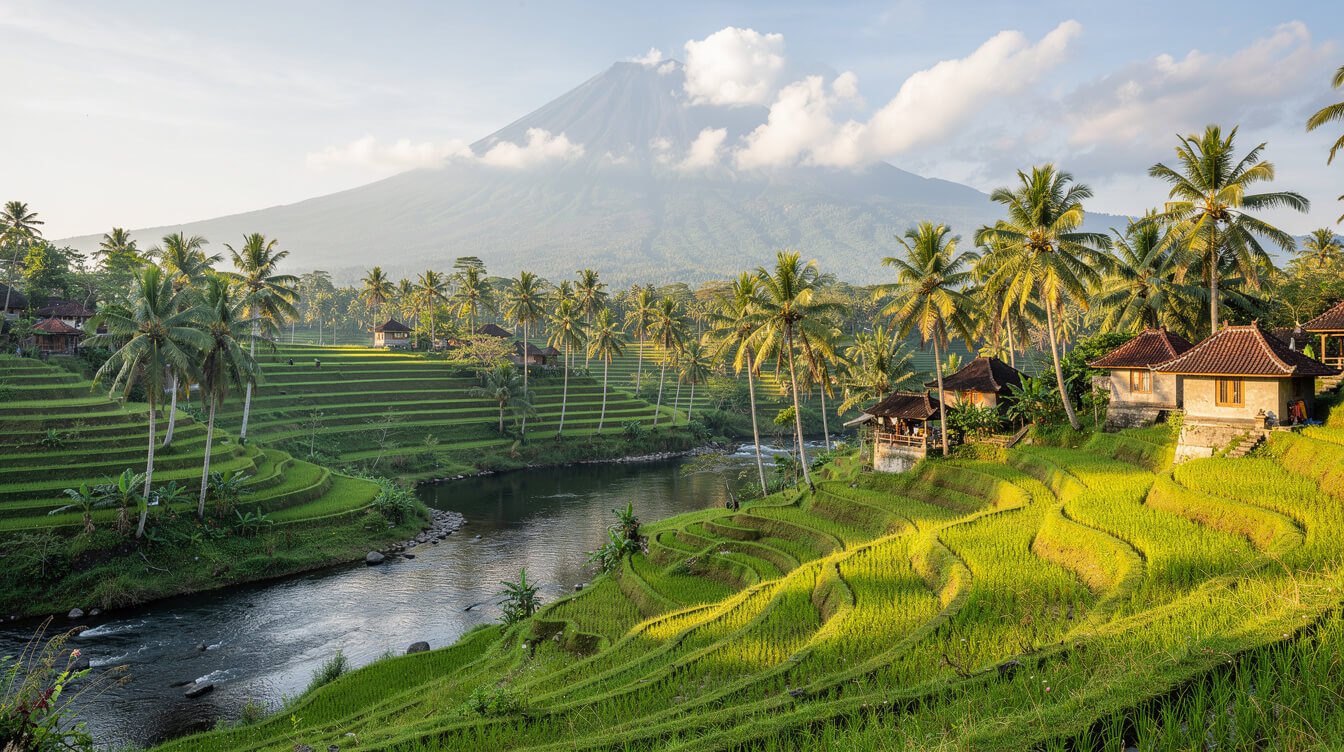
Most guests are back at the villa by mid-afternoon, a little sun-tired and very happy, with the rest of the day to swim, nap, and eat dinner on the terrace. For more ideas, our list of day trips from Ubud covers the rest of the island.
Frequently Asked Questions
Is the Gates of Heaven in Bali worth visiting?
Yes, if you go at dawn and know what to expect. Mount Agung through the gate on a clear morning is unforgettable, and Lempuyang is one of Bali’s most important sanctuaries. If you arrive late, expect a long queue and possibly a cloud-covered volcano. Pairing it with Tirta Gangga makes the drive worthwhile.
Is the reflection at the Gates of Heaven real?
No. There is no water in front of the gate. The reflection comes from a small mirror held under your phone’s lens by a local photographer. The gate and the mountain are real; only the water is not.
How far is the Gates of Heaven from Ubud?
About 75 kilometers, or roughly two hours by car each way. To arrive near first light, you leave Ubud around 3:30 to 4 am.
How much does Lempuyang Temple cost in 2026?
Recent reports list about IDR 100,000 for foreign adults, though some sources quote less, plus about IDR 50,000 for the return shuttle and a small tip for the photographer. Budget IDR 150,000 to 200,000 per person in cash.
How long is the queue for the Gates of Heaven photo?
Anywhere from 30 minutes at first shuttle to 3 or 4 hours at midday on busy days. Arriving before 7 am gives you the shortest wait.
Can I visit the Gates of Heaven Bali in the rainy season?
Yes. The temple stays open, but clouds often hide Mount Agung by mid-morning between November and March. Go at dawn, stay flexible on the day, and skip the upper climb if the steps are wet.
When is Lempuyang Temple closed to tourists?
For about five days around each pujawali ceremony, every 210 days. Recent closures were 19 to 23 November 2025 and 17 to 21 June 2026. The next is expected around 13 to 17 January 2027. Confirm before you go.
Final Thoughts
The Gates of Heaven Bali is two places at once. One is a minute in front of a camera, a small mirror, a famous frame. The other is a seven-temple mountain where Balinese families have climbed with offerings for centuries, and where the volcano in the gap is not a backdrop but the point. Go at dawn, bring cash and patience, take the mirror photo and the honest one, and if your legs allow, keep climbing past the crowd. The quiet starts a few hundred steps up.
Then come home to Ubud, slip into the pool, and let the early start catch up with you. That part, we can promise, is easy.

Join our newsletter — fun, new, exciting Bali news
Ceremony days, market finds, new trails and small stories from Ubud. Delivered now and then, always worth opening.