How Far Is Ubud from Seminyak: Your Complete Transport Guide Plus What Changes When You Arrive
How far is Ubud from Seminyak? Door to door, it’s roughly 28 kilometers — but the real answer has less to do with distance and more to do with what changes along the way. On a clear afternoon with light traffic, the drive takes about an hour. On a Friday evening in high season, closer to ninety minutes, sometimes more. Either way, you’re not just crossing kilometers. You’re crossing from one Bali into another.
We get asked this question every week, usually from guests planning a few days on the beach before they come stay with us in the rice fields, or the reverse — people who’ve had their fill of Ubud’s quiet and want two nights of Seminyak’s beach clubs before they fly home. So here’s the honest version: the numbers, the transport options, what the drive actually feels like, and why some of our guests end up flipping their itinerary once they’ve made the trip. If you’re still mapping out the rest of the island, our complete Bali travel guide is a good place to see how this route fits into a wider trip.
How Far Is Ubud from Seminyak? The Quick Answer

The distance between Seminyak and Ubud is about 25 to 30 kilometers depending on exactly where you’re starting and ending — a beachfront villa in Petitenget versus a hotel near Ubud’s Monkey Forest will shave off or add a few kilometers either way. Drive time is the number that actually matters, and it swings more than the distance does:
- Off-peak (early morning or midday): 60–75 minutes
- Standard traffic: 75–90 minutes
- Friday afternoon, Sunday evening, or holiday weekends: 90 minutes to 2 hours
Bali doesn’t have highways connecting these two towns — you’re on two-lane roads through Kerobokan, Mengwi, and Sayan, threading past temple ceremonies, school traffic, and the occasional cow crossing without much urgency. Google Maps will give you a number. Add twenty minutes to it and you’ll be closer to the truth.
A few things that make the trip longer than the map suggests: Nyepi eve and the days around a full moon ceremony can close roads through certain villages entirely, school pickup around 1–2pm slows anything passing through Mengwi, and the stretch through Kerobokan is essentially Bali’s version of rush-hour gridlock from 4–7pm most weekdays. None of this is a reason to avoid the trip — it’s just worth building into your plans rather than discovering it in the back of a Grab car with a flight to catch.
Transport Options Compared: Private Driver vs Grab vs Shuttle
You have three realistic ways to make this trip, and each one changes the experience, not just the cost.
Private driver
This is what we arrange for almost every guest, and it’s the option we’d choose ourselves. A private driver costs somewhere between 350,000 and 550,000 IDR one way depending on the vehicle and how far in advance you book, and the difference is comfort and flexibility — air conditioning that actually works, a driver who knows to avoid the worst of the Canggu bottleneck, and the freedom to stop wherever you want along the way. Book a driver for the full day rather than a one-way transfer, and the per-hour cost drops considerably if you’re planning to make stops.
Grab or Gojek
The ride-hailing apps work for this route and will usually run you 150,000 to 250,000 IDR, roughly half the cost of a private driver. The tradeoff: some drivers won’t take long inter-town fares and will cancel once they see the destination, cancellations happen more often on this route than on short in-town hops, and you’re in whatever car shows up — sometimes a compact hatchback with a trunk that barely fits two suitcases. If you’re traveling light and flexible on timing, it’s a perfectly reasonable way to go.
Shuttle or shared van
Shared shuttles run scheduled routes between Seminyak and Ubud for as little as 100,000–150,000 IDR per person. They’re the budget option, but you’re on their schedule, not yours, and you’ll likely make two or three stops to pick up or drop off other passengers before you get where you’re going. Perisai and Kura2 Shuttle both run this route several times daily if you want to book ahead.
Renting your own scooter or car
Some guests ask about self-driving. We’d steer most first-time visitors away from this particular route — Bali’s traffic patterns take some acclimating to, an international driving permit is legally required, and the stretch through Kerobokan in late afternoon is not where you want to be learning Balinese traffic etiquette for the first time. If you’re an experienced rider who already knows Bali roads, a scooter can be genuinely enjoyable for the more open stretches near Mengwi, but we’d still recommend a driver for your first pass at this route.
Our honest take: unless you’re traveling solo on a tight budget, a private driver is worth the extra rupiah. You’ll stop when something catches your eye, and you’ll arrive without having negotiated a fare on your phone with a screaming toddler in the back seat.
What the Journey Actually Looks Like (and Worth-It Stops Along the Way)
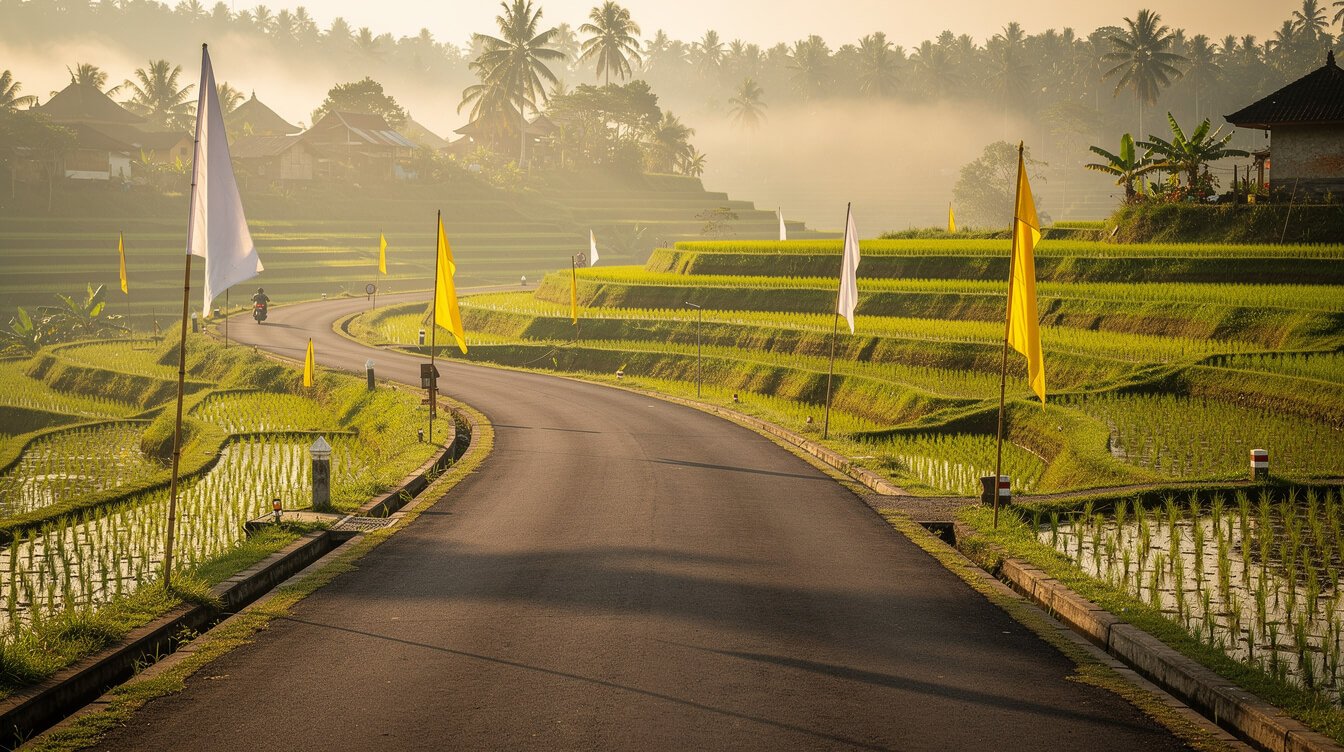
The first twenty minutes out of Seminyak look like most beach towns anywhere — surf shops, beach clubs, motorbikes three deep at every light. Around Kerobokan, the roads widen slightly and the villas start to space out. By the time you pass through Mengwi, rice fields begin showing up between housing compounds, and the temple flags start to outnumber the billboards.
A few stops worth building into the drive if you have the time:
- Tanah Lot or Taman Ayun Temple — a short detour if you haven’t seen either yet; Taman Ayun is quieter and less crowded than most temple stops, and its moated grounds make for an easy 30-minute wander.
- Jatiluwih or Tegalalang rice terraces — Tegalalang is closer to Ubud and easy to fold into the last leg of the drive; Jatiluwih is further out of the way but considerably less crowded if you have a full day to spend.
- A roadside warung — ask your driver where they’d actually eat. It’s almost always better than the tourist-facing cafés with the laminated menus, and usually a fraction of the price.
- Small woodcarving or silver villages around Mas and Celuk, if you like watching craftspeople work rather than just buying the finished piece.
- A coffee stop in Mengwi or Sayan — both towns have small local coffee shops worth ten minutes if you want to stretch your legs before the last winding stretch into Ubud.
None of these add more than 20–30 minutes if you’re selective, and they turn a transfer into something closer to a proper afternoon. We’d rather see guests treat this as a small day trip in its own right than as dead time between two hotel check-ins — and once you’re settled in Ubud, our guide to things to do in Ubud covers plenty more worth carving out time for.
Get a free 3-day sample itinerary
Tell us what kind of stay you’re picturing and we’ll send a sample 3-day Ubud itinerary — rice fields, temples, and the slow mornings that make the trip worth it.
What Changes When You Arrive in Ubud: The Sensory Shift
This is the part that doesn’t show up on a map. Somewhere around Sayan, the road narrows, the valley opens up, and the air changes — literally cooler, thanks to Ubud’s elevation, and thick with the green smell of wet rice fields instead of salt and sunscreen. The soundtrack shifts too: beach club bass gives way to roosters, running water, and — if you time it right — gamelan practice drifting up from a village banjar at dusk.
Guests who’ve spent a few nights in Seminyak often tell us the same thing when they arrive: their shoulders drop. Not metaphorically — you can watch it happen on the pool deck within the first hour. Seminyak asks something of you: to be seen, to be out, to keep pace. Ubud doesn’t ask anything. Mornings start slow here. Made will have coffee and fresh fruit out on the deck before most guests are even awake, and there’s no music competing with it, just the gardener working somewhere out of sight and the sound of water moving through the pool’s edge.
The light changes too. Seminyak’s afternoon glare off the ocean gives way, by the time you reach Ubud, to the softer green-gold light that filters down through jungle canopy and rice stalks. Evenings arrive earlier here, in a way — not because the sun sets sooner, but because the pace of the day slows down to meet it. A 6pm walk through the village feels unhurried in a way it rarely does along the beach roads.
It’s not that one town is better than the other — they’re built for different moods. But the shift between them is real enough that we tell guests to expect it, rather than be surprised by it.
The Case for Doing It in Reverse: Ubud as Base, Seminyak as Day Trip
Most itineraries treat Ubud as the side trip — a couple of nights inland before heading back to the beach. We’d gently argue for flipping that. Base yourself in Ubud for the bulk of your stay, and treat Seminyak as a single day (or evening) out, rather than the other way around.
Here’s why it tends to work better:
- You keep your peace and still get your beach day. A day trip down to Seminyak for lunch, some shopping, and sunset at a beach club gives you the full experience without needing to pack and unpack twice.
- Ubud is a better place to actually live in for a week. A private villa with a full kitchen, a chef, and a garden gives you somewhere to return to and recover, rather than another hotel room in a different postcode — our guide to where to stay in Ubud walks through what to look for.
- The drive feels different depending on direction. Arriving into the quiet of Ubud after a loud day at the beach feels like exhaling. Arriving into Seminyak’s energy after a week of stillness can feel like the opposite — jarring rather than exciting, for a lot of our guests.
- You avoid checking out twice. Splitting a week evenly between two towns means two packing days, two check-ins, and two sets of new staff or hosts to get oriented with. Staying put and day-tripping cuts that logistics tax in half.
And Seminyak isn’t the only beach option from here — if you’d rather explore the coast without relocating, our roundup of day trips to Bali’s beaches from Ubud covers a few closer alternatives too.
If you only have five or six nights in Bali, we’d suggest four or five of them here, with one day carved out for Seminyak, rather than splitting your stay evenly and packing twice. For longer stays of ten days or more, two or three nights in Seminyak at the front or back end of the trip can work well — just not sandwiched in the middle, where it interrupts the rhythm you’ve settled into.
How We Arrange the Transfer for Our Guests
We handle this door-to-door for anyone staying with us, whether you’re arriving from Seminyak, a hotel near the airport, or coming straight off a flight. The team confirms your pickup time and location, books a driver we already trust, and lets you know roughly what the drive will look like that day given traffic and any temple ceremonies happening along the route (these close roads without warning, and locals plan around them — we do too).
If you want to build in stops — a temple, the rice terraces, lunch somewhere that isn’t in a guidebook — tell us in advance and we’ll build it into the route rather than leaving it to chance. It’s one less thing to plan before you’ve even landed. And if your flight lands late or plans shift, message the team directly rather than the driver — we’ll handle the adjustment on our end.
For guests doing a Seminyak day trip partway through their stay, we can arrange the same driver for a return trip later in the week, so you’re not re-explaining your preferences to someone new each time.

Book the Villa
Wherever your Bali trip starts, this is where it can slow down — three ensuite bedrooms, a full team, and a garden that does the rest.
Ubud vs Seminyak: Which Bali Should You Choose?
If you’re still deciding where to spend most of your trip, it usually comes down to what you’re actually looking for:
Choose Seminyak if: you want beach clubs, nightlife, boutique shopping, and the energy of being around a lot of other travelers. It’s Bali as a scene.
Choose Ubud if: you want rice fields, temple ceremonies you can hear from your terrace, slower mornings, and a place that feels like it belongs to Bali rather than to tourism. It’s Bali as a place to actually be. If you’re weighing Ubud against Bali’s other inland-adjacent hub, our Ubud vs Canggu comparison covers that trade-off too.
A few quick answers to what guests usually ask next:
Can I do Ubud as a day trip from Seminyak instead? You can, but we’d steer against it — three hours round-trip in a car for a few hours in Ubud undersells both towns. If Ubud only fits as a day trip in your schedule, at least give it a full day rather than a rushed half-day loop.
Is there a faster way between them? Not really — no toll road connects the two towns yet, though one has been discussed for years. For now, the two-lane route through Mengwi is the only practical option.
What time should I leave to avoid traffic? Before 9am or after 8pm gives you the clearest roads in either direction. Midday is manageable; late afternoon is the one window worth actively avoiding.
Most people don’t need to choose completely — that’s what the transfer is for. But if we’re being honest about which one guests tend to remember more clearly a year later, it’s usually the mornings in the rice fields, not the afternoon at the beach club. That’s not a knock on Seminyak. It’s just what tends to stay with people.
Whichever way you’re making the trip, the road between them is part of the story, not just the logistics. Give it the hour and a half it deserves, make a stop if you can, and let the valley do the rest when you arrive.

Join our newsletter — fun, new, exciting Bali news
A letter from Bali, now and then — what’s blooming, what’s in season, and what’s new around the villa.