How to Travel Through Bali: A Route-by-Route Guide From Coast to Rice Field
Most Bali guides treat the island as a list — a dozen places to visit, ranked and reviewed, with no sense of how one connects to the next. But the best way to travel through Bali isn’t a checklist. It’s a route: a south-to-north arc that starts at the beach, climbs through rice country, and ends somewhere near a volcano, with the landscape and the pace of your days changing the whole way. This guide follows that arc — coast to rice field to highland — so you can plan a trip that actually flows, instead of a string of disconnected stops linked by traffic.
Why “Through” Changes Your Bali Trip
Most first-time visitors pick one base and day-trip everywhere from it, which works, but it flattens an island that actually has real geographic range — surf towns, terraced farmland, misty highlands, and a volcanic spine, all within a few hours of each other. Treating Bali as a route instead of a single base means each leg of the trip has its own character: the energy of the south coast gives way to the quiet of the interior, which gives way to the cooler air and slower rhythm of the north.
This matters most for how you pack your days. A single-base trip means longer round-trip drives for anything outside your immediate area. A route-based trip means you’re never more than 30-45 minutes from what’s around you, because you keep moving toward it. The tradeoff is packing and unpacking a few more times — worth it if you have 7+ days and want to actually feel the island change under you, less worth it if you have 4 days and want to go deep in one place instead.
It also changes how you experience distance. Bali is a small island — you could technically drive from the southern beaches to the northern volcanoes in half a day — but Balinese roads rarely move as fast as the map suggests. A route built around that reality, with a few nights at each stop rather than long day trips back and forth, tends to feel far less rushed than the same ground covered from a single base, even though the total distance traveled ends up similar.
South Coast: Seminyak, Canggu, Uluwatu — Days 1-3
Almost every route through Bali starts here, simply because the airport is here. Seminyak brings polish — beach clubs, restaurants, boutique shopping — while Canggu, just north, has the surf-and-coffee-shop energy that draws digital nomads and long-stay travelers. Further south, Uluwatu’s clifftop temples and world-class breaks are worth the extra drive if surfing or dramatic coastline are on your list.
Two to three days here is usually enough to shake off jet lag, get a feel for Balinese beach culture, and decide how much of that energy you actually want for the rest of the trip. Most travelers find the south is best experienced early, while you’re still adjusting — by day three, the traffic and the crowds start to feel like a reason to move on rather than a reason to stay.
What to prioritize if time is short
One sunset at Uluwatu, one proper beach club afternoon in Seminyak or Canggu, and one meal that isn’t at your hotel. Skip trying to see all three towns in depth — pick the one or two that match your trip’s energy and let the rest go.
Choosing between Seminyak, Canggu, and Uluwatu
Seminyak suits travelers who want polish without a long drive from the airport — restaurants, spas, and shopping within walking distance of most hotels. Canggu, twenty minutes further north, trades some of that polish for a more relaxed, creative energy — this is where you’ll find the co-working cafes, the yoga studios stacked three to a block, and a surf break gentle enough for a first lesson. Uluwatu is the outlier: less nightlife, more cliffside quiet, and a temple at sunset that’s worth the extra hour of driving on its own. If you’re only choosing one, Canggu gives the broadest taste of south-coast Bali; Uluwatu gives the most dramatic single day.
What a typical south-coast day costs
Budget travelers can eat well for the price of a coffee back home at a local warung, while a beach club day with a lounger and a few drinks runs considerably more. The range is wide enough that the south coast can suit almost any budget — the trick is deciding upfront how much of your trip you want to spend on beach-club afternoons versus saving that budget for the villa stay and staffed comforts waiting inland.
The Drive Inland: What Changes
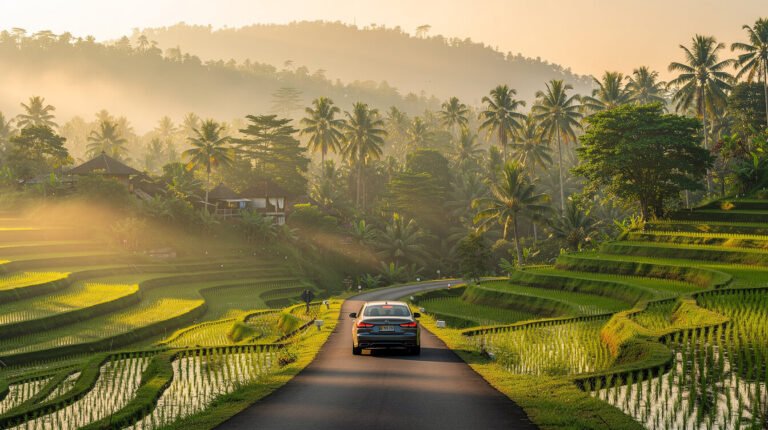
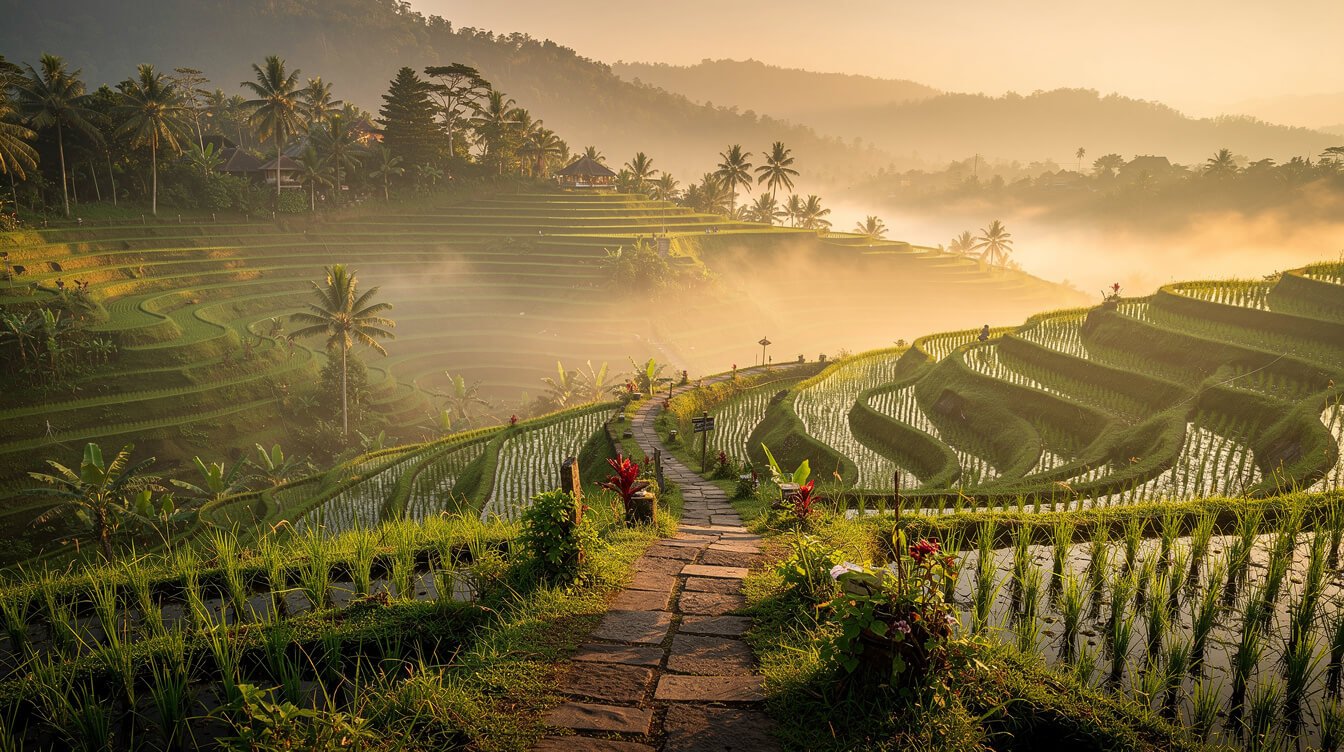
The drive from the south coast to Ubud is short on the map — under two hours without traffic — but it’s where the island genuinely changes. Concrete gives way to green within the first thirty minutes. Rice terraces start appearing on both sides of the road, temples become more frequent, and the traffic thins into something closer to village pace. This is the drive where most travelers first understand why people talk about Bali’s interior differently than its coast.
If you have the flexibility, break this drive up rather than powering through it. Tegalalang’s rice terraces sit almost exactly on the route and make a natural halfway stop. A short detour to a roadside warung for lunch — the kind with plastic chairs and better food than most tourist restaurants — is a good way to arrive in Ubud already feeling like you’ve left the coast behind, not just changed hotels.
Signs you’ve left the coast behind
The traffic sounds change first — fewer motorbike horns, more roosters. Then the roadside stalls shift from surfboard rentals to fruit stands and offerings-makers weaving palm-leaf baskets for the next ceremony. By the time you can see terraced rice fields on both sides of the road at once, you’ve crossed whatever invisible line separates Bali’s coast from its interior. Most travelers notice this shift happens faster than they expected — often within the first hour of the drive, well before Ubud itself comes into view.
Get a free 3-day sample itinerary
Not sure how to break your route into legs? We’ll send you a sample 3-day Ubud itinerary, built the way we’d plan it for our own guests.
Ubud Cultural Heartland — Days 4-7
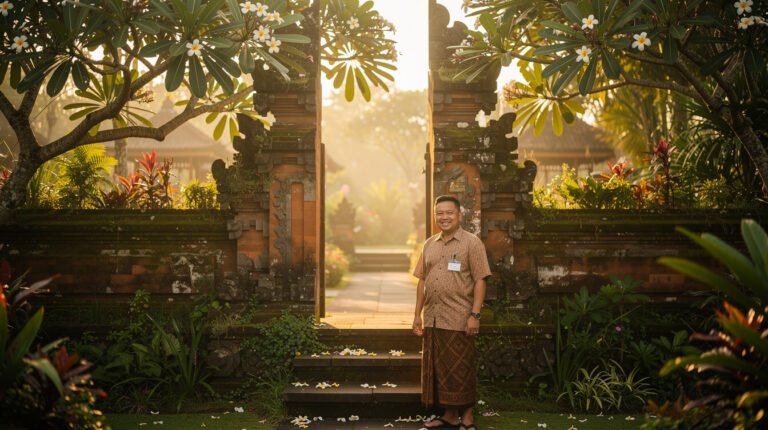
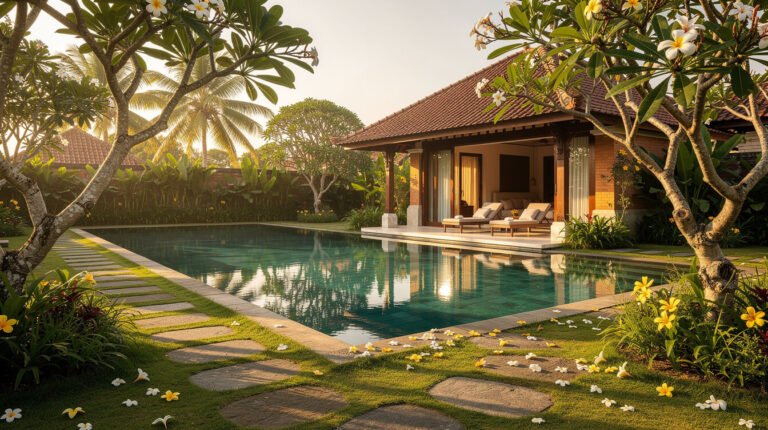
Ubud is where most route-based trips slow down, and it deserves the extra days. This is Bali’s cultural and spiritual center — temples, traditional dance performances, art markets, and the rice terraces the island is famous for, all within a compact, walkable core. It’s also where staying somewhere staffed, private, and quiet makes the biggest difference to how the days actually feel, since Ubud rewards slow mornings as much as it rewards sightseeing.
A useful four-day rhythm here: one day for the classic sights (Monkey Forest, Saraswati Temple, the art market), one day for rice terraces and a village walk at your own pace, one day for something active (cycling, a cooking class, a spa afternoon), and one day with genuinely nothing planned. Guests who build in that unplanned day consistently say it’s the one they remember best — the villa pool, the garden, the sound of the neighborhood in the afternoon.
For a tighter version of this stretch, our 3-day Ubud itinerary covers the same ground in a more condensed form if your route needs to move faster.
Where the route earns its detours
Ubud is also the natural hub for half-day detours that don’t require repacking: Tegenungan waterfall in the morning, the Campuhan Ridge walk at golden hour, a cooking class that turns the morning market run into that night’s dinner. Because these are all thirty minutes or less from most Ubud stays, they fit into the same “unplanned day” without turning it into another full travel day — which is exactly the advantage of routing through Ubud rather than day-tripping into it from the coast.
What changes about mealtimes here
South coast dining skews international — pizza, poke bowls, smoothie bars built for a beach-town crowd. Ubud’s food scene leans back toward Balinese and Indonesian cooking, with a wellness-cafe layer on top of it. It’s the easiest place on the route to eat well without trying — warungs serving nasi campur a few steps from your stay, and a villa kitchen that can turn out a full Balinese meal without you ever needing a reservation.
North: Volcanoes, Hot Springs — Days 8-10
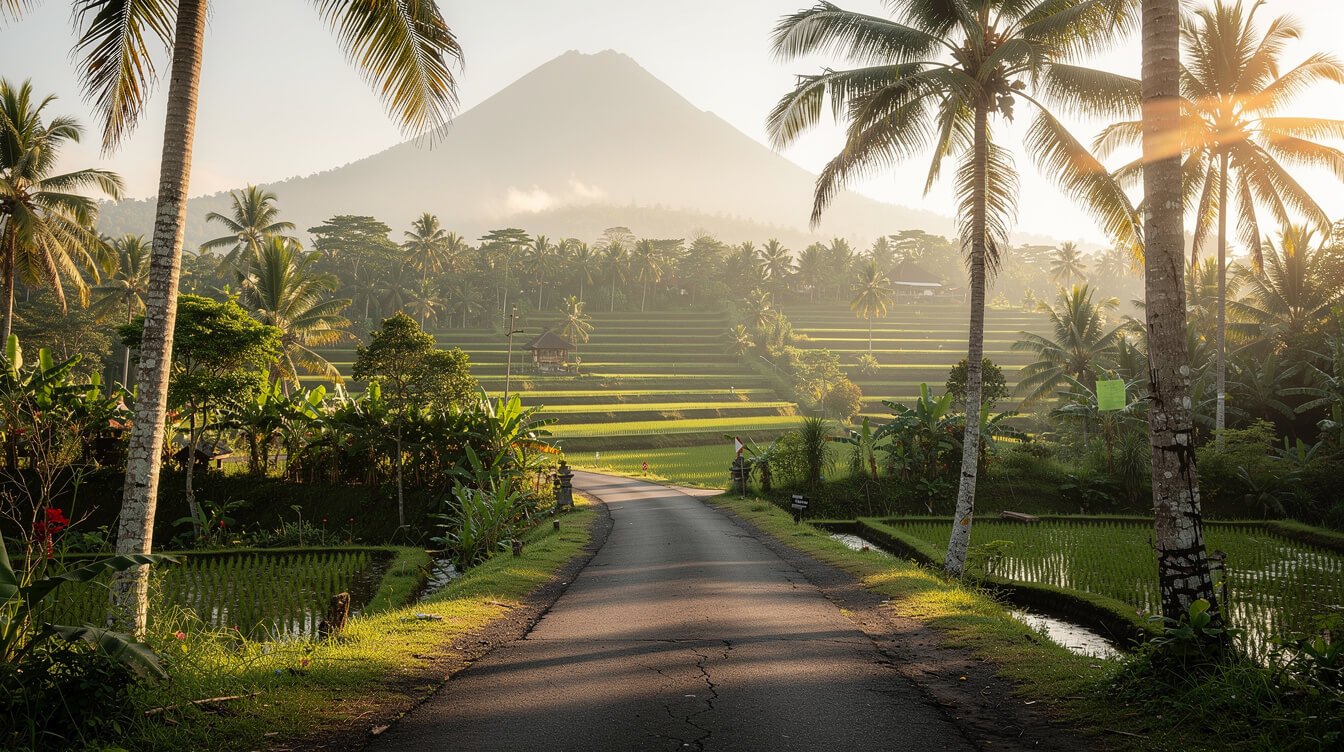
Continuing north from Ubud, the landscape climbs and cools. Mount Batur’s sunrise trek is the main draw — a pre-dawn hike rewarded with a crater-rim view over the clouds — and it pairs naturally with the nearby hot springs, where a soak afterward undoes most of the ache from the climb. Lake Batur and the surrounding highland villages have a different, quieter energy than anywhere else on the route: cooler air, fewer visitors, and a landscape that looks more like a volcanic caldera than a tropical postcard.
This is the leg of the route most travelers skip when they’re short on time, and it’s genuinely the biggest loss if you do — nowhere else on the island feels quite like it. Even a single overnight up here, timed around the sunrise trek, is worth the detour from an otherwise Ubud-and-coast trip.
What the sunrise trek actually involves
Pickup times are brutally early — usually around 2am — for a two-hour climb that puts you on the crater rim just as the sky starts to lighten. Guides cook eggs on the volcanic steam vents near the summit, which sounds like a gimmick until you’re eating them at altitude, watching the sun come up over Lombok in the distance. The descent is faster but harder on the knees than the climb up, and by mid-morning you’re usually back at the hot springs, which is where the whole effort stops feeling like exercise and starts feeling like the reward.
Who should skip this leg
Anyone traveling with young children, anyone with real mobility limitations, or anyone who simply can’t face a 2am wake-up on vacation. There’s no shame in skipping the trek — the drive up to Kintamani for a daytime crater-lake view, without the pre-dawn climb, captures a good deal of the same landscape without the physical demand.
East: Sidemen, Amed
If your route has room for one more leg, the east coast rewards it. Sidemen is rural Bali at its most undisturbed — rice terraces without the crowds of Tegalalang, and views toward Mount Agung that rival anything more famous. Amed, on the coast, is a slower, more local alternative to the south’s beach towns — black sand, calm snorkeling, and a handful of dive shops rather than beach clubs.
This stretch works best for travelers who’ve already had their fill of Bali’s busier stops and want a few days of genuine quiet before flying home, or for divers heading toward the Liberty wreck near Tulamben, a short drive further up the coast.
Sidemen versus Amed: which one fits your route
Sidemen suits travelers who want more rice terraces and mountain views without the crowds — it’s essentially a quieter, slower version of what draws people to Ubud in the first place, minus the cafes and the traffic. Amed suits travelers who want water — calm bays for snorkeling, black volcanic sand, and dive shops that feel more like local operations than tourist outfits. Both are reachable from Ubud in under two hours, and either makes a natural final stop before looping back toward the airport, since both sit roughly on the way if your flight departs from the south.
Why this leg gets skipped, and when that’s the right call
The east coast simply asks for more days than most itineraries have left by the time travelers reach it — it’s the leg most often cut when a trip runs long on the south coast or in Ubud. That’s a reasonable trade if you’d rather go deeper earlier in the route. But if slow, uncrowded rice country and quiet water are what you came to Bali for in the first place, it’s worth protecting these days rather than letting them be the ones that get cut.

Make Ubud your route’s anchor stay
A staffed villa in the heart of the route means your chef, manager, and garden are waiting whichever direction you’re coming from — south coast or highland.
Plan Your Route: Timing, Transport, and How Long You Actually Need
A full south-to-north-to-east route — coast, Ubud, volcanoes, east coast — genuinely needs 10-14 days to not feel rushed. Seven days is enough for a shorter version: south coast, Ubud, and one push north for the sunrise trek, skipping the east entirely. Four or five days is really only enough for one region done properly, most often the south coast plus Ubud.
For transport, a private driver booked by the day or by the leg is the most practical option for a route like this — luggage, timing, and multi-stop days are far easier with a driver who already knows the roads than with a rental scooter or self-driven car, especially once you’re navigating narrower mountain roads in the north and east. Most drivers are happy to work leg-by-leg rather than requiring a single multi-day booking, so you can swap or extend based on how each stretch of the trip actually goes.
Best time of year to run this route
Dry season, roughly April through October, is the easier window for a multi-leg route like this — mountain roads in the north and east stay more reliably passable, and the sunrise trek up Batur is far less likely to be socked in by cloud. Rainy season, November through March, doesn’t rule the route out, but it does mean building in slightly more flexibility around the volcano leg specifically, since a wet, cloud-covered morning can make the trek pointless. The south coast and Ubud legs hold up fine in either season — short, predictable afternoon showers rather than days lost entirely.
Packing for a route that changes elevation
This is the detail most single-base trips never have to think about, and route-based trips often get wrong: the north is genuinely cooler, especially before dawn for the Batur trek, where a light jacket earns its space in the bag. Everywhere else on the route, standard tropical packing applies. A small day bag you can grab for each leg — rather than living out of a full suitcase at every stop — makes the multiple check-ins and check-outs considerably less of a chore.
A simple route cheat sheet
- 4-5 days: South coast → Ubud
- 7 days: South coast → Ubud → one push north for Batur sunrise
- 10-14 days: South coast → Ubud → north (Batur, hot springs) → east (Sidemen, Amed)
Whichever length you choose, our 7-day Bali itinerary and 10-day Bali itinerary break these routes down day by day, and our broader Bali travel guide covers the logistics — visas, money, what to pack — that apply no matter which version of the route you take.
Quick answers
Do I need a different place to stay for each leg of the route? Yes, typically — most travelers base in 2-3 locations across a route like this (south coast, Ubud, and optionally the north or east) rather than one single base for the whole trip.
Is a route-based trip more expensive than staying in one place? Not necessarily. Transport costs go up slightly with more legs, but you often save on the long day-trip drives a single-base trip requires.
What if I only have a few days — should I still try to move through multiple regions? Not really. Under five days, pick one or two adjacent regions (south coast and Ubud is the classic pairing) and go deeper rather than spreading thin. Our Bali travel tips guide has more on making that call for a short trip.
Should I book all my accommodation before arriving, or plan as I go? Book the anchor stays — especially Ubud, where the good staffed villas fill up — before you land, and treat the shorter legs (a night in the north, a night or two east) with more flexibility, since availability there tends to be looser and last-minute options are easier to find.
Is it better to loop back to the south for my flight, or fly out from somewhere else? Bali only really has one international airport, in the south, so the route naturally has to end back there regardless of how far north or east it goes. Building in a short buffer day near the coast before your flight — rather than a long final-day drive straight from the east or north — takes the pressure off if traffic runs long.
However you build it, the route matters more than the list. Bali rewards travelers who let the island change under them — coast to rice field to highland — rather than treating every stop as an isolated errand. Plan the arc first, then fill in the stops, and the trip tends to take care of the rest.

Join our newsletter — fun, new, exciting Bali news
A short note from Ubud, now and then — what’s blooming, what’s worth the trip, and what we’re cooking for guests this month.