Bali Travel Prices: Your Honest 2026 Budget Guide for Every Kind of Trip
Bali Travel Prices in 2026: What You’ll Actually Spend
Bali travel prices swing more than most first-time visitors expect, and almost nobody warns you how much. The same ten-day trip can cost $400 or $4,000 depending on when you book, where you stay, and how many small decisions you make without realizing they carry a price tag. There is no single answer to “how much does Bali cost” — there are three or four honest answers, and which one applies to you depends on the trip you actually want.
This guide breaks down real numbers: seasonal swings, daily budget tiers from backpacker to full staffed villa, and the hidden costs that quietly inflate almost every traveler’s final bill. We also want to be upfront about where a staffed villa stay — the kind of trip we know best — actually sits on that spectrum, because it is not where most people assume.
By the end, you should be able to build a realistic number for your own dates instead of guessing from a single Instagram reel claiming Bali costs $20 a day (it can, but that number buys you a very different trip than the one most people are picturing).
One more thing worth saying upfront: almost every Bali pricing guide online is written from a backpacker-first lens, because that’s who writes travel blogs. That leaves a real gap for anyone traveling as a couple, a family, or a group of friends splitting a villa — the economics change completely once you’re not pricing a single bed, and most of the existing content never gets there.
The Three Seasons That Change Every Price in Bali
Before any other budget line, timing decides your trip’s cost more than almost anything else. Bali runs on three broad seasons, and the swing between them is not subtle — identical itineraries can vary by 30 to 50 percent depending on when you fly in.
High season runs roughly July through August, plus the stretch from late December through the first week of January. The weather is at its most reliable — dry, sunny, low humidity — and it lines up with European summer holidays, Australian school breaks, and the Christmas-to-New-Year rush. Flights climb fastest here: a round-trip from Los Angeles that costs $950 in March can push past $1,600 in August, and villas, hotels, and private drivers all raise their rates to match demand.
Low season covers October through April, minus the holiday peak, and is often called the rainy season — though in practice this usually means an intense afternoon downpour rather than a lost day. The one real exception is Nyepi, Bali’s Hindu new year, when the entire island (including the airport) goes silent for 24 hours. Low season is where the deepest discounts live: luxury resort rates can drop 25 to 35 percent, and private pool villas are sometimes available at half their high-season rate.
Shoulder season — May, June, and September — is the quiet secret. You get dry-season weather without the dry-season crowd or price tag. If you can build your trip around these three months, you are almost always getting the best ratio of good weather to fair pricing anywhere on the Bali calendar.
The takeaway: before you build a single line item of your budget, pin down your season. It changes every number below by a meaningful margin.
Daily Budget Tiers: Backpacker, Mid-Range, and Luxury Compared

Most Bali trip-cost advice collapses into three honest tiers. None of these include international airfare — this is what you spend once you’ve landed.
| Travel Style | High Season / Day | Low Season / Day | What’s Typically Included |
|---|---|---|---|
| Backpacker | $45 – $60 | $30 – $40 | Dorm bed or basic losmen room, warung meals, scooter rental |
| Mid-Range | $150 – $250 | $90 – $150 | Boutique hotel or shared villa, mix of local and Western dining, ride-share or occasional private driver |
| Luxury / Staffed Villa | $500+ | $350+ | Private pool villa or five-star resort, in-house or fine dining, dedicated private transport |
A few honest notes on these numbers. The backpacker tier is real and genuinely enjoyable if the goal is maximum mobility on minimum spend — but it means sharing space, cooking logistics, and your own transport every day. The mid-range tier is where most first-time couples and families land, and it is also where the biggest “hidden surprise” costs tend to appear (more on that next). The luxury tier includes both five-star resorts and staffed private villas, but — and this is the part most budget guides skip — those two options deliver very different value for a similar nightly number, which we unpack further down.

Get a free 3-day sample itinerary
See exactly how a few days in Ubud fits together — and roughly what each day costs — before you commit to anything.
The Hidden Costs Nobody Budgets For

Every Bali budget guide covers flights, hotels, and food. Almost none cover the smaller line items that quietly add up to real money by day ten.
Visa: Most nationalities now get a Visa on Arrival, generally around $35 for a 30-day stay, extendable once for a similar fee. Budget for both if you’re staying longer than a month.
Local SIM and data: A tourist SIM with a reasonable data package runs $8–$15 for two to three weeks — small, but easy to forget until you’re standing in the airport arrivals hall.
Temple and attraction entrance fees: Individually tiny ($2–$5 at most sites), but if your itinerary includes four temples, two waterfalls, and a rice terrace walk in the same week, that’s easily $40–$60 you didn’t line-item anywhere.
Tipping: Not mandatory, but genuinely appreciated and increasingly expected for drivers, spa therapists, and villa staff. A good working rule is 10,000–20,000 IDR per service, more for a full-day driver.
Water and sun protection: Tap water isn’t drinkable, so bottled or filtered water is a daily cost most people forget to count — usually $2–$4 a day per person if you’re not refilling from a larger bottle.
Scooter logistics: Rental itself is cheap ($5–$8/day), but add fuel, the international driving permit most insurers now require, and the very real cost of an accident without proper coverage, and a “budget” scooter trip can turn expensive fast.
None of these individually breaks a budget. Stacked together across a ten-day trip, they can add $150–$300 per person that almost no spreadsheet accounts for in advance.
Where a Staffed Villa Actually Lands on the Price Spectrum

Here’s where most Bali budget content gets the comparison wrong. It lines up “five-star resort” against “staffed private villa” as if they’re the same category at a different price — when really, they’re solving different problems.
A resort room, even an excellent one, is a room. Everything else — breakfast, dinner, a driver for the day, a massage — is an additional line item, billed separately, at resort pricing. A staffed three-bedroom villa with a private chef, a house manager, and daily housekeeping bundles all of that into one number. When you actually add up what a resort stay costs once you tally the restaurant meals, the hired driver, and the extra treatments, the gap between “resort” and “staffed villa” narrows considerably — and for a group of four to six splitting the cost across bedrooms, a staffed villa in Ubud frequently comes out ahead per person.
The clearest way to see this: price out what it would cost to separately hire a private chef for a week in Bali, a dedicated driver, and a dedicated house cleaner, on top of a standard villa rental. You’ll find the average cost of an in-villa private chef alone often rivals the price difference between a self-catering rental and a fully staffed one. A staffed villa isn’t a luxury markup on top of a villa — it’s a bundle that usually costs less than buying each piece separately.
That doesn’t make a staffed villa the right choice for every traveler. If you want to move fast between three towns in a week, a lighter setup serves you better. But if your trip is built around one place — a week based in Ubud, say — the math tends to favor the villa model more than people expect walking in.
Group size changes this math more than anything else. A couple splitting a one-bedroom villa sees a very different per-person number than a family of six filling every bedroom in a three-bedroom private pool villa. The services — chef, driver, manager, housekeeping — don’t multiply by headcount the way hotel rooms do, so the more people traveling together, the more a staffed villa tends to win on pure cost-per-person, on top of everything it already wins on for comfort and privacy.
What a Day at Villa Amrita Actually Costs You

Numbers are easier to trust when they’re grounded in an actual day, so here’s what a typical day looks like once you’re staying with us, and what it would have cost to assemble piece by piece elsewhere.
Breakfast is already covered — our chef has been to the morning market before you’re awake, and whatever you asked for last night (or didn’t ask for at all, because the team remembered from yesterday) is on the table by the time you come down. A dedicated driver takes you to Tegallalang or a waterfall for the morning, no app, no negotiating a fare. Lunch happens wherever you want it to — back at the villa, cooked fresh, or at a warung the team actually recommends rather than the one with the best Google reviews. The pool is cleaned and the garden tended while you’re out, so you come back to it already ready. Dinner, again, is whatever you want it to be — a quiet night in with a private dinner on the terrace, or a reservation the house manager made for you at a restaurant that doesn’t take walk-ins easily.
Priced separately — a driver for the day, three meals cooked and served, pool and garden maintenance, and concierge-style reservations — that’s a genuine stack of individual costs most travelers end up paying for anyway, just scattered across different vendors and apps instead of one villa rate.
Rates for a stay with us vary by season and group size, the same way every honest Bali number does — our team is always glad to walk you through the real numbers for your specific dates rather than quote a one-size figure here.

Book the Villa
See real availability and rates for your dates — no separate line items, no surprise add-ons.
How to Budget Smart for Your Bali Trip

A few practical moves make the biggest difference to your final number, regardless of which tier you’re traveling in.
Book your season on purpose, not by accident. Shifting a trip from August to June can cut your accommodation cost by a third without changing a single other decision.
Decide your transport model up front. Constantly re-negotiating scooter rentals or app rides adds friction and small costs all day. A fixed daily or weekly driver rate, arranged once, is usually both cheaper and calmer than paying per trip.
Separate “must-do” from “nice if it happens.” Entrance fees and tours add up fast when every single recommendation gets booked. Pick the three or four experiences that actually matter to you and let your villa team or guide suggest the rest based on your pace, not a checklist.
Ask what’s already included before you add anything. If you’re staying somewhere staffed, many of the things you’d otherwise book and pay for separately — breakfast, a driver, reservations — may already be part of your stay. Always ask before booking a duplicate service.
Carry a mix of cash and card. Warungs, local markets, and smaller temples often expect cash; bigger restaurants and hotels take cards. Carrying both avoids last-minute ATM runs that eat into your day.
Travel as a group when the trip allows it. If you’re already planning to visit Bali with family or friends, booking one staffed villa together instead of separate hotel rooms almost always lowers everyone’s individual cost while raising the quality of the trip — it’s one of the few travel decisions where “better” and “cheaper per person” point the same direction.
Price your flights separately from your season research. Flight costs don’t always track the same calendar as accommodation costs — a flexible search across a two-week window can sometimes find a shoulder-season flight price even inside a nominally “high season” accommodation window.
Bali Travel Prices: Frequently Asked Questions
Is Bali expensive to visit in 2026?
It depends entirely on your travel style. A backpacker can comfortably manage $30–$40 a day in low season; a couple wanting a staffed villa experience should plan for $350 or more a day in the same period. Bali can be genuinely affordable or genuinely indulgent — both are real, honest versions of the island.
What is the cheapest time to visit Bali?
October through April, excluding the Christmas-to-New-Year peak, generally offers the lowest prices across flights and accommodation — with the trade-off of more frequent afternoon rain.
How much should I budget per day for food in Bali?
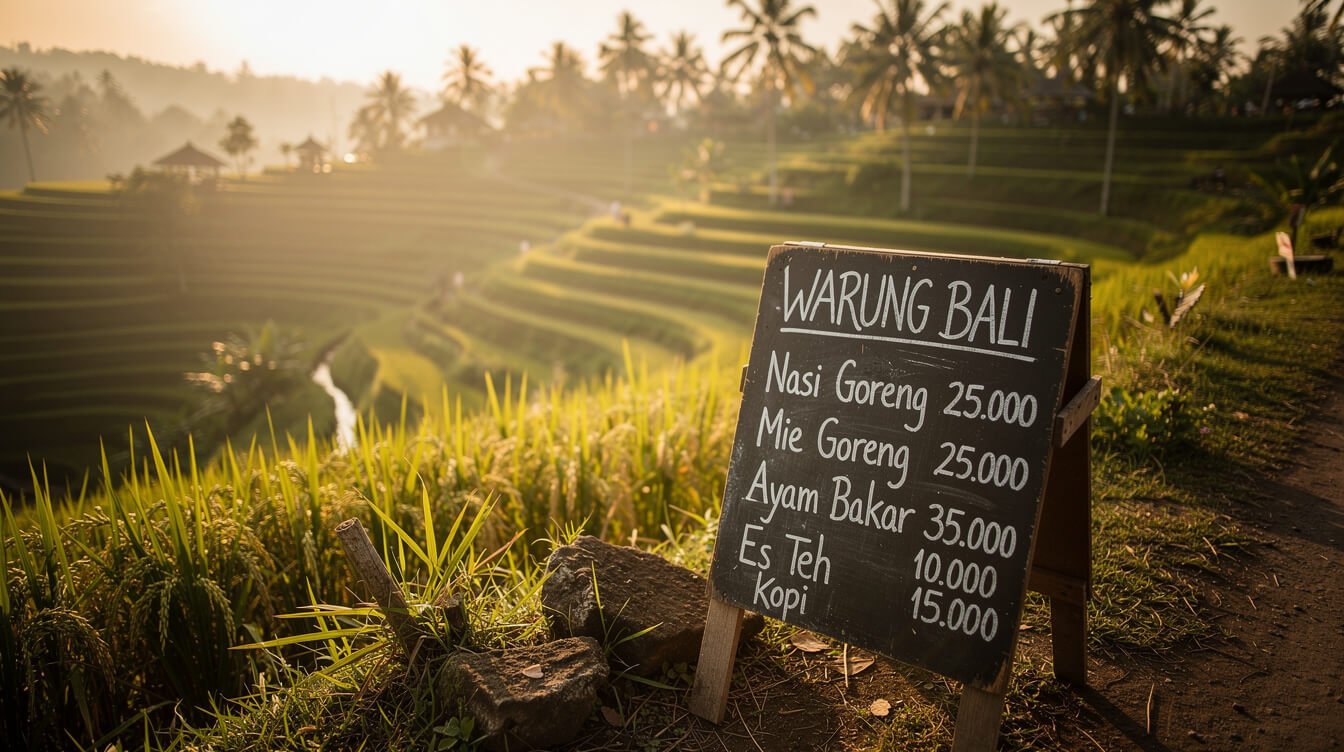
Warung meals typically run $2–$5 per dish; a nicer Western-style restaurant meal is $10–$25. Staying somewhere with an in-house chef removes this line item almost entirely.
Is a private villa more expensive than a hotel in Bali?
Not necessarily, especially for groups. Split across three or four bedrooms, a staffed villa’s nightly rate per person is often comparable to or lower than booking the same number of hotel rooms — while including services a hotel charges for separately.
Do I need cash for most things in Bali?
Yes, for warungs, markets, and smaller attractions. Keep a reasonable amount of Rupiah on hand and top up as needed rather than relying solely on cards.
How much are flights to Bali in 2026?
Highly season-dependent. Long-haul fares from the US or Europe can range from under $800 in low season to well over $1,500 at the August and New Year peaks; flights from Australia often swing between roughly $400 and $800 across the same calendar.
Should I tip in Bali?
It’s not mandatory but genuinely welcomed, especially for drivers, spa staff, and villa team members who often go well beyond what’s asked. A loose guide is 10,000–20,000 IDR per service, more for a full day of driving or a team that’s looked after you all week.
Is it cheaper to travel Bali as a group?
Often, yes — particularly if you book a shared villa rather than individual hotel rooms. Costs like a private driver, a chef, or daily housekeeping stay roughly flat regardless of group size, so they shrink per person the more people you’re traveling with.
Final Thoughts: What Your Money Actually Buys in Bali
Bali travel prices aren’t one number — they’re a set of honest trade-offs between flexibility, comfort, and how much you want handled for you versus how much you want to handle yourself. A backpacker trip and a staffed villa stay aren’t really competing for the same traveler; they’re answering different questions about what kind of week you want to have.
What we’d gently push back on is the assumption that “staffed” automatically means “unreachable.” Once you add up what a comparable week actually costs when every piece — chef, driver, cleaning, concierge — is purchased separately, the gap to a bundled villa stay is usually smaller than people expect, and sometimes it isn’t a gap at all.
Whichever way you travel, build your budget with your eyes open: pick your season on purpose, count the small costs honestly, and ask what’s already included before you pay for it twice.

Join our newsletter — fun, new, exciting Bali news
Honest budgeting tips, seasonal price shifts, and real stories from Ubud — straight to your inbox, no spam.