
Bali Villa Rental Long Term: Your Complete Guide to Extended Stays in Ubud
A bali villa rental long term changes everything about the way you experience this island. Instead of rushing through temples and rice terraces in a blur of five-day highlights, you settle in. You learn the rhythm of the village. You discover the warung that makes the best nasi campur on your street. Your mornings develop their own unhurried shape — coffee on the pool deck, the gardener already trimming frangipani before you open your eyes, the mist still sitting in the valley below.
This guide covers everything you need to know about renting a villa in Bali for an extended stay — from choosing between a staffed villa and a bare lease, to navigating visas, neighborhoods, budgets, and the small daily details that turn a trip into a life. Whether you’re planning a month-long reset, a season of remote work, or a full year of Ubud mornings, this is your practical, experience-based roadmap.
Why Bali Villa Rental Long Term Makes More Sense Than You Think

Most travelers visit Bali for a week. They see the highlights, eat the meals, take the photos, and leave feeling like they barely scratched the surface. A bali villa rental long term flips that equation entirely.
When you stay for a month or longer, Bali stops being a destination and starts being a place you actually live. You shop at the morning market instead of tourist restaurants. You recognize the woman who sells mangoes on the corner. You learn which afternoons bring rain and which bring the kind of golden light that makes the rice terraces glow.
The economics shift too. Nightly rates at hotels and short-term rentals can run $150-400+ per night in Ubud. Extended villa stays — whether monthly or seasonal — often work out to a fraction of that cost per day. You get more space, more privacy, and more genuine comfort for less money per night than most hotel rooms offer.
Beyond the financial logic, there’s something deeper. Extended stays give you the thing that short trips can’t — the slow accumulation of familiarity that turns a beautiful place into your place. You develop routines. You build relationships. You stop performing “vacation” and start simply living.
If you’re considering a bali villa rental for the first time, an extended stay may be the most rewarding way to experience the island.
The Staffed Villa Difference for Bali Villa Rental Long Term
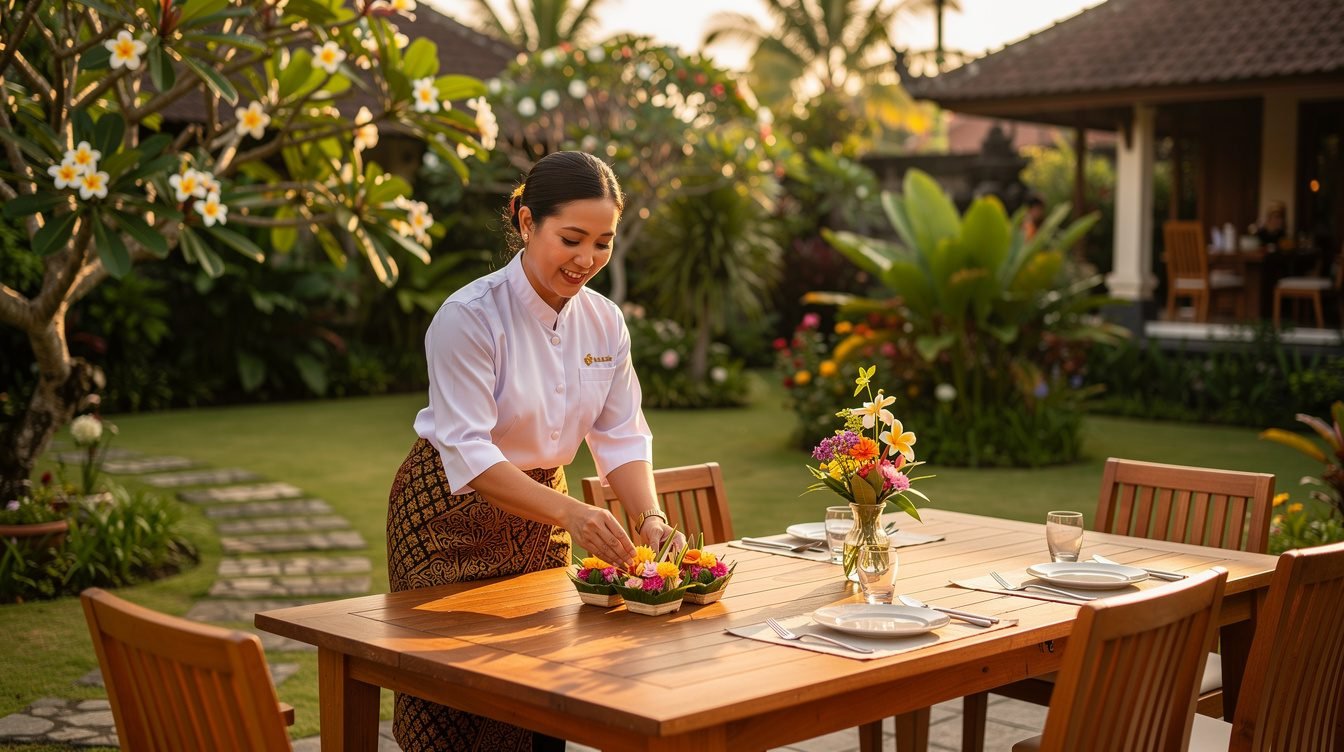
Here’s where most “bali villa rental long term” guides get it wrong. They treat all villa rentals as the same category — find a house, sign a lease, move in. But there’s a fundamental difference between renting an empty property and booking a staffed villa for an extended stay.
An empty lease gives you walls and a roof. A staffed villa gives you a team.
At a properly staffed villa in Ubud, your days feel different from the first morning. The manager has already checked your arrival details with the driver. The chef has asked about your dietary preferences and shopped the market at dawn. The housekeeper has arranged fresh flowers in your room. The gardener has been tending the grounds since before sunrise — not because anyone told him to, but because he takes genuine pride in the garden being extraordinary when you walk through it.
For extended stays, this difference compounds. Over weeks and months, a good staff team becomes your local infrastructure. The manager books your driver for day trips and knows which restaurants to call for reservations. The chef learns your breakfast rhythm — maybe you want eggs at 8 on weekdays but sleep in on Sundays. The housekeeper notices what you need before you ask.
This is the gap between renting a villa with a private pool in Ubud and actually being held during your stay. Staff who care — who are paid well and treated as people, not as costs — create an experience that no amount of marble or infinity pool can replicate.
What Daily Life Actually Looks Like During an Extended Villa Stay

Forget the Instagram version of Bali. Here’s what your days actually feel like when you’re in the middle of a bali villa rental long term in Ubud.
Morning starts early — not because you set an alarm, but because the birds do. Ubud wakes before the heat. By 6 AM, the garden smells like wet earth and frangipani. Coffee appears on the pool deck. If you have staff, breakfast follows whenever you want it — fresh tropical fruit, Balinese crepes, eggs the way you like them. Your only decision is whether to swim first or eat first.
Midday belongs to work, exploration, or deliberate stillness. Many long-term guests work remotely — Ubud has reliable fiber internet in most villa areas, and the time zone works well for Asian and Australian business hours. Others use midday for exploring — a morning walk through the rice terraces, a visit to the artisan silver workshops in Celuk, or a quiet hour at a warung with a book.
Afternoon brings the rain, most days between November and April. It arrives fast, hammers the roof for an hour, and leaves the air clean and cool. This is nap time, reading time, the hour when the pool feels warmest against cool rain-washed air.
Evening in Ubud is early and gentle. Sunset hits around 6:15 PM year-round. The gamelan from the nearest temple drifts across the rice fields. Dinner at home — if your villa has a chef — is often the best meal of your day. Fresh fish from the morning market, local vegetables, sambal made from scratch. After a month, you stop wanting to eat out.

Get a Free 3-Day Sample Itinerary
See what your first three days in Ubud could look like — morning to evening, curated by our team who lives here year-round.
Best Ubud Neighborhoods for a Bali Villa Rental Long Term
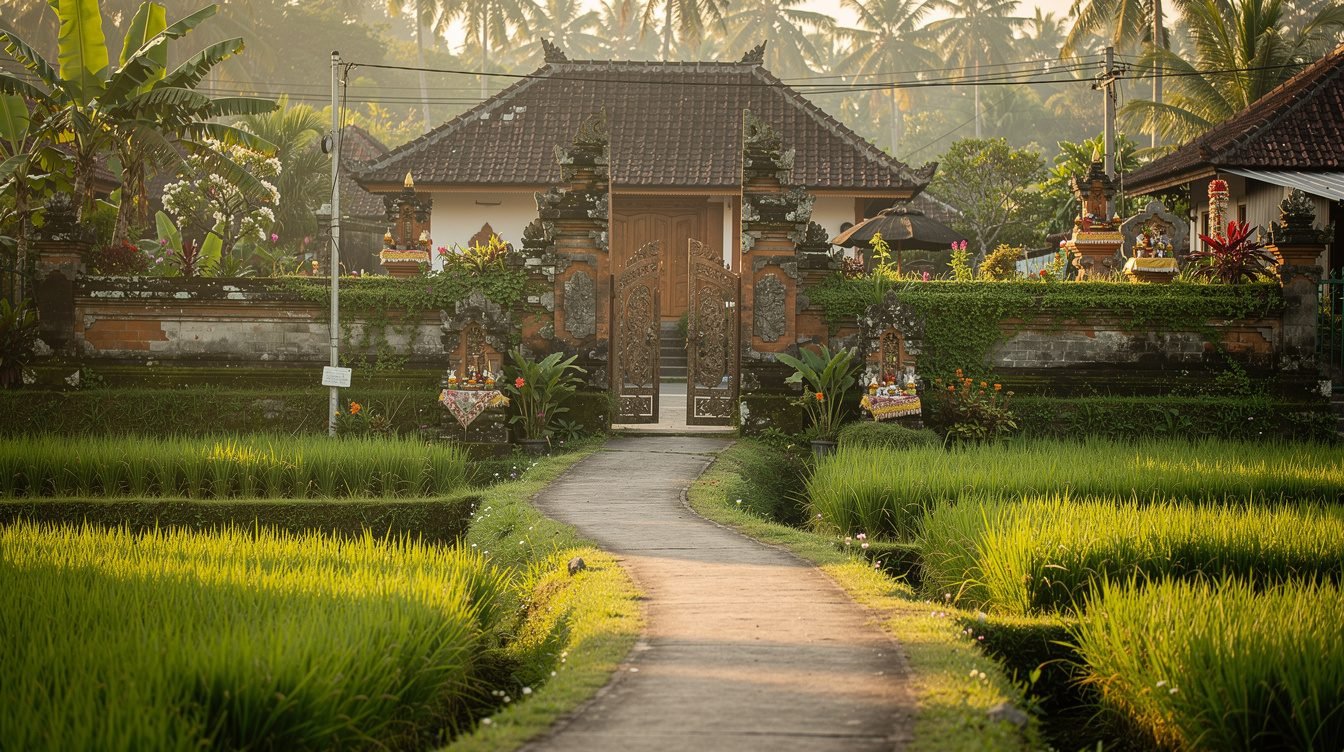
Ubud isn’t one place — it’s a collection of villages, each with its own character. Where you choose to base your bali villa rental long term shapes your entire experience.
Penestanan sits on a ridge above the main Ubud center. It’s quieter, greener, and popular with artists and long-term expatriates. The rice fields here are some of the most photographed in Bali. Walking distance to central Ubud takes about 20 minutes — far enough to feel village-quiet, close enough for evening dinners in town. Many of the best private pool villas in Ubud are concentrated here.
Sayan occupies a deep river valley west of town. This is where the Four Seasons and COMO Shambhala are located, which tells you something about the scenery. Sayan villas tend to sit on dramatic valley slopes with layered rice terrace views. It’s the most secluded Ubud neighborhood — ideal if your priority is total immersion in nature with minimal village noise.
Central Ubud — Jalan Raya Ubud and the streets radiating from the market — gives you walkable access to everything: restaurants, yoga studios, galleries, the palace, and the Monkey Forest. The trade-off is traffic noise during the day. For long-term stays, many people start here and eventually drift outward to quieter areas.
Tegallalang lies 20 minutes north of Ubud center, home to the famous terraced rice fields. Villas here tend to be larger, cheaper, and more isolated. Perfect for families or groups who want space and don’t mind driving into town.
Lodtunduh and Mas sit south of central Ubud. Traditional woodcarving villages with deep cultural roots. Less touristy, more authentically Balinese. This is where long-term residents who want genuine village life — temple ceremonies, community events, the neighbor’s roosters — tend to settle.
What a Bali Villa Rental Long Term Actually Costs

Costs for a bali villa rental long term vary dramatically depending on what you’re actually renting. Here’s an honest breakdown based on current Ubud market conditions.
Empty villa (yearly lease): A basic 2-bedroom villa in Ubud leases for roughly $5,000-15,000 per year. These are unfurnished or semi-furnished, with no staff, no pool maintenance, and no services. You handle everything yourself — utilities, garden upkeep, repairs, cleaning. This model works best for expatriates who already know Bali and want full control over their living situation.
Furnished villa (monthly): A furnished 2-3 bedroom villa with pool runs $1,500-4,000 per month in Ubud. This includes furniture, basic kitchen equipment, and usually a weekly cleaner. You’re still handling your own cooking, shopping, and daily management. Good for digital nomads who want comfort without full-service hospitality.
Staffed villa (extended stay): A fully staffed villa with private chef, daily housekeeping, villa manager, and gardener costs more per month — but the per-day value is extraordinary when you factor in what you’re actually receiving. Three meals a day prepared by a private chef. Fresh flowers in every room. Pool cleaned and garden manicured daily. A manager who handles your logistics, from arranging drivers to booking activities. When you calculate the cost of eating out three times a day, hiring cleaners, and managing your own logistics, the staffed model often works out to be comparable — with dramatically less friction.
Daily living costs beyond rent: Ubud is remarkably affordable once you’re settled. A warung lunch costs $2-4. Organic groceries from the market run $30-50 per week for two people. A scooter rental is $50-70 per month. High-speed internet is $25-40 per month. A spa treatment in Ubud costs a fraction of what you’d pay in most Western cities.
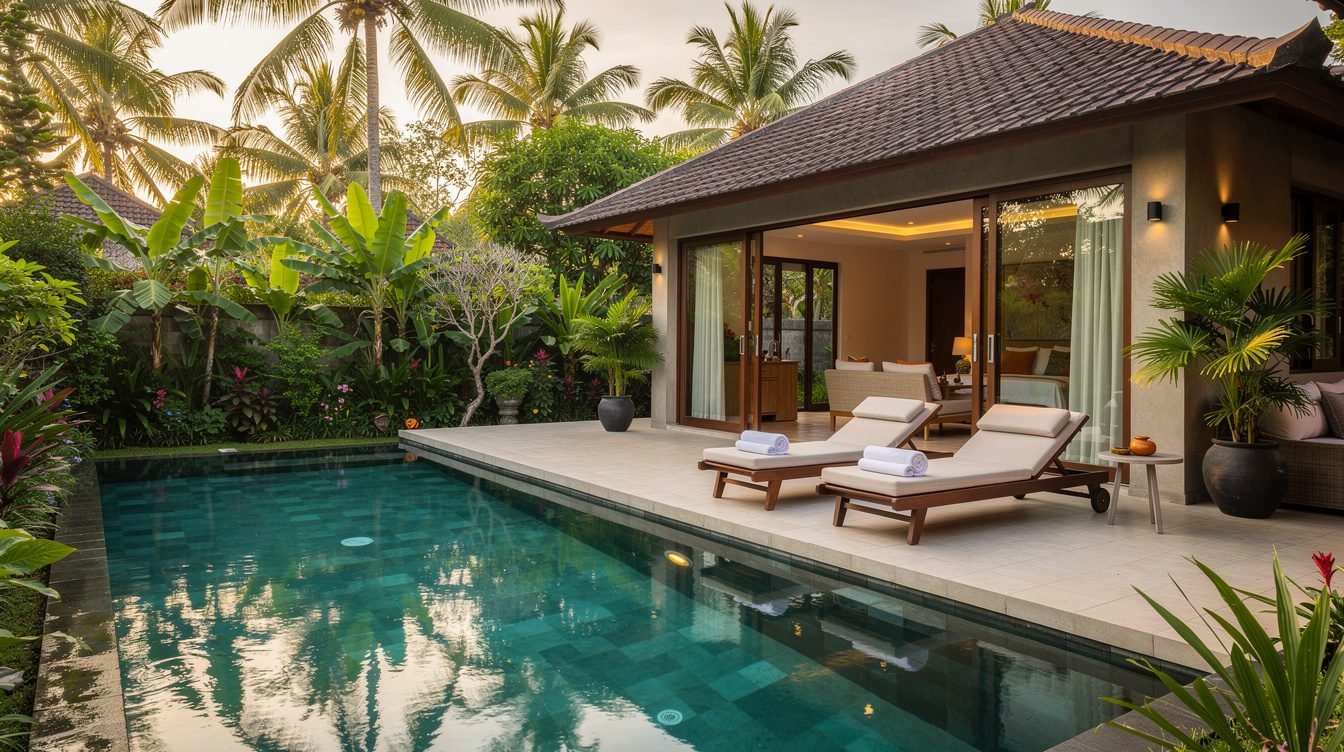
Ready to Stay Longer?
Villa Amrita offers extended stays with full staff — private chef, daily housekeeping, and a team that makes Ubud feel like home from day one.
Visas and Logistics for Your Extended Bali Villa Stay

The practical side of a bali villa rental long term centers on one question: how long can you legally stay?
Visa on Arrival (VOA): Most nationalities receive a 30-day visa on arrival at Ngurah Rai Airport. This can be extended once for an additional 30 days at a local immigration office — giving you up to 60 days. The extension costs around $35 and requires a visit to the immigration office in Denpasar or a local agent. Many long-term villa guests use this option for 1-2 month stays.
B211A Social/Cultural Visa: For stays of 60-180 days, the B211A is the most common option. This visa requires a sponsor (your villa management team or a visa agent can arrange this). It starts at 60 days and can be extended monthly up to a maximum of 180 days. Cost is roughly $300-500 for the initial visa plus $35-50 per monthly extension.
Digital Nomad Visa (E33G): Indonesia’s remote worker visa allows stays of up to 12 months. Requirements include proof of employment or freelance income from outside Indonesia, health insurance, and a minimum income threshold. Processing takes 2-4 weeks. This is the cleanest option for year-long stays.
KITAS (Limited Stay Permit): For stays exceeding one year, a KITAS provides a 12-month renewable permit. This requires a local sponsor and more documentation but provides the most stable long-term status.
Practical tips: Always work with a reputable visa agent — your villa manager can recommend one. Keep your passport valid for at least 6 months beyond your intended stay. Carry color copies of your passport and visa at all times. Register your stay at the local banjar (village administration) within 24 hours of arrival — your villa staff usually handles this for you.
How to Design an Extended Bali Villa Stay That Actually Works

The difference between a good extended stay and an extraordinary one comes down to design — not the villa’s architecture, but how you structure your time, your rhythms, and your relationship with the place.
Build routines, but keep them loose. The best long-term guests find their rhythm within the first week. Maybe it’s morning yoga on the villa deck, followed by a swim, then breakfast. Maybe it’s a daily walk through the rice fields before the heat builds. Whatever shape your days take, let them develop naturally — and give yourself permission to break the pattern whenever something more interesting presents itself.
Use your staff as local guides. The team at a staffed villa knows Ubud in ways that no guidebook covers. Ask your chef where she shops and why. Ask the gardener about the temple ceremony happening next week. Ask the manager which road to take for the best sunrise view. Over weeks and months, these conversations become your real education in Balinese life.
Schedule “nothing” days. The most common mistake of extended stays is trying to fill every day with activities. Ubud rewards stillness. Some of your best days will be the ones where you swim, read, eat lunch by the pool, watch the afternoon rain arrive, and realize you haven’t left the villa grounds since morning.
Invest in wellness. An extended stay in Ubud opens the door to genuine health practices — not tourist-grade yoga selfies, but sustained daily practice that actually changes how you feel. Many long-term guests develop weekly rhythms that include yoga practice, meditation sessions, traditional Balinese healing, and wellness rituals that become part of their Ubud life rather than a one-time experience.
Connect with the community. Ubud has a vibrant expatriate community alongside deep Balinese village culture. Attend a full-moon ceremony at the nearest temple. Join a conversation circle at a local cafe. Volunteer at an animal shelter or environmental project. Extended stays give you the time to build real connections — the kind that make you miss people, not just places, when you leave.
Frequently Asked Questions About Bali Villa Rental Long Term
What’s the minimum stay for a long-term villa rental in Bali?
It depends on the rental model. Empty property leases typically require 6-12 month commitments. Furnished rentals often start at 1-3 months. Staffed villas can accommodate extended stays from as short as two weeks to several months — ask about monthly rates, as many properties offer significant discounts for longer bookings.
Is WiFi reliable enough for remote work in Ubud?
Yes, in most established villa areas. Fiber internet delivers 20-100 Mbps in Penestanan, Sayan, Central Ubud, and nearby neighborhoods. Always confirm internet speed before booking, and ask whether the villa has a backup connection. Power outages are rare but happen — a good villa will have an inverter or generator.
What about healthcare during a long stay?
Ubud has several quality clinics for routine care, including BIMC Ubud and Toya Devasya Medical. For anything serious, Denpasar (45 minutes south) has international-standard hospitals. Health insurance with medical evacuation coverage is essential for any stay longer than a month. Your villa manager can recommend a local GP for regular checkups.
Can I bring my pet to Bali for a long-term stay?
Indonesia has strict quarantine requirements for imported animals, especially dogs and cats. The process involves months of pre-departure paperwork, vaccinations, and a quarantine period on arrival. Most long-term visitors find it simpler to arrange care for pets at home. If bringing a pet is essential, start the process at least 6 months before departure.
Is it safe for families with children?
Ubud is one of the safest places in Southeast Asia for families. Crime is very low, the community is welcoming to children, and several international schools (Green School, Bali Island School) accept short-term enrollments. The main safety concerns are typical tropical ones — pool supervision, sun protection, and road traffic on scooter-heavy roads.
What’s the best time of year for an extended stay?
The dry season (April-October) offers the most consistently sunny days, but the wet season (November-March) has its own appeal — lower prices, fewer tourists, and the landscape at its greenest. Many long-term guests prefer arriving in April or May, when rates are still reasonable and the weather is settling into dry-season patterns.
How do I handle banking and money during a long stay?
ATMs are widely available in Ubud. Use a travel-friendly bank card with no foreign transaction fees (Wise, Revolut, and Charles Schwab are popular choices). Most villas accept bank transfer for monthly payments. Keep some cash in Indonesian Rupiah for markets, warungs, and small purchases. Digital payment apps like GoPay and OVO are increasingly accepted.

Join Our Newsletter
Fun, new, exciting Bali news — delivered to your inbox. Ubud insights, travel tips, and the kind of stories that make you start checking flight prices.