Balinese People: Your Complete Guide to Understanding Bali’s Heart and Soul
The Balinese people are the reason visitors come to Bali once and spend the rest of their lives finding ways to return. Not the rice terraces. Not the temples. Not the Instagram sunsets. The people. Their warmth reaches you before you understand why — in the way a stranger smiles at you on a village path, in the small offering placed at your doorstep before dawn, in the genuine “how was your sleep?” from someone who actually wants to know the answer.
We say this as a villa team in Ubud who lives and works alongside Balinese people every day. Our chef, our manager, our gardener — they are Balinese. The way they care for guests is not trained hospitality. It is the way they were raised, the way their grandparents lived, the way their entire culture understands the relationship between host and visitor. This guide is our attempt to share what we have learned by being part of their world.
Who Are the Balinese People? A Culture Unlike Anywhere Else
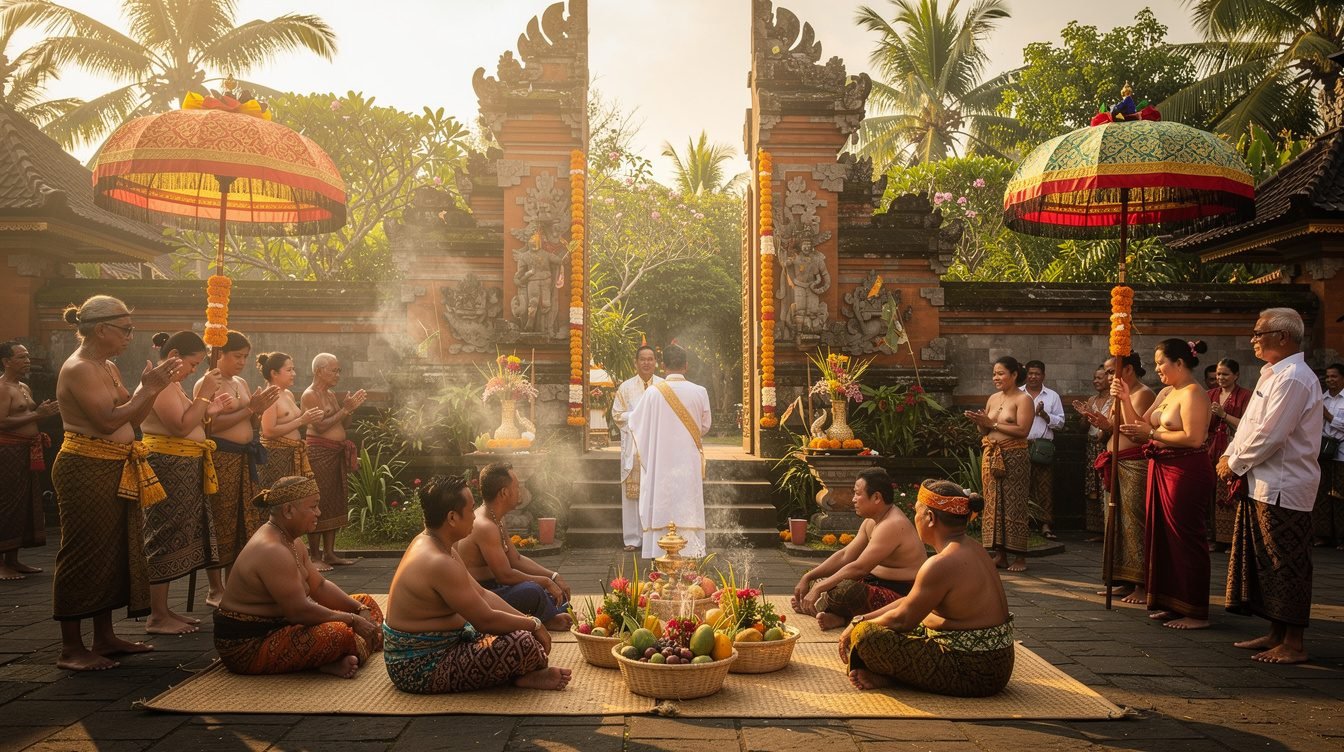
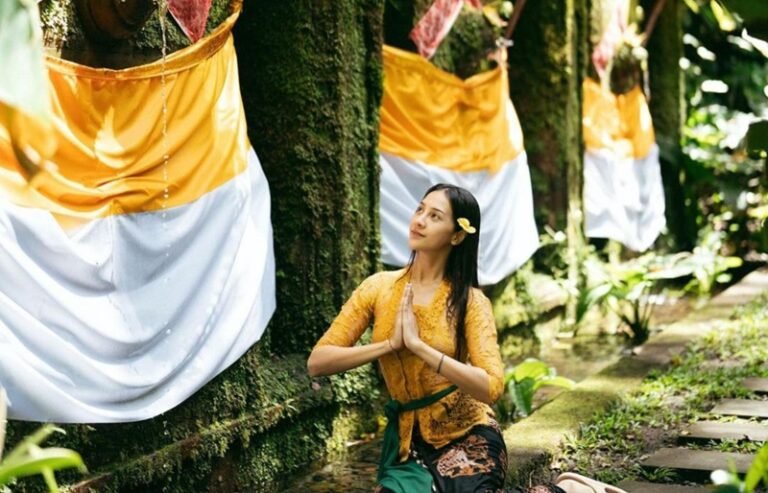
The Balinese people are an ethnic group of roughly 4.2 million who call the island of Bali home. They make up about 85 percent of the island’s population, and their culture is one of the most distinct in Southeast Asia — a living, breathing tapestry of Hindu-animist spirituality, artistic expression, and community bonds that have survived centuries of outside influence.
What makes Balinese people genuinely different from other Indonesian ethnic groups is the depth of integration between daily life and spiritual practice. There is no separation between “secular” and “sacred” in Bali. The woman arranging flowers at her front gate at 6 AM is performing a religious act. The farmer checking his rice terraces is honoring a thousand-year-old irrigation system that is itself a form of prayer. The things you experience in Ubud — the ceremonies, the art, the food — are not performances for tourists. They are the texture of ordinary Balinese life.
The Balinese speak their own language (Bahasa Bali) alongside Indonesian, with a complex system of speech levels that changes depending on who you are talking to and their social position. Most Balinese people in tourist areas also speak English, often with a warmth and directness that catches visitors off guard. They want to connect. It is cultural, not commercial.
Balinese People and Spirituality: The Rhythm That Shapes Every Day
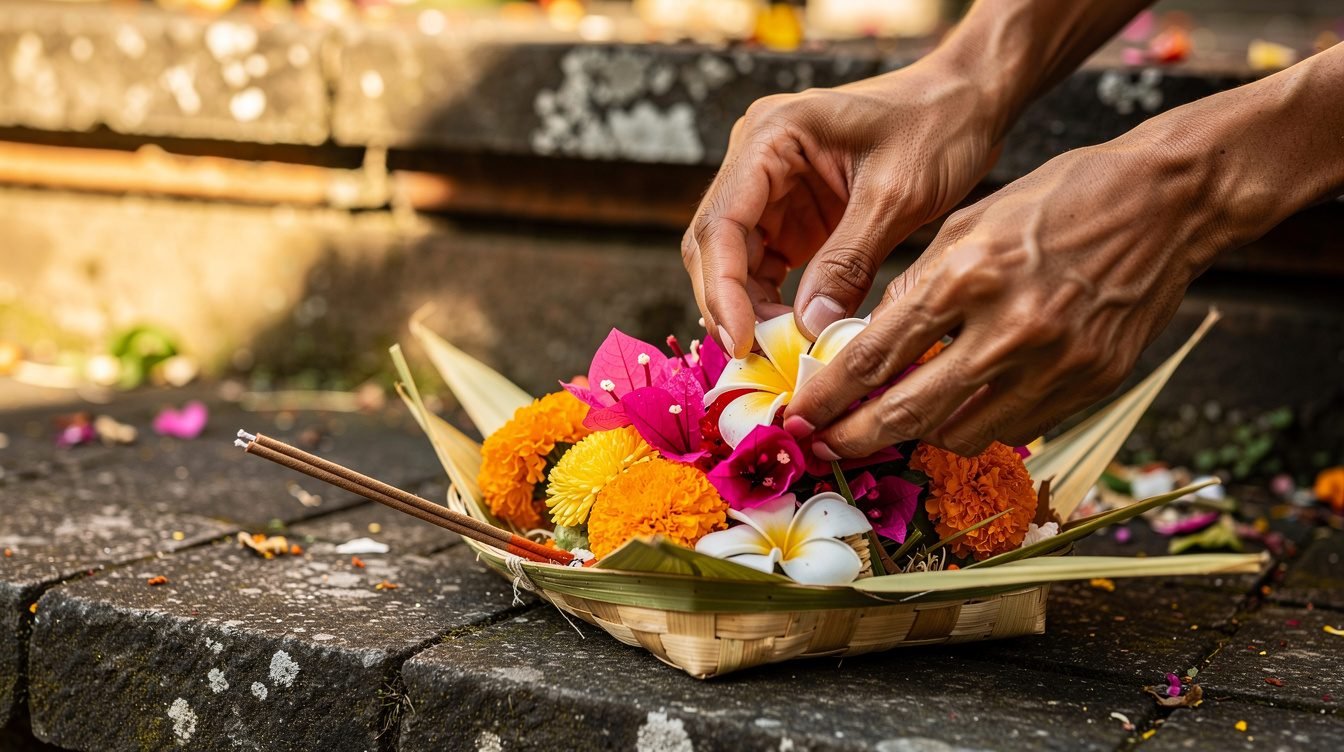
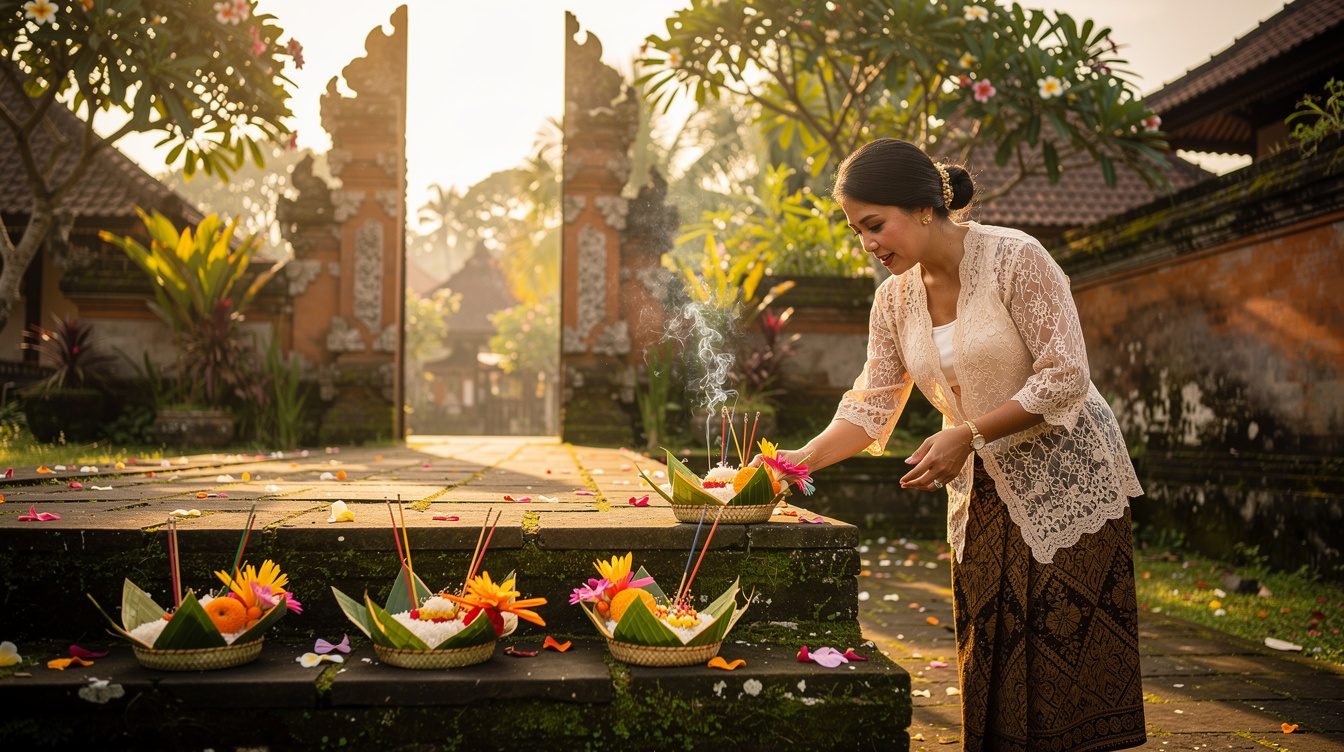
If you spend even a single day in Bali, you will step over a canang sari. These small woven palm-leaf baskets filled with flowers, rice, and incense appear on sidewalks, temple steps, shop counters, taxi dashboards, and villa terraces — placed fresh every morning by Balinese hands. They are offerings to maintain balance between the forces of good and the forces of chaos. The Balinese do not consider this optional. It is as essential as breathing.
Balinese Hinduism (Agama Hindu Dharma) is the spiritual foundation of the island, but it looks nothing like the Hinduism you would encounter in India. It blends Hindu theology with ancient animist beliefs — the conviction that spirits inhabit everything: trees, rivers, stones, crossroads. The concept of sekala (the seen world) and niskala (the unseen world) governs how Balinese people navigate their lives. When a Balinese person places an offering at the base of a tree, they are acknowledging the spirit that lives there. When they build a new house, a priest must first determine where the spiritual energy flows so the structure does not disrupt it.
The three supreme gods — Brahma (creator), Vishnu (preserver), and Shiva (destroyer) — sit at the top of the spiritual hierarchy. But the Balinese relationship with the divine is intensely personal and local. Every family compound has its own temple. Every village has at least three temples. There are over 20,000 temples across the island, and on any given day, at least a few hundred are hosting ceremonies. If you visit during Nyepi (the Day of Silence), you will witness the most dramatic expression of this spirituality — an entire island going completely silent for 24 hours.
For visitors staying in a private villa in Ubud, this spiritual rhythm becomes the background soundtrack of your stay. Your villa manager may ask you to be mindful during certain ceremony days. Your gardener will place offerings at the villa’s shrine each morning. These are not inconveniences. They are invitations to witness something genuine.
Get a Free 3-Day Sample Itinerary
Discover how three days in Ubud unfold when a villa team designs the rhythm for you — temples, rice fields, ceremonies, and quiet moments included.
The Banjar: How Balinese People Build Community
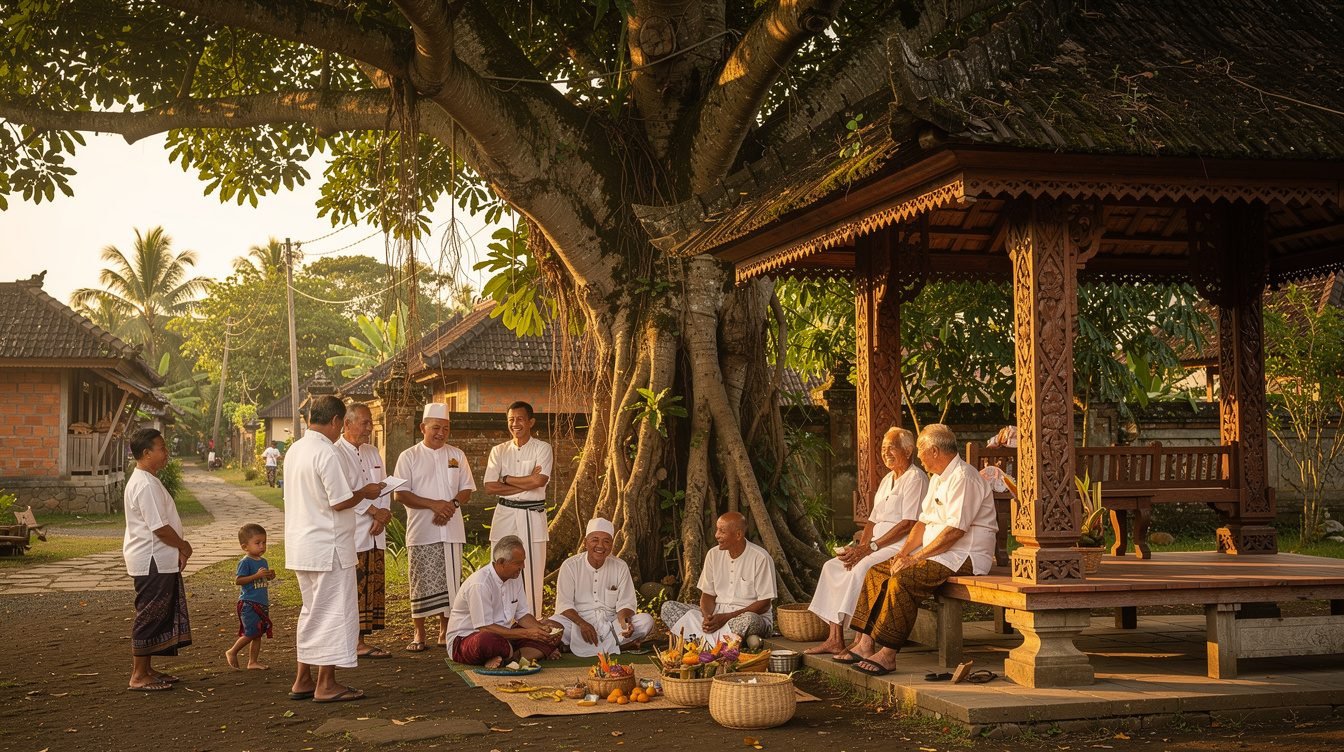
The banjar is the heart of Balinese social life, and understanding it helps you understand why Balinese people behave the way they do. A banjar is a neighborhood council — a hyper-local governing body that manages everything from temple ceremonies to dispute resolution to collective labor. Every Balinese adult belongs to a banjar, and participation is not optional. If you do not show up when the banjar calls a meeting or a work day, you face social consequences that carry real weight.
This system produces something remarkable: a culture of genuine mutual obligation. When a family in the banjar has a ceremony — a wedding, a cremation, a temple anniversary — the entire community shows up to help. Hundreds of people cooking, decorating, carrying, organizing. No one is paid. No one keeps score. The understanding is simple: when it is your turn, everyone will show up for you too.
This is why Balinese people are the way they are with guests. The instinct to help, to anticipate needs, to make sure you are comfortable — it is not a service industry skill. It is what the banjar teaches from childhood. The chef at your villa who asks if the spice level was right, the gardener who cuts a frangipani stem and leaves it on your breakfast table, the manager who remembers you mentioned wanting to see a ceremony — they are doing what their culture trained them to do: take care of the people in their space.
Balinese People and the Arts: Where Creativity Is a Way of Life
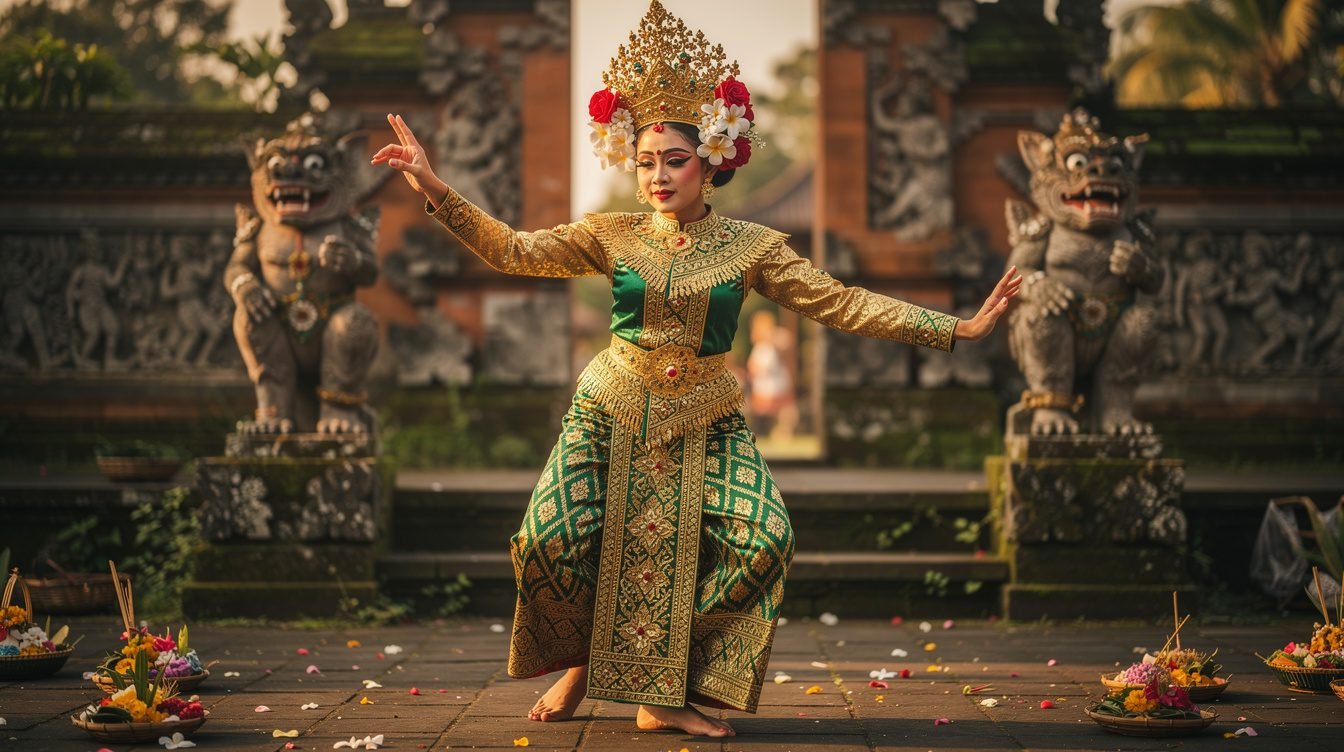
In most cultures, “art” lives in galleries and concert halls. In Bali, it lives everywhere. The stone carving on a village wall is not decorative — it tells a story from the Ramayana. The gamelan orchestra rehearsing behind a temple is not a concert — it is preparation for a religious ceremony. The woman painting intricate patterns on a ceremonial cloth is not an artist in the Western sense — she is fulfilling a spiritual duty.
Balinese people are immersed in artistic expression from birth. Children learn traditional dance as naturally as they learn to walk. Young men train in gamelan percussion. Women master the art of creating elaborate offerings that can take days to assemble — towering structures of fruit, flowers, and rice cakes that would qualify as installation art in any contemporary gallery.
The major traditional art forms include:
- Legong and Barong dance — intricate temple dances that retell Hindu mythology through precise hand movements, eye expressions, and body angles
- Gamelan music — bronze percussion orchestras that produce the shimmering, cascading sound that defines the Balinese soundscape
- Wood and stone carving — functional and decorative work visible on every temple, gate, and traditional building
- Batik and ikat weaving — textile arts with symbolic patterns that carry spiritual meaning
- Painting — from the classical Kamasan style to the Ubud school that emerged in the 1930s through collaboration with Walter Spies and Rudolf Bonnet
Ubud became the center of Bali’s artistic identity for a reason. The royal family of Ubud actively supported artists, creating an environment where creative expression and daily life merged seamlessly. Today, you can walk through Ubud’s streets and encounter more working artists per square meter than almost anywhere else on earth.
Balinese People and Food: What the Kitchen Reveals About the Culture
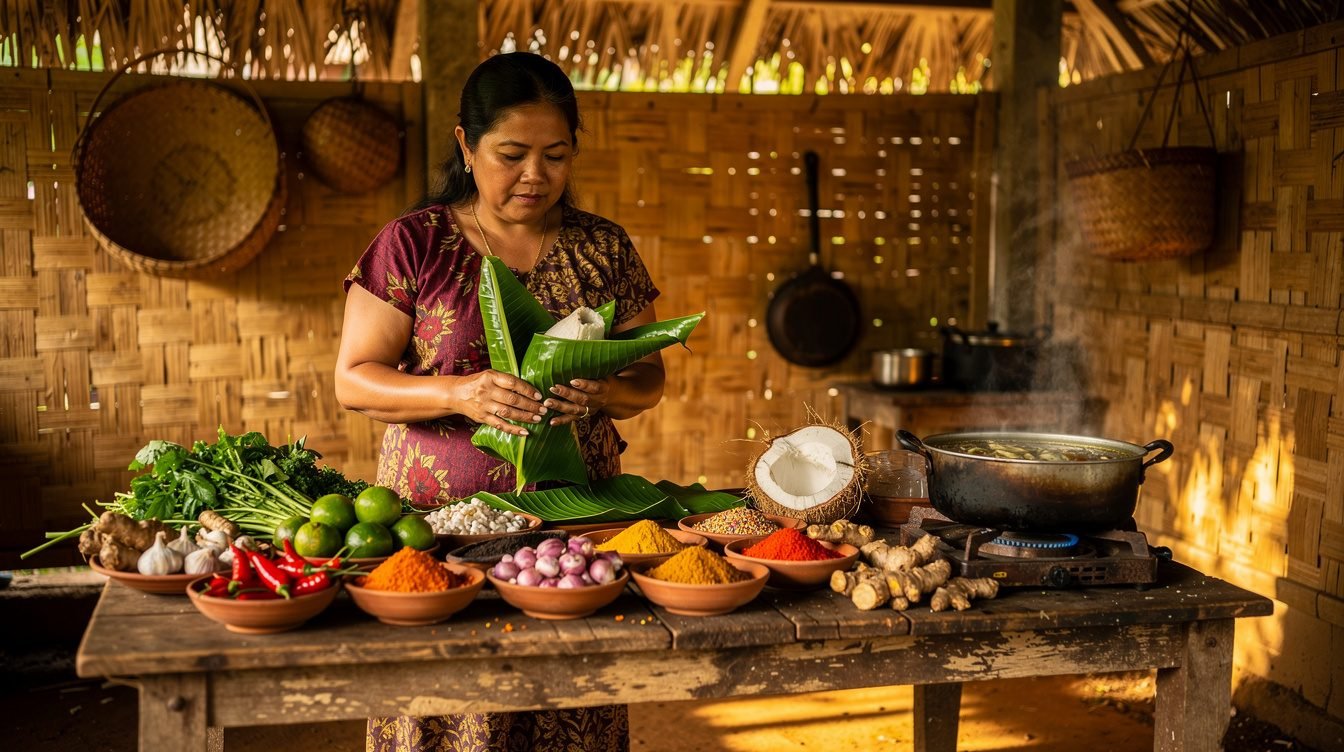
Balinese food tells you more about the people than any cultural guide can. The base of nearly every dish — bumbu, the aromatic spice paste — requires a mortar, a pestle, and patience. Shallots, garlic, ginger, galangal, turmeric, candlenuts, chili, lemongrass, shrimp paste. Ground by hand, layered with intention, cooked slowly. This is not fast food culture. This is a culture that believes the act of preparing food is an act of care.
Signature Balinese dishes reveal the values underneath:
- Babi guling (suckling pig) — traditionally prepared for ceremonies, requiring hours of communal effort. The whole village participates.
- Lawar — a finely chopped mix of vegetables, coconut, and meat that accompanies every significant ceremony. Making lawar is a collective act — men chop while elders supervise the seasoning.
- Nasi campur Bali — the daily meal: rice with small portions of multiple dishes. It reflects the Balinese philosophy of balance — a little of everything, nothing in excess.
- Jaje — traditional cakes and sweets made for offerings and celebrations, often colored with natural dyes from pandan, turmeric, and butterfly pea flower.
At a staffed villa in Bali, the private chef’s cooking becomes one of the most intimate ways to experience Balinese culture. Our chef at Villa Amrita does not just cook meals — she shares recipes her grandmother taught her, explains why certain dishes appear on certain days, and adjusts spice levels with the kind of attentiveness that comes from genuinely wanting you to enjoy the food.
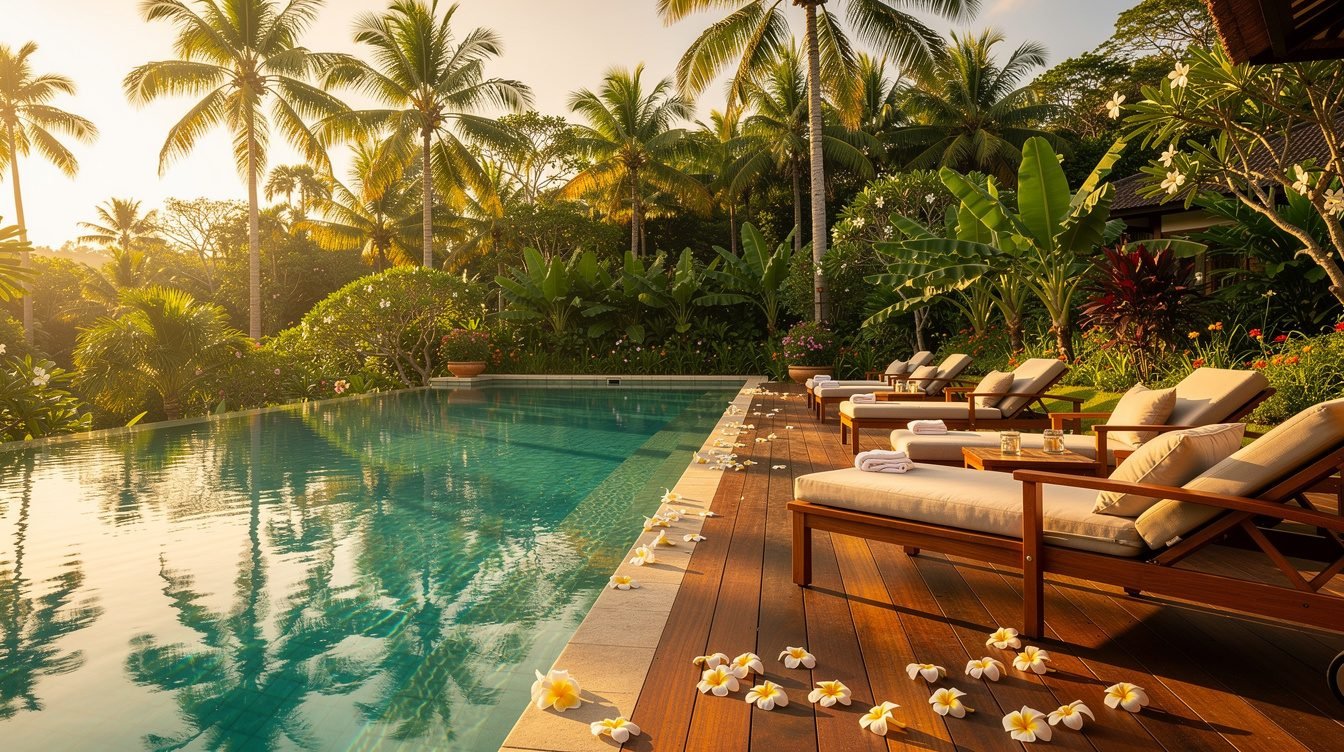
Stay with Balinese People Who Genuinely Care
Villa Amrita is a staffed villa in Ubud where the team — chef, manager, gardener — make your stay feel like coming home to Bali.
Balinese People and the Land: The Subak System and Rice Terrace Life
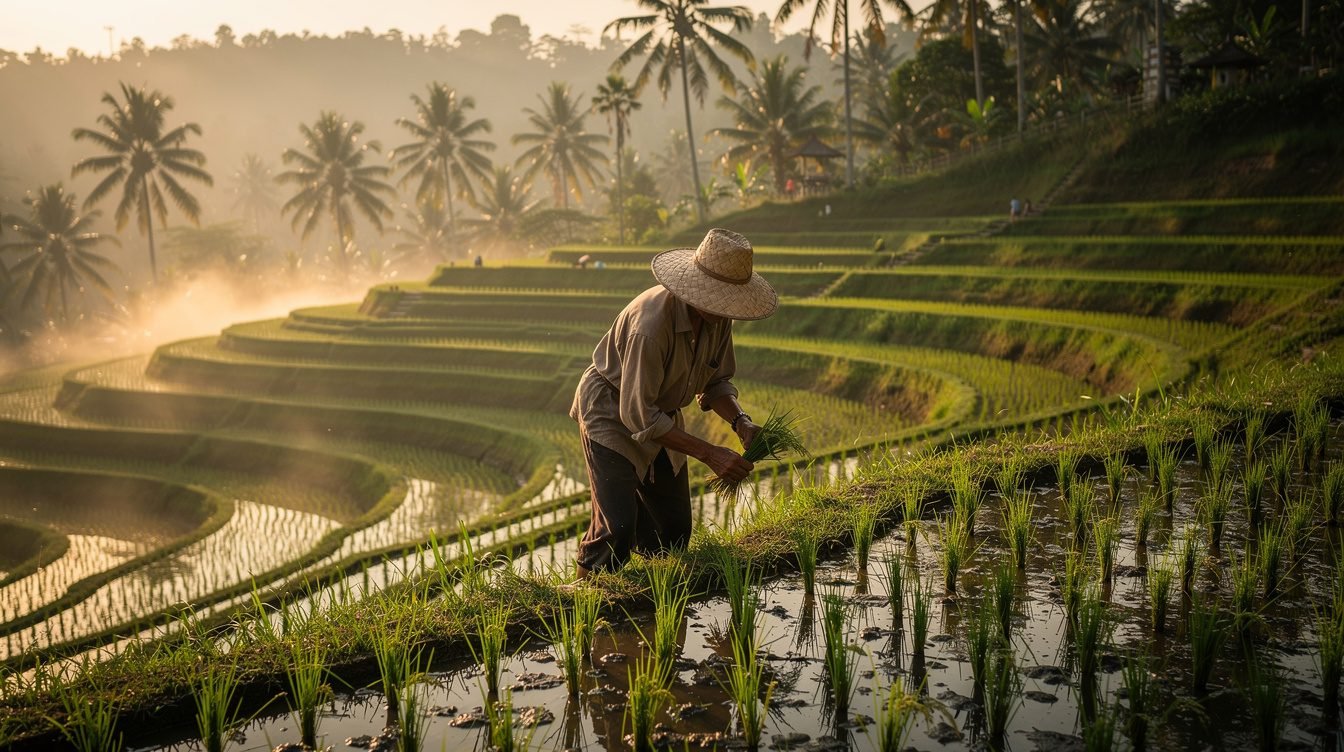
The relationship between Balinese people and their land is best understood through the subak — the cooperative water management system that has governed Bali’s rice terraces for over a thousand years. In 2012, UNESCO recognized the subak as a World Heritage cultural landscape, not just for its engineering but for the philosophy that drives it.
The subak operates on Tri Hita Karana — the Balinese principle of three causes of well-being: harmony with God, harmony with other people, and harmony with nature. Farmers in a subak share water not based on land size but on a system of rotating access governed by temple ceremonies and collective agreement. A farmer upstream cannot hoard water. The subak priest determines the planting schedule based on astronomical and spiritual calculations. Everyone plants. Everyone harvests. The land feeds everyone.
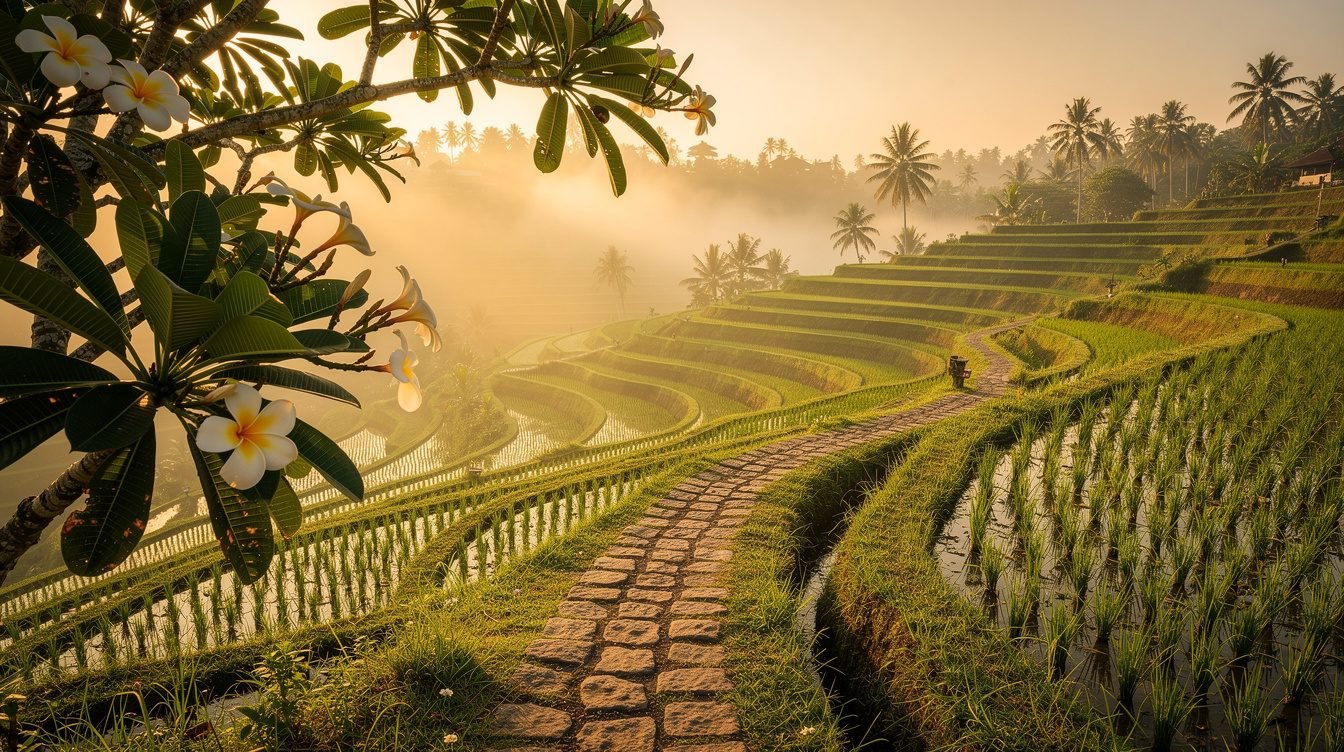
When you visit the Tegallalang Rice Terraces near Ubud, you are looking at a living expression of this philosophy. Those cascading green paddies are not scenery — they are a cooperative spiritual practice maintained by Balinese farmers who understand that their individual prosperity depends on the well-being of the whole system.
This same philosophy shapes how Balinese people approach hospitality. The idea that your well-being is connected to the well-being of everyone around you — that taking care of a guest is not transactional but relational — runs through every interaction you will have on the island.
Modern Balinese People: Tradition Meets the Contemporary World

One of the most fascinating things about Balinese people is how they hold tradition and modernity without apparent contradiction. A young Balinese man might spend his morning placing offerings at the family temple, his afternoon coding at a tech startup in Denpasar, and his evening rehearsing with his village gamelan group. These are not competing identities. They are layers of the same person.
Tourism has been Bali’s dominant industry for decades, and it has shaped the island in profound ways. The generation of Balinese people born after the 1990s grew up with international visitors as a constant presence. They speak multiple languages. They understand global culture. Many have traveled. But they also maintain their ceremonial obligations, attend banjar meetings, and observe the religious calendar with the same seriousness as their grandparents.
The tension, where it exists, is real. Land prices have risen dramatically. Young Balinese people sometimes struggle to afford homes in areas their families have lived for generations. The influx of digital nomads and remote workers — particularly in areas like Canggu and parts of Ubud — has created economic opportunities alongside cultural friction. But the remarkable thing is how Balinese people navigate this: with pragmatism, warmth, and a spiritual framework that absorbs change without losing its core.
If you want to understand modern Bali, spend time in Ubud. Walk the Campuhan Ridge at dawn and count how many young Balinese joggers pass you alongside the tourists. Visit the Ubud market where traditional craft sellers now accept digital payments. Sit in a café where a Balinese barista makes your pour-over coffee and then excuses herself because she needs to attend a ceremony at her village temple. This is the real Bali — not a museum, not a theme park, but a living culture actively choosing what to keep and what to adapt.
How to Respectfully Connect with Balinese People During Your Visit
Balinese people are among the most welcoming you will encounter anywhere in the world. But genuine connection requires respect, and respect requires understanding. Here are the things that matter most:
Temple etiquette. Always wear a sarong and sash when entering a temple. Women who are menstruating are asked not to enter — this is a spiritual boundary, not a social one. Remove your shoes. Keep your voice low. Never position yourself higher than a priest or a shrine. If you are unsure, ask. Balinese people would far rather you ask than accidentally offend.
Offerings. Never step on a canang sari. These small offerings on the ground are not litter — they are prayers. Walk around them. If your villa team places offerings at your door, leave them be. They are protecting your space.
Physical contact. The head is considered the most sacred part of the body. Do not touch a Balinese person’s head, even a child’s, even affectionately. Use your right hand when giving or receiving anything — the left hand is considered unclean.
Ceremony days. On major ceremony days (Galungan, Kuningan, full moon, new moon), roads may be blocked by processions, shops may close early, and your villa staff may need time to attend their own ceremonies. This is not an inconvenience to work around — it is the cultural fabric you came to experience. Be patient. Be present. Ask your villa team for guidance — they will help you understand what is happening and often invite you to observe.
Language. Learn a few words of Balinese or Indonesian. Om swastiastu (the Hindu greeting), terima kasih (thank you), permisi (excuse me). The Balinese light up when visitors make even a small effort. It signals that you see them as people, not as service providers.
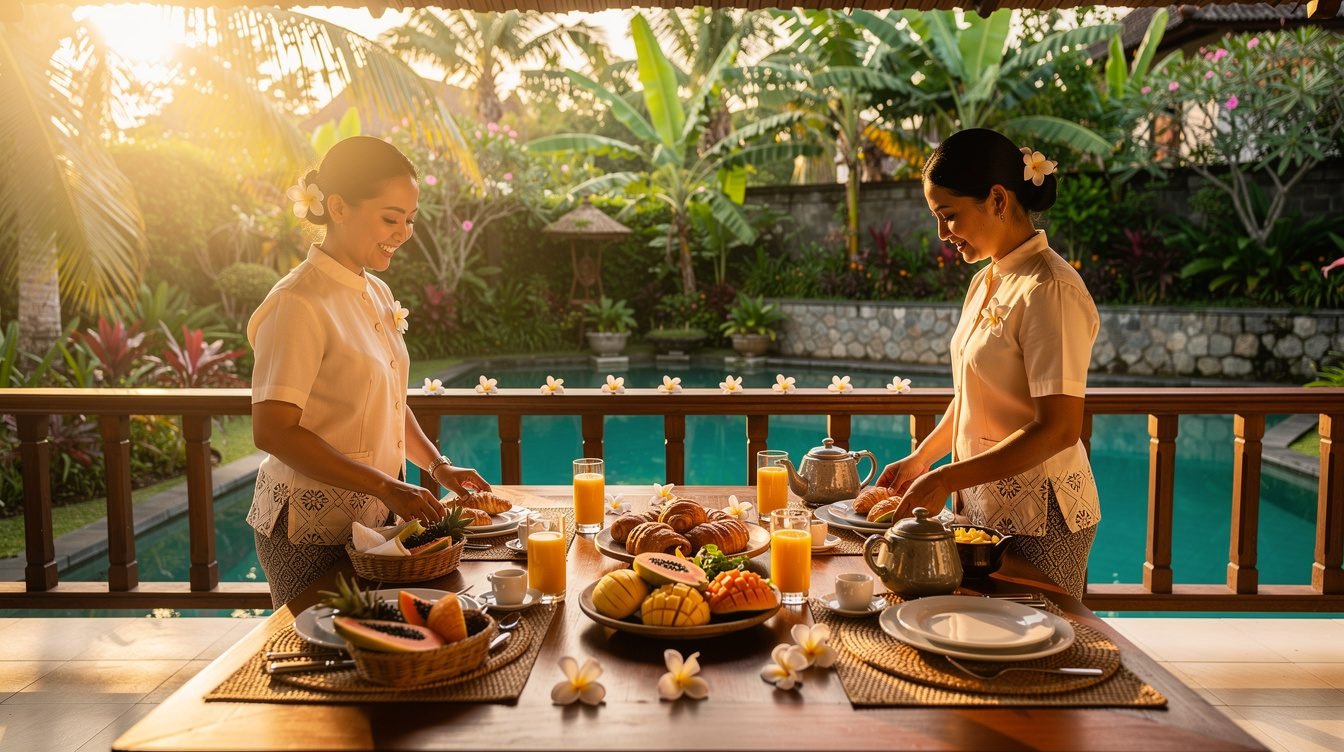
The staffed villa difference. Staying at a staffed villa in Ubud gives you something no resort can: daily, genuine, unhurried interaction with Balinese people who are not performing hospitality but living it. When your villa chef shares a recipe, your manager explains a ceremony, or your gardener shows you a plant he is proud of — these are real moments of cultural exchange. They happen because the relationship is intimate enough to allow them.
Frequently Asked Questions About Balinese People
What religion do Balinese people follow?
Balinese people predominantly practice Agama Hindu Dharma, a unique form of Hinduism blended with ancient animist traditions and Buddhist influences. Unlike mainland Indonesian Islam, Balinese Hinduism centers on maintaining balance between the seen (sekala) and unseen (niskala) worlds through daily offerings, temple ceremonies, and community rituals.
What language do Balinese people speak?
Balinese people are typically bilingual, speaking Bahasa Bali (the Balinese language) in daily life and Bahasa Indonesia for official and cross-cultural communication. Balinese has complex speech levels that change based on social context. In tourist areas, many Balinese people also speak English.
Are Balinese people friendly to tourists?
Exceptionally so, and it is genuine. Balinese culture places deep value on welcoming guests — the concept of tamu (guest) carries spiritual weight. You are not just a customer; you are someone who has entered their space, and caring for you is a form of spiritual practice.
What is the caste system in Bali?
Bali has a traditional social hierarchy with four main castes: Brahmana (priests), Kshatriya (warriors/rulers), Vaishya (merchants), and Shudra (commoners). However, the system is less rigid than India’s. Most Balinese people are Shudra, and while caste influences naming conventions and certain ceremonial roles, it does not prevent social mobility or daily interaction across groups.
How can I experience authentic Balinese culture?
Stay in Ubud rather than the beach resort areas. Visit during a ceremony period (Galungan-Kuningan is extraordinary). Stay at a staffed villa where the team can guide you. Attend a temple ceremony (with proper dress). Take a cooking class with a local family. Walk village paths rather than main roads. The more time you spend in one place, the more the culture opens to you.

Join Our Newsletter — Fun, New, Exciting Bali News
Weekly stories from Ubud — ceremonies, hidden spots, seasonal rhythms, and the small moments that make Bali extraordinary. Straight to your inbox.