Balinese Dance: A Guest’s Guide to Legong, Barong, Kecak and the Dances You’re Not Meant to See
The gamelan starts before you’ve found your seat. A shimmer of bronze, then a crash, then silence. Then a girl of perhaps twelve steps through a carved stone gate in a costume of gold-painted cloth, her fan snapping open, her eyes suddenly huge. For the next ninety minutes you’ll watch something that looks like theater and feels like prayer. That’s Balinese dance: one of the oldest living performance traditions in Asia, and in Ubud you can see it almost any night of the week.
Most guides hand you a list of dance names and a ticket price. We’d rather help you understand what you’re watching: why some dances are performed for tourists and others never will be, how to tell a Legong from a Baris before the program notes tell you, why the dancers’ eyes move the way they do, and how to behave if you’re ever invited into a temple courtyard to watch the real thing. By the end, you’ll sit in that plastic chair under the lanterns and see far more than a pretty show.
What Is Balinese Dance? An Offering Before It’s a Performance
In the simplest terms, Balinese dance is a family of traditional dance forms from the island of Bali, Indonesia, always performed with live gamelan music, and rooted in Balinese Hinduism. It ranges from slow, solemn temple processions to fast, fierce warrior solos and long dance dramas drawn from the Ramayana and Mahabharata.
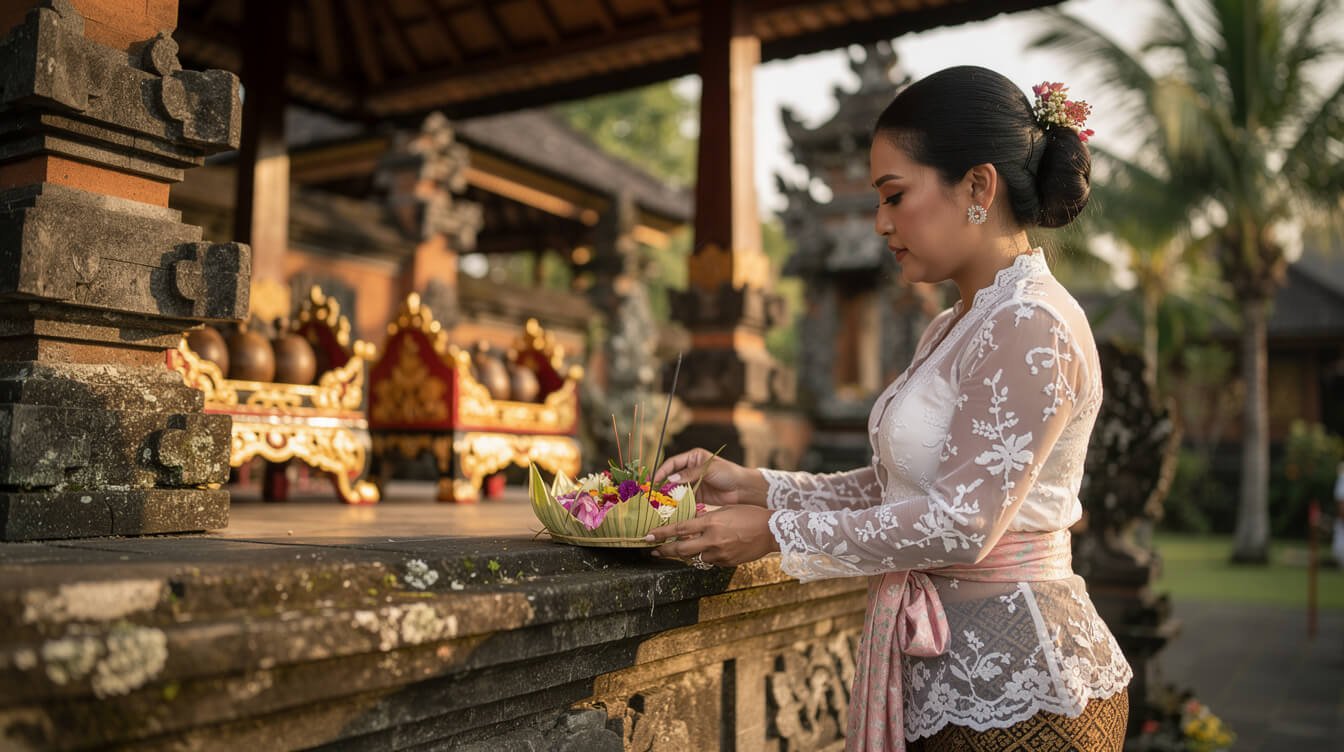
What sets it apart is purpose. In much of the world, dance is something you go out to see. In Bali, dance began as something you give. Many dances are part of ceremonies, offered to the gods and ancestors in the same spirit as the small palm-leaf offerings you’ll see on every doorstep in Ubud. Even the shows staged for visitors usually begin with a small offering and a prayer at the edge of the stage. If you watch closely before the music starts, you’ll often see it.
That’s why Balinese dancers talk about taksu, a kind of spiritual charisma or inner energy that makes a performance come alive. Technique can be taught. Taksu is something a dancer grows into, and audiences here can feel the difference. If you’d like to understand the faith behind all this, our guide to Bali’s religion is a good place to start.
What are Balinese dances called?
There’s no single name. The word tari simply means dance in Indonesian, so you’ll see names like Tari Legong, Tari Pendet or Tari Baris. Each dance has its own name, story, costume and music. The ones you’re most likely to meet as a visitor are Legong, Barong, Kecak, Baris, Pendet, Topeng and Janger, plus the long Ramayana dance dramas.
The Three Genres of Balinese Dance: Sacred, Ceremonial and Made for You
In 2015, UNESCO inscribed the Three Genres of Traditional Dance in Bali on its Representative List of the Intangible Cultural Heritage of Humanity. That title is worth knowing, because it’s the most useful key there is to Balinese dance. The Balinese themselves sort their dances into three circles, from most sacred to most public.
Wali: the sacred dances
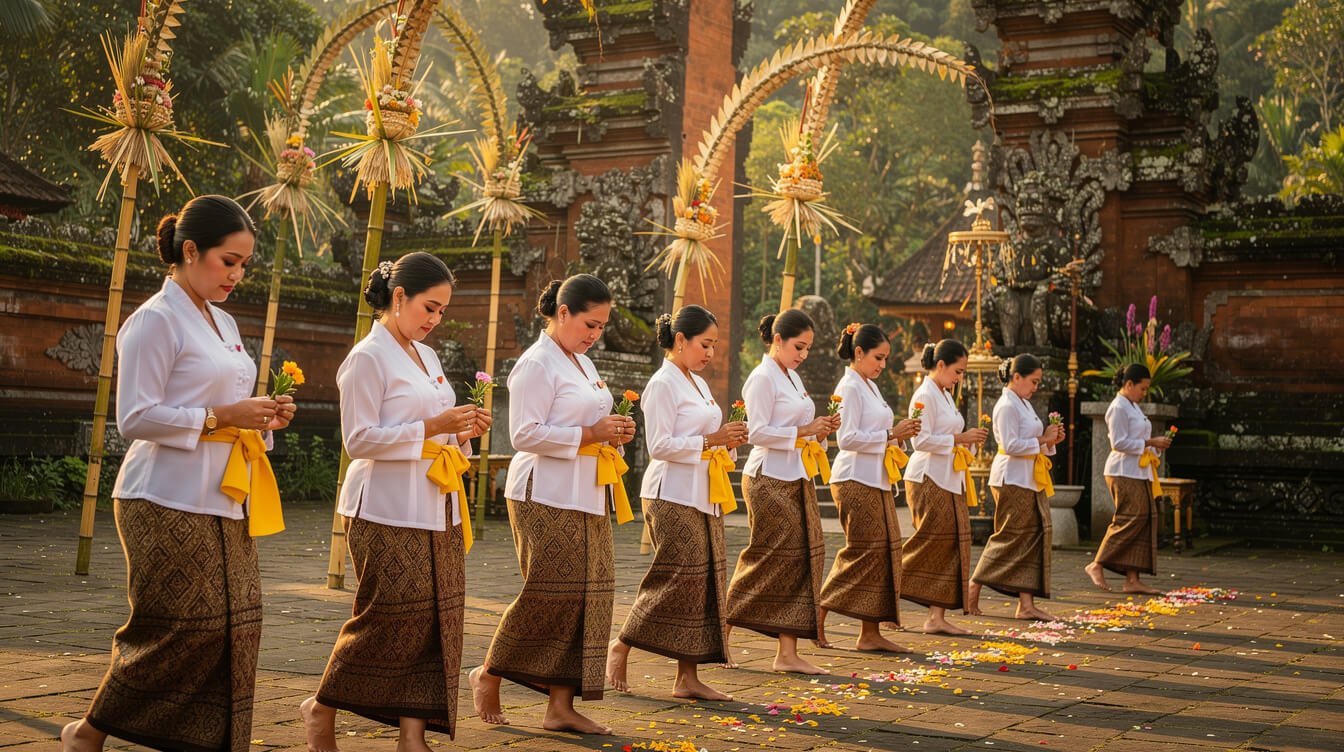
Wali dances belong inside the innermost temple courtyard, during ceremonies. They are offerings, not shows. Examples include the Rejang, a slow, graceful procession danced by women and girls; the Sanghyang Dedari, a trance dance; and the Baris Upacara, a ceremonial warrior dance performed by lines of men. You won’t buy a ticket to these. If you see one, it’s because you happen to be at a temple ceremony, and you are a guest at someone else’s worship.
Bebali: the ceremonial dances
Bebali dances sit in the middle courtyard. They accompany ceremonies and often tell stories, but they also speak to the human audience. The UNESCO listing names the masked Topeng Sidhakarya (also called Topeng Pajegan), the ancient Gambuh dance drama, and the Wayang Wong dance drama. You’ll sometimes see Topeng at village ceremonies, where a single masked dancer plays one character after another.
Balih-balihan: the dances for everyone
Balih-balihan dances are for the outer courtyard and the wider community: entertainment, art, celebration. This is the genre you’ll see on stage in Ubud. UNESCO’s examples are the Legong Kraton, the flirtatious social Joged Bumbung, and the Barong Ket. Kecak, the famous chanting dance, also belongs here as a 20th-century creation for audiences.
Here’s the gentle truth this system gives you: the dances you buy tickets for are meant for you. You’re not intruding on anything. And the dances you can’t buy tickets for are simply not part of the visitor’s world, unless you’re invited in.
Five Balinese Dances to Know and How to Recognize Them
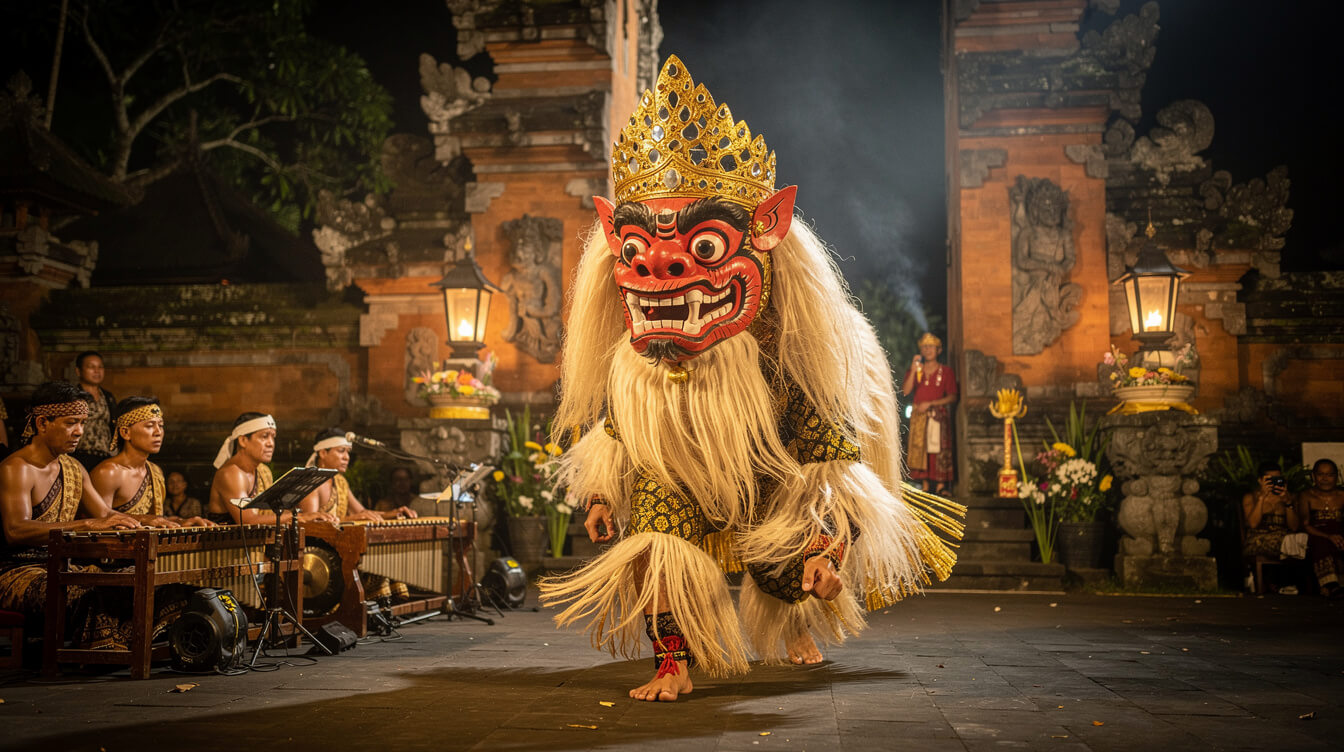
You don’t need a program to know what’s in front of you. A few visual clues will do it.
1. Legong: the dance of the girls in gold
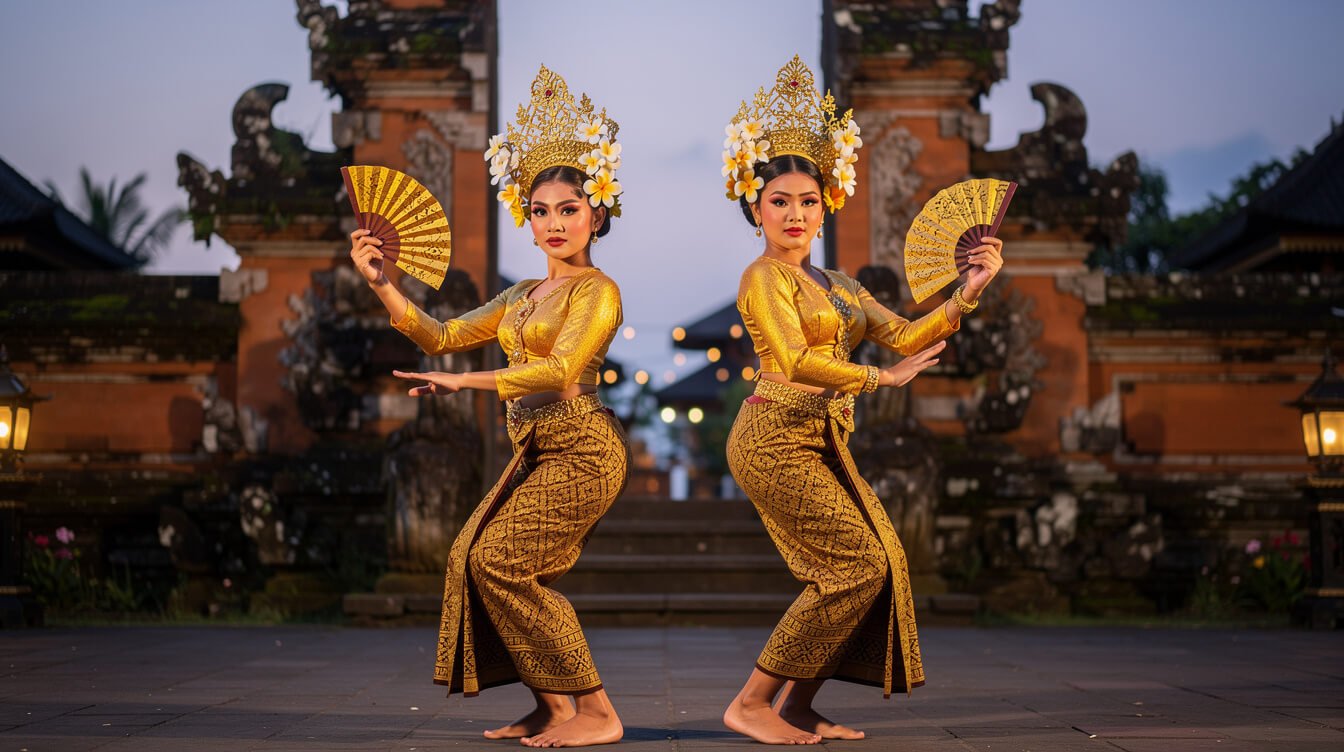
Look for two or three young female dancers in tightly wrapped, gold-painted cloth and tall headdresses crowned with frangipani, moving in near-perfect unison. Fans flutter. Eyes flash. Feet barely seem to touch the ground. Legong grew up in the royal courts of the 19th century and is the most refined of all Balinese dances. The classic story, Legong Lasem, follows a king who abducts a princess and the ill omen of a bird that warns him of his fate. Often a third dancer, the condong, plays an attendant who opens the piece.
2. Barong: the good beast and the witch
If a large, shaggy creature with a carved red mask, a golden crown and a clacking jaw walks onto the stage, danced by two men inside one body, you’re watching Barong. Barong is a protective spirit, part lion, part dog, part guardian. His great opponent is Rangda, the widow-witch with long nails and wild hair. The battle between them never truly ends, because in Balinese thought good and evil are held in balance rather than defeated. In some versions, men with kris daggers fall into trance and turn the blades on themselves without harm. It’s dramatic, and it often makes children in the audience shriek with delight.
3. Kecak: the chorus of voices
No gamelan at all. Instead, a circle of dozens of bare-chested men chants “cak-cak-cak” in interlocking rhythms around a flickering lamp, while dancers in the center act out scenes from the Ramayana. Kecak was shaped in the 1930s, drawing on the chorus of the older Sanghyang trance ritual. We’ve written a full guide to the Kecak dance in Ubud, so we’ll keep this one short. If you want the cliff-top version, see our Uluwatu Temple guide.
4. Baris: the warrior
A single male dancer, or a line of them, in a tall triangular helmet and layers of colored cloth panels that fan out when he turns. His stance is wide and grounded, his eyes fierce, his movements sudden. Baris portrays a young warrior preparing for battle, and the solo version is a test of a dancer’s control. The ceremonial form, Baris Upacara, is a sacred wali dance, which is a lovely example of the same dance family crossing the genres.
5. Pendet: the welcome
Young women carrying small bowls of flowers, scattering petals toward the audience or the shrine. Pendet began as a temple dance of welcome for the gods and became a welcome dance for human guests too. It’s often the first dance on a program, which makes it a beautiful way to begin your evening.
A bonus: Topeng, the masks
If one dancer keeps leaving the stage and returning as someone else, you’re watching Topeng, the masked dance. Each mask is a character: a proud king, a doddering old man, a clown who talks to the audience. Masks are carved and consecrated before they’re danced, and the best Topeng dancers can make you laugh in a language you don’t speak.
Get a free 3-day sample itinerary
Three good days in Ubud: rice field walks at first light, a temple morning, a market, and an evening of Balinese dance under the lanterns. We will send you a free 3-day sample itinerary.
Why Balinese Dancers Move Their Eyes: Seledet, Mudra and Agem
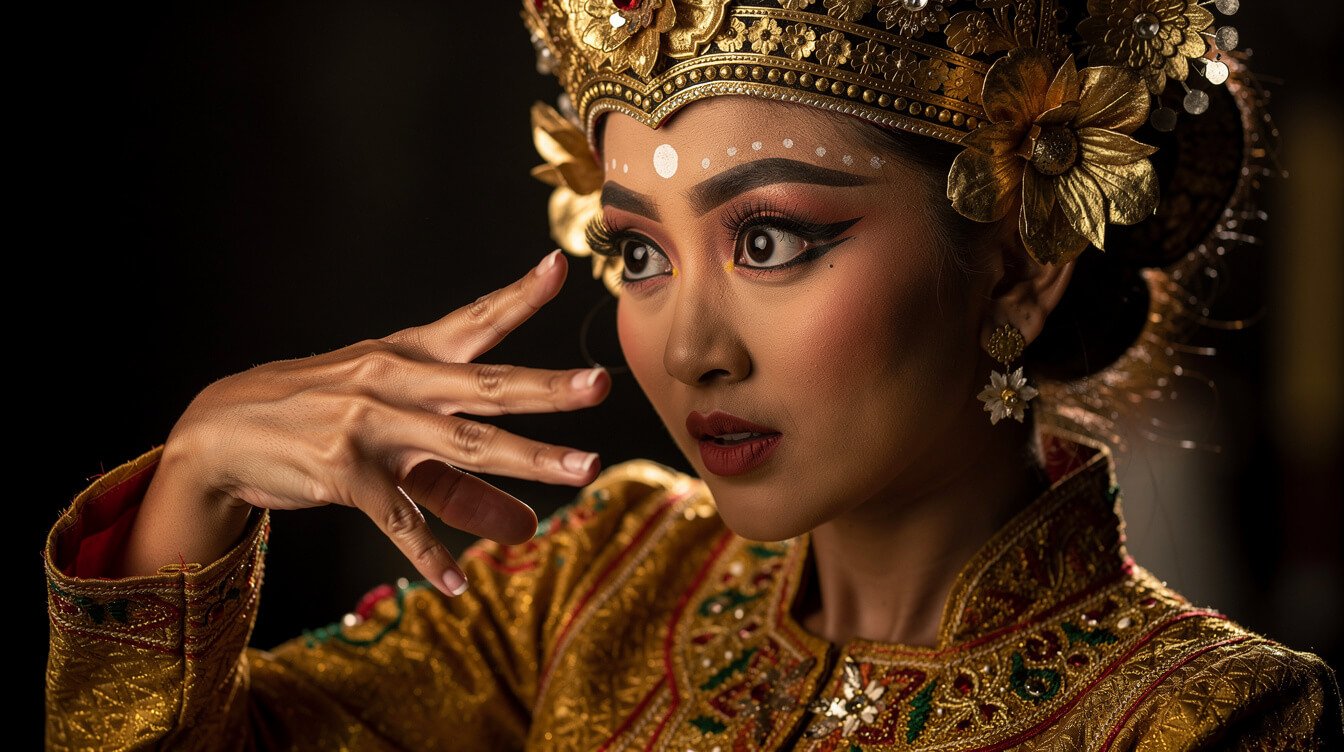
Ask anyone after their first Balinese dance what they remember, and most will say the same thing: the eyes. The dancer’s eyes open wide, freeze, then flick sharply left, right, left, almost too fast to follow. It can feel startling, even a little unsettling. It’s completely intentional.
Seledet: the eye movement
The eye movement is called seledet. Balinese dancers use their eyes to carry emotion and to direct your attention, the way an actor uses their voice. The UNESCO description of Balinese dance lists facial expressions and eye movements that reveal happiness, sadness, anger, fear and love. A sharp seledet can say alarm, defiance or delight. A slow, softened gaze can say longing. In a Legong, the eyes are lively and coquettish. In a Baris, they glare like a hawk’s. Teachers often correct a child’s eyes before anything else, which we wrote about in a short daily piece, The Eyes the Dance Teacher Corrects First.
Mudra: the hands
Watch the fingers next. They spread, bend backward and tremble at the tips. These hand gestures, often called mudra, come from a long Hindu-Buddhist tradition of sacred gesture, and in Balinese dance they shape every phrase. The quivering fingers (ngeliput in some teachers’ vocabulary) catch the light and make the whole body seem to vibrate with energy.
Agem: the stance
Finally, look at the body’s base. The agem is the fundamental posture: knees bent and turned outward, back arched, chest lifted, elbows raised high. It’s demanding to hold and gives Balinese dance its angular, sculpted look, completely unlike the flowing lines of ballet. UNESCO describes it simply as “a basic posture with the knees outward and the stomach held in.” Once you see the agem, you’ll notice it in temple carvings and paintings all over Ubud.
Put the three together, eyes, hands and stance, and you start to see Balinese dance as a language. You won’t understand every word. But you’ll know it’s speaking.
Where to See Balinese Dance in Ubud: Choosing Your Night and Your Stage
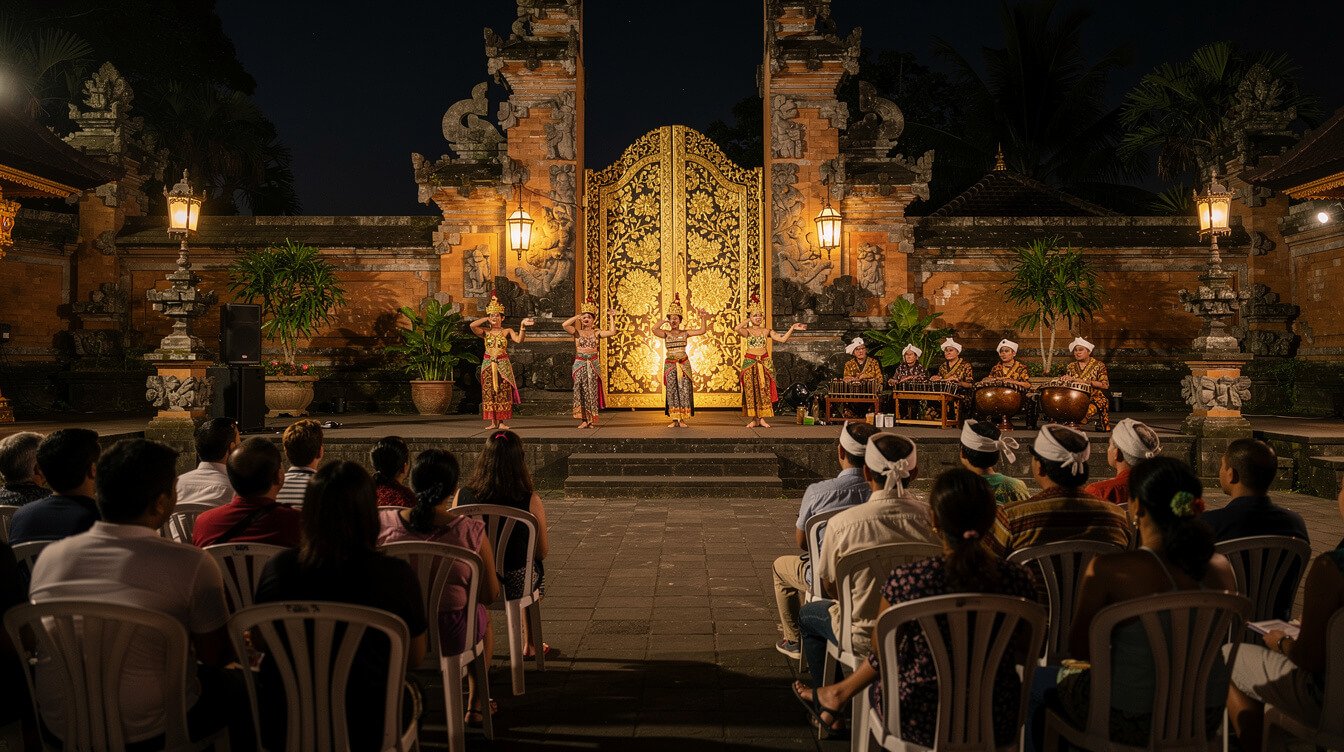
Ubud has long been called the cultural heart of Bali, and on most evenings several dance performances run at once within walking distance of the town center. Here’s how to choose.
The main stages
- Ubud Palace (Puri Saren Agung). The most atmospheric setting in town: a royal courtyard with a carved split gate as the backdrop. Programs rotate through the week, mostly Legong and Barong, with Ramayana nights. Read our guide to Ubud Palace and its evening dances for more on choosing a night there.
- Pura Taman Saraswati. The lotus-pond temple a few minutes’ walk from the palace. Performances here have the water garden as a backdrop. Our Ubud Water Palace guide covers the temple itself.
- Pura Dalem Ubud. The temple of the dead at the top of the main road, with a moody stone setting that suits Kecak and Barong nights.
- Village stages around Ubud. Nearby villages, including Peliatan, Batuan and Teges, have their own dance groups and long performance traditions. These shows are often smaller and quieter, and sometimes feel more like a community evening than a town event.
How it works
Most Ubud performances start in the early evening, commonly around 7:30 PM, and run for about 60 to 90 minutes. Tickets are usually sold at the gate or by sellers on the main street in the afternoon, at modest prices. That said, programs, start times and prices change by venue, night and season, so treat any schedule you read online, including this one, as a guide only. Check the board at the venue, or the program sheet handed out on the main road, on the day you go.
Tips for a better evening
- Arrive 20 to 30 minutes early. Seating is often first come, first served, and the front rows go fast at the palace.
- Read the program first. Most venues hand out a short story sheet. Five minutes of reading turns a beautiful show into a story you can follow.
- Watch the gamelan, too. The dancers and musicians cue each other constantly. A tiny gesture from the lead drummer can change the whole tempo. If the music draws you in, our daily piece on the evening gamelan is a small taste of how it fills Ubud’s nights.
- Flash off, please. Photos are generally fine, but flash distracts the dancers. Stay seated so the people behind you can see.
- Bring a light layer and insect repellent, especially in the wet season, when an evening shower can roll through. Some stages are open-air.
Which dance should you choose?
If you only have one night, choose Legong for elegance or Barong for drama and fun. If you have children with you, Barong is usually the crowd-pleaser, and the stories are easy to follow. If you love music and voice, choose Kecak. If you have three nights, see all three, and you’ll be amazed how different they feel. Ask the team about which stages and nights suit your group during your stay.
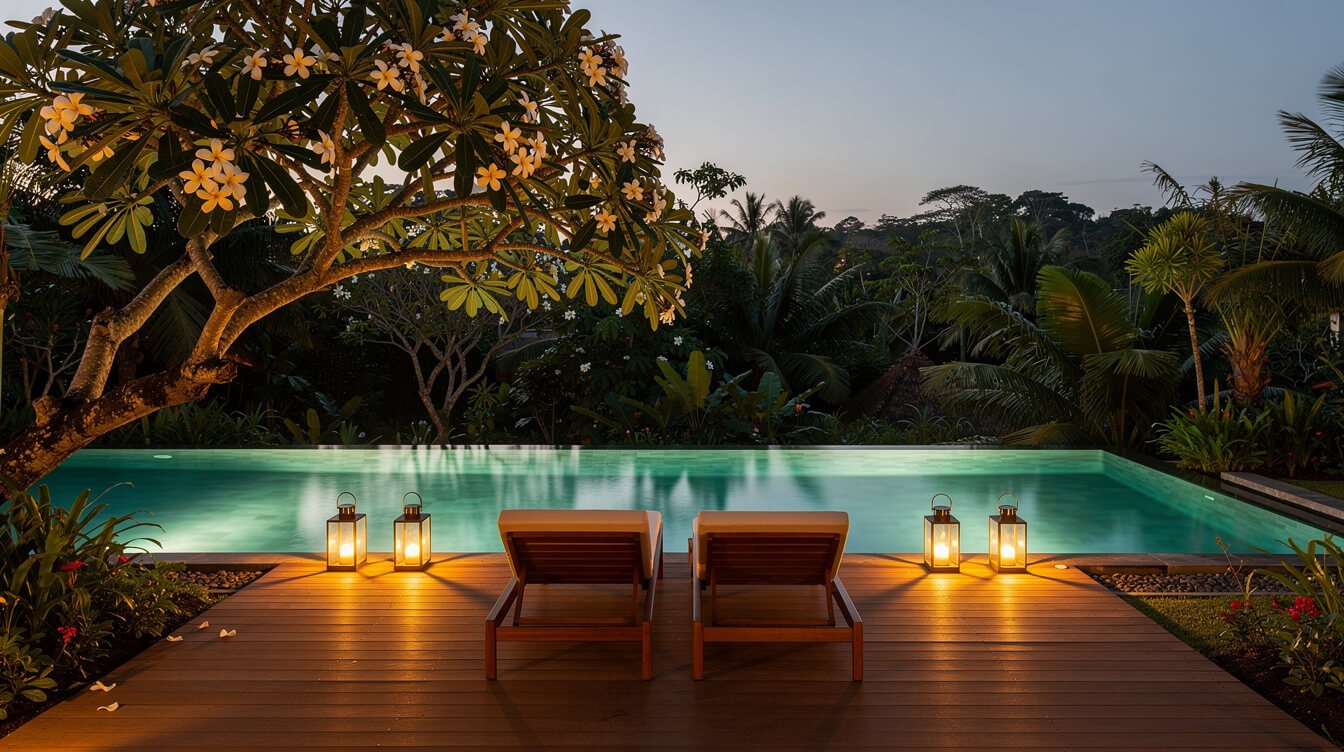
Book the Villa
Walk home from the palace stage to three bedrooms, a private pool and a quiet tropical garden in Ubud, with a team on hand so your evenings stay unhurried. Check availability for your dates.
If You’re Invited to a Temple Ceremony: How to Watch Balinese Dance Respectfully
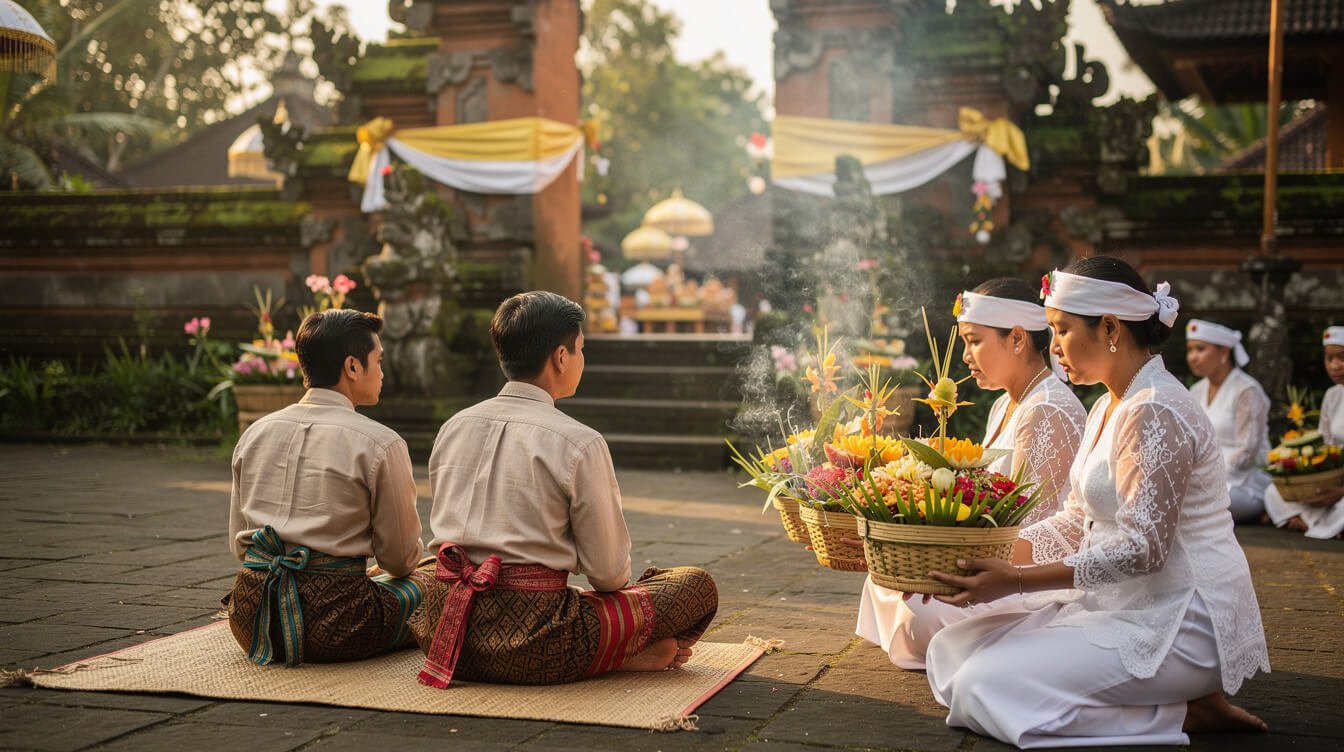
Sometimes the best Balinese dance you’ll see has no stage at all. During a temple anniversary, called an odalan, or a major holy day like Galungan, the village temple fills with families in white and gold, offerings stacked high, and gamelan playing for hours. You might glimpse a line of women dancing the Rejang, or a masked Topeng dancer entertaining the gods and the crowd at the same time.
Balinese people are often warm and welcoming to respectful visitors at these moments. If a local friend or guide invites you, it’s a real gift. Here’s how to honor it:
- Dress properly. A sarong and a sash (selendang) tied at the waist are required in any temple. Cover your shoulders. Simple, modest, light-colored clothing is best.
- Follow your host’s lead. Enter only the courtyards you’re shown. Inner courtyards may be closed to non-worshippers.
- Never stand higher than the priest or the offerings, and don’t sit on walls or shrines for a better view.
- Don’t walk in front of people who are praying, and never step over offerings on the ground.
- Ask before photographing, and never use flash during a ceremony. Sacred dances are a prayer, not a photo opportunity. Many visitors find the experience richer with the phone away.
- Women who are menstruating are traditionally asked not to enter temples. It’s a local religious custom, and visitors are expected to respect it.
- Sit quietly at the edges, keep your voice low, and don’t touch anything you’re not offered.
It also helps to know the island’s ceremony calendar, which follows the 210-day Balinese pawukon cycle rather than the Western calendar. Our guide to Ubud’s temples and their ceremonies explains how it works and what to expect.
The Next Generation: Where Balinese Dance Is Learned
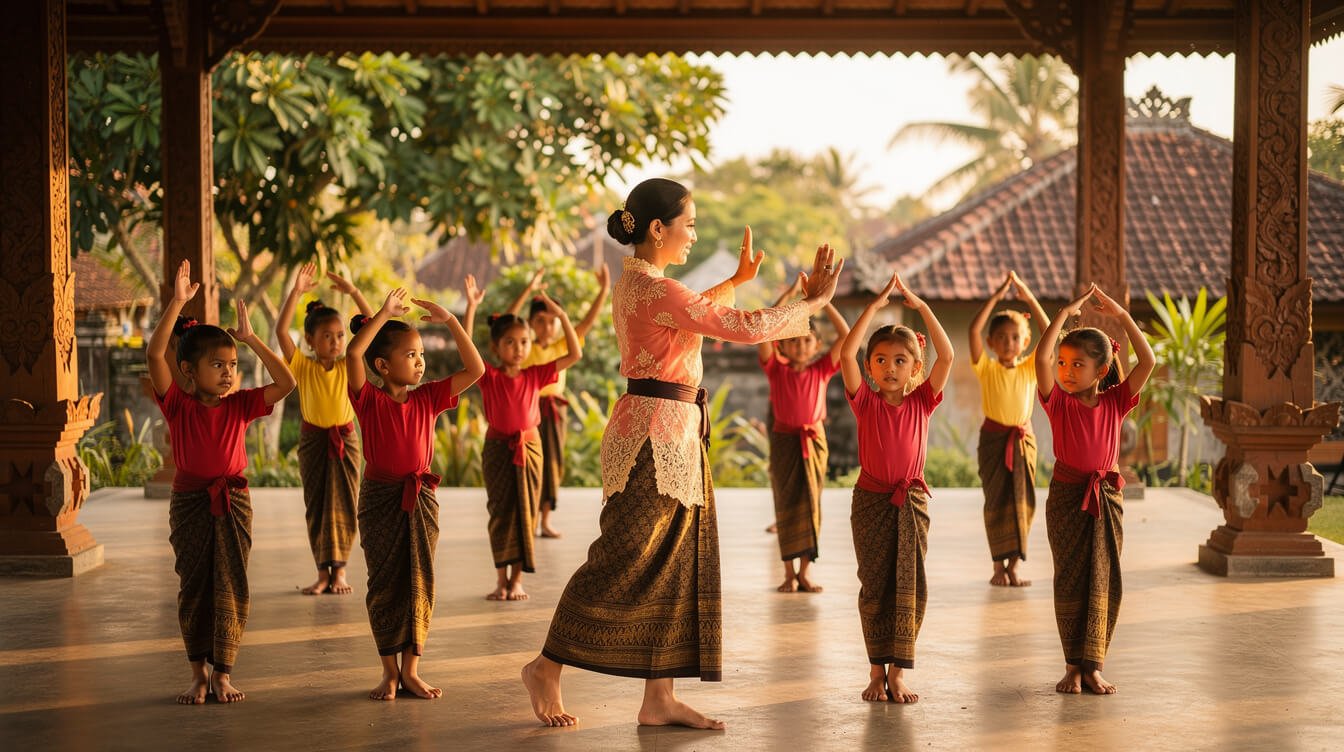
Walk through Ubud in the late afternoon, and sooner or later you’ll hear a teacher counting over a gamelan recording, coming from an open-sided community hall. Inside, rows of small girls in practice sarongs hold their elbows high and try to make their eyes as wide as the teacher’s. This is how Balinese dance survives: not in museums, but in the banjar, the village neighborhood association, and the sanggar, the local dance studio.
UNESCO notes that Balinese dances are mainly passed to children informally, from an early age, in groups. Training starts with the basic positions and movements and moves on to more complex dances, practiced until the sequence is memorized. Many of the dancers you’ll see on stage in Ubud began this way, sometimes at five or six years old. We’ve also written about a family workshop that keeps dance and music alive in one quiet alley.
Can visitors take a Balinese dance class?
Yes. Several studios and cultural centers in and around Ubud offer short beginner lessons for visitors, from a single hour to a few sessions. You’ll learn the agem stance, a few hand positions and, if you’re brave, the seledet. Expect your thighs to ache the next morning. It’s one of the most memorable things families can do together, and children often pick it up faster than their parents. Ask the team for a suggestion that fits your dates.
A few words of Balinese go a long way at these moments, too. Our short guide to the Balinese language will help you say thank you properly to the teacher.
Balinese Dance FAQ
What is traditional Balinese dance?
Traditional Balinese dance is a family of dance forms from Bali, performed to live gamelan music and rooted in Balinese Hinduism. It’s divided into three genres: sacred wali dances, ceremonial bebali dances, and balih-balihan dances for entertainment. UNESCO inscribed these three genres as Intangible Cultural Heritage in 2015.
What are five traditional Balinese dances?
Five of the best known are Legong, Barong, Kecak, Baris and Pendet. Other important dances include Topeng (masked dance), Rejang (a sacred temple dance), Joged (a social dance) and Janger.
Why do Balinese dancers move their eyes?
The eye movement, called seledet, is a core part of the dance’s expressive language. Dancers use sharp, wide-eyed glances to convey emotions such as joy, anger, fear and love, and to guide the audience’s attention. It works together with hand gestures (mudra) and the basic stance (agem).
Where is the best place to see Balinese dance?
Ubud is the island’s dance capital. Ubud Palace, Pura Taman Saraswati and Pura Dalem Ubud host regular evening performances, and nearby villages such as Peliatan have long dance traditions of their own. Kecak at Uluwatu Temple is the famous sunset option in the south.
How much does a Balinese dance show cost in Ubud?
Ticket prices for the regular Ubud evening shows are generally modest, but they vary by venue and change over time. Check at the venue or with the ticket sellers on the main road on the day you go.
Is Balinese dance suitable for children?
Very much so. Barong performances, with their big friendly beast and comic moments, are often a hit with kids. Shows last about an hour to an hour and a half, so bring water and something to fan yourself with.
Can I photograph Balinese dance?
At ticketed performances, photos are generally welcome, without flash. At temple ceremonies, ask first, avoid flash, and put the camera away during prayers and sacred dances.
Balinese dance rewards attention. The first night, you’ll see gold and color and wonderful noise. By the second, you’ll start catching the eyes, the fingers and the stance. And if you’re lucky enough to stand at the edge of a village temple one afternoon while a line of women dances the Rejang for the gods, you’ll understand why the Balinese say a dance is, first of all, an offering.

Join our newsletter — fun, new, exciting Bali news
Ceremony days, market finds, new trails and small stories from Ubud. Delivered now and then, always worth opening.