Why the Rice Changes Color Every Week in Ubud
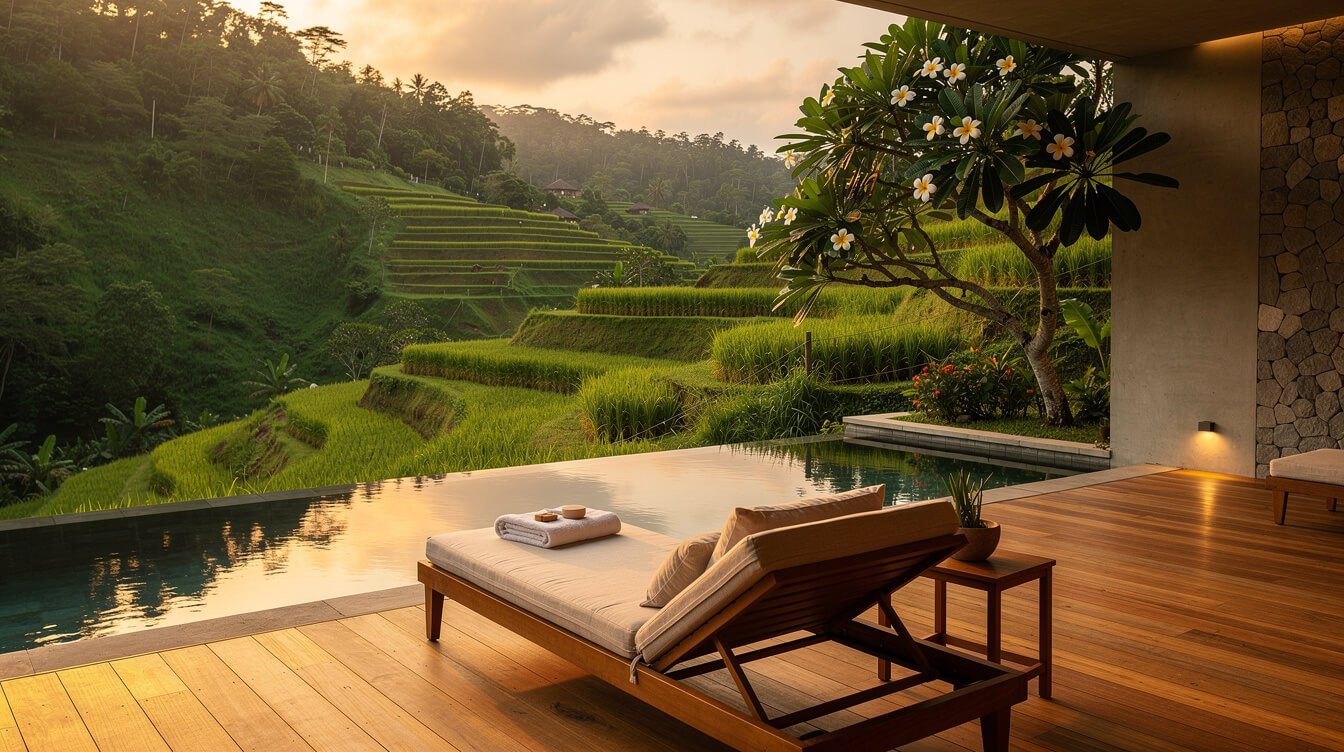
You notice it on day three. The ubud rice fields below the terrace look different than they did when you arrived — a shade greener, or the water has disappeared under a soft carpet of shoots. Nobody mentioned it. Nobody had to. The rice is keeping its own calendar, and if you stay long enough, you start reading it.
The View That Never Holds Still
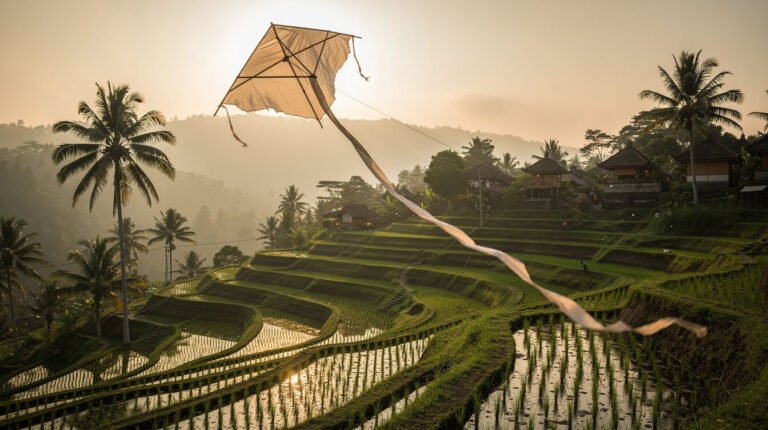
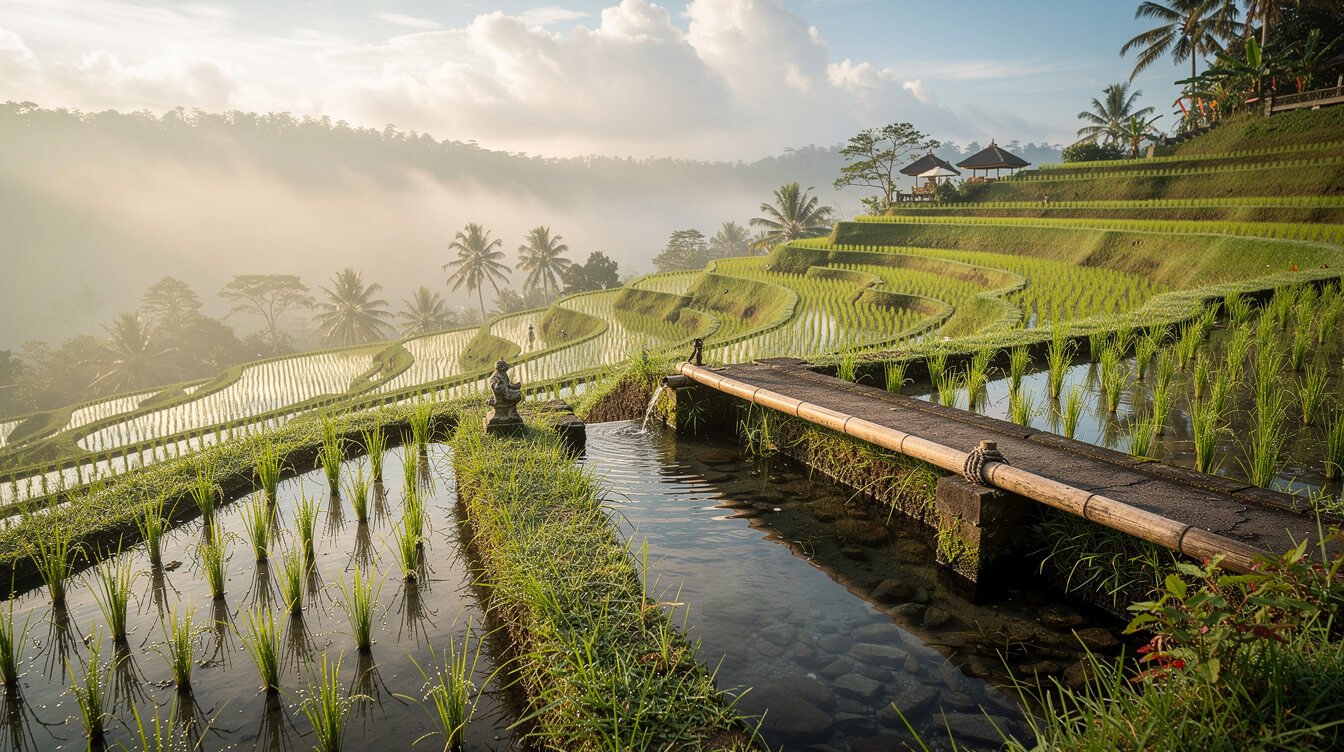
Most visitors photograph the rice terraces once and move on. But the terraces are not a single view — they are a cycle. One week the paddies are mirrors, reflecting cloud and sky, every contour of the hillside doubled in still water. The next, pale green filaments break the surface like the first breath of something patient. A week later, the green is dense enough to swallow the light whole.
By the time the stalks bow heavy with grain, the valley has turned gold — a warm, papery gold that catches the late-afternoon sun and holds it. Then the harvest comes, the stubble is burned, the water returns, and the whole thing begins again. In Ubud, landscape is not scenery. It is a clock.
What Each Color Tells You
The colors are not random. Mirror-water means the fields have just been plowed and flooded — the soil is resting, absorbing nutrients, waiting. The pale shoots that follow are the transplanting phase, when farmers wade barefoot through mud to place each seedling by hand. Deep emerald is the tillering stage, the rice multiplying from a single stem into a clump of twenty. And the gold — that is the grain filling, the weight building, the whole paddy leaning toward its purpose.
Each phase lasts roughly two to three weeks. If you stay for seven nights, you will see the change. Not dramatically, not all at once. But the green you left at breakfast will be a different green by the time you sit down for dinner.
Get a free 3-day sample itinerary
The Gardener Reads the Fields
Made grew up in a farming family two villages over. His grandfather worked these same terraces before they became a backdrop for villa guests and travel photographs. So when Made looks out from the garden at 6 AM, he is not admiring the view. He is reading it.
“The water is low in the upper terrace,” he said one morning, adjusting the hose on a heliconia bed. “They will flood again before Friday.” He was right. By Thursday evening, the paddy above the garden wall had become a mirror again, and the frogs had returned to announce it.
He knows which phase of the water cycle brings the dragonflies, when the herons arrive to hunt in the shallows, and why the light looks different when the rice is tall. It is the same intuitive knowledge he brings to the villa garden — reading what the plants need before they show stress, watering before the soil cracks, trimming before the overgrowth tangles.
What Subak Teaches About Care
The Balinese do not irrigate rice the way you might expect. There is no central authority deciding who gets water and when. Instead, they use subak — a cooperative system over a thousand years old, where every farmer along a watershed coordinates planting, flooding, and harvesting through consensus. No one takes more water than their share. No one plants out of turn.
It works because everyone understands that what flows to your terrace depends on what your neighbor does upstream. Care is shared. The result is shared. UNESCO recognized subak as a cultural landscape precisely because it proves that beauty and function can be the same thing.
Book the Villa
Your Front-Row Seat
From the upper terrace, morning coffee in hand, you watch the mist lift off the valley in slow layers. The paddies below are still holding last night’s coolness, and the green is so saturated it looks painted. A farmer crosses the lower terrace with a hoe over one shoulder. Two white herons lift off the far edge and circle back.
Nobody curated this for you. It is not a set, not a performance. It is Wednesday morning, and the rice is doing what it has done here for a thousand years — growing, changing color, feeding people, feeding the landscape, feeding something in you that you did not know was hungry.
Stay long enough, and you stop photographing it. You just watch.

Join our newsletter — fun, new, exciting Bali news