Jatiluwih Rice Terraces: Reading Bali’s UNESCO Landscape on a Day From Ubud
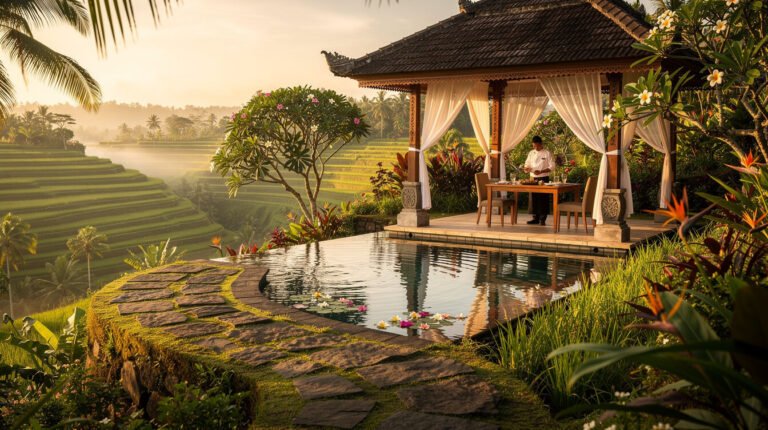
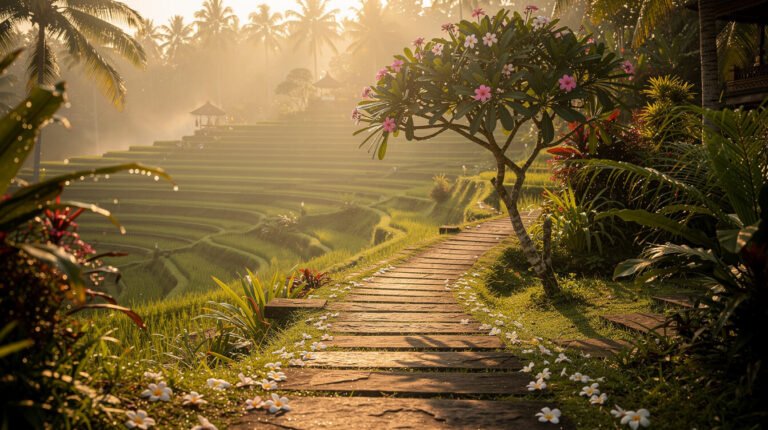
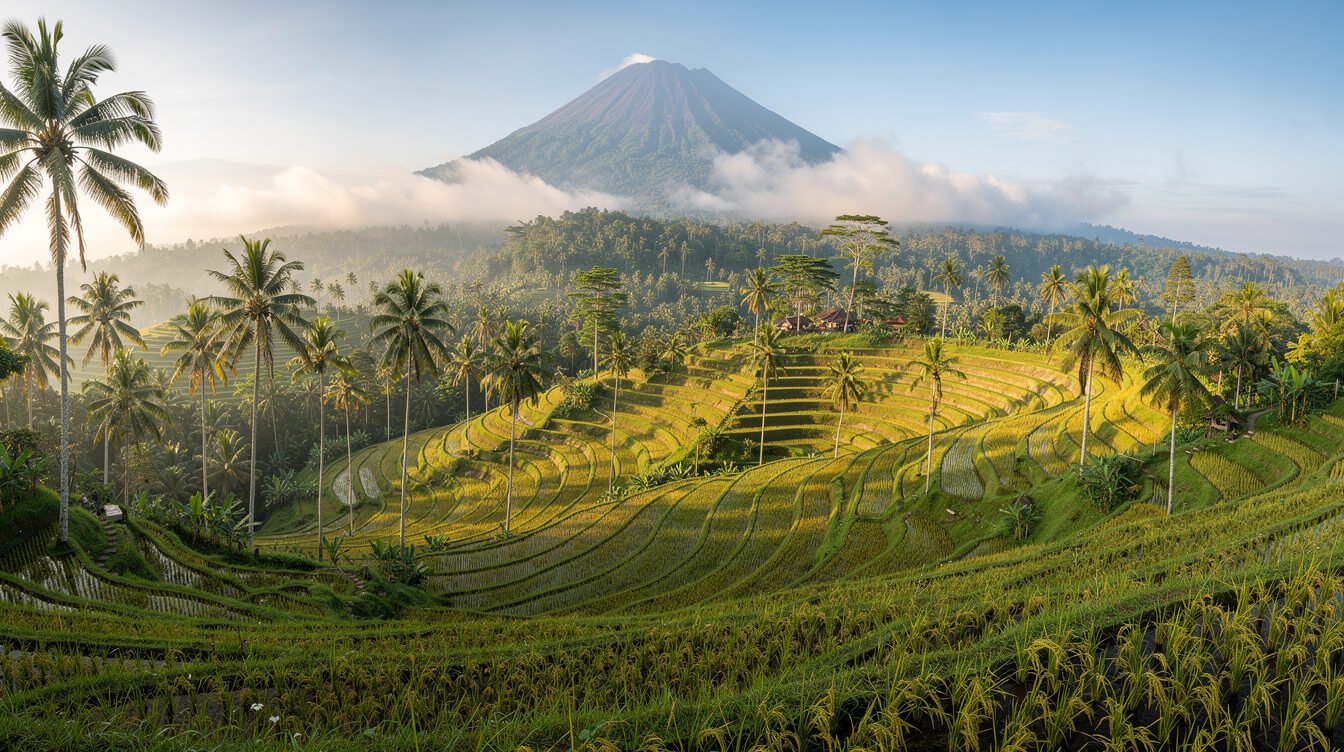
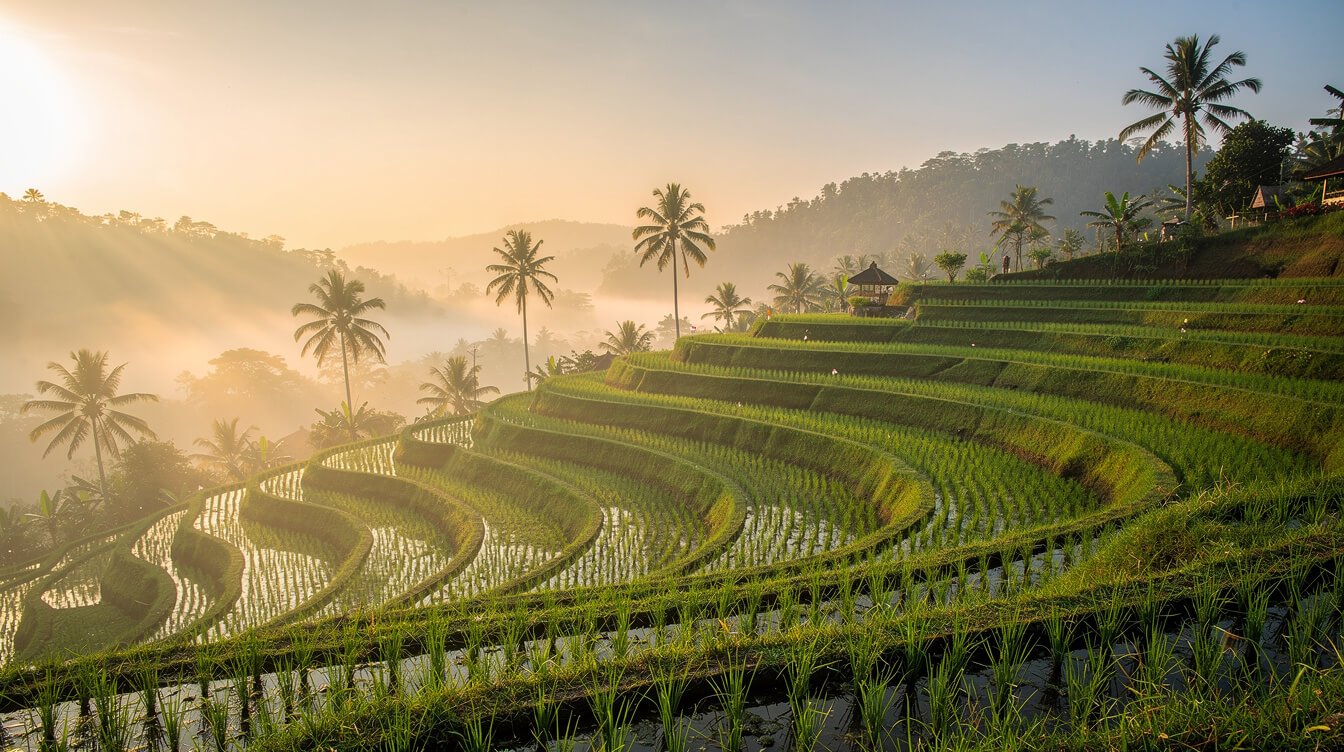
Stand at the top of the slope early, before the tour vans arrive, and the first thing you notice is the sound. Water runs everywhere: through stone channels, over the lip of one terrace into the next, past your feet in a ditch no wider than your hand. The valley below you steps down in long, curving shelves of rice, and above it all Mount Batukaru wears its morning cloud. These are the Jatiluwih rice terraces, the largest and most celebrated rice landscape in Bali, and from Ubud they make one of the most rewarding days you can spend on the island.
Most guides treat Jatiluwih as a view with a ticket booth. Pay the fee, take the photograph, drive on. We’d like to give you something more useful: a way to read the terraces. In this guide you’ll learn where Jatiluwih is and why UNESCO cares about it, how the ancient subak water system moves water from a mountain lake to a single rice plant, what the fields look like in each month of the year, which walking route suits your time and legs, how Jatiluwih compares with the terraces closer to Ubud, how to walk among working farmers with care, and how to pair it with the lake temple at Bedugul for one long, beautiful highland day.
Jatiluwih Rice Terraces at a Glance: Where They Are and Why UNESCO Listed Them
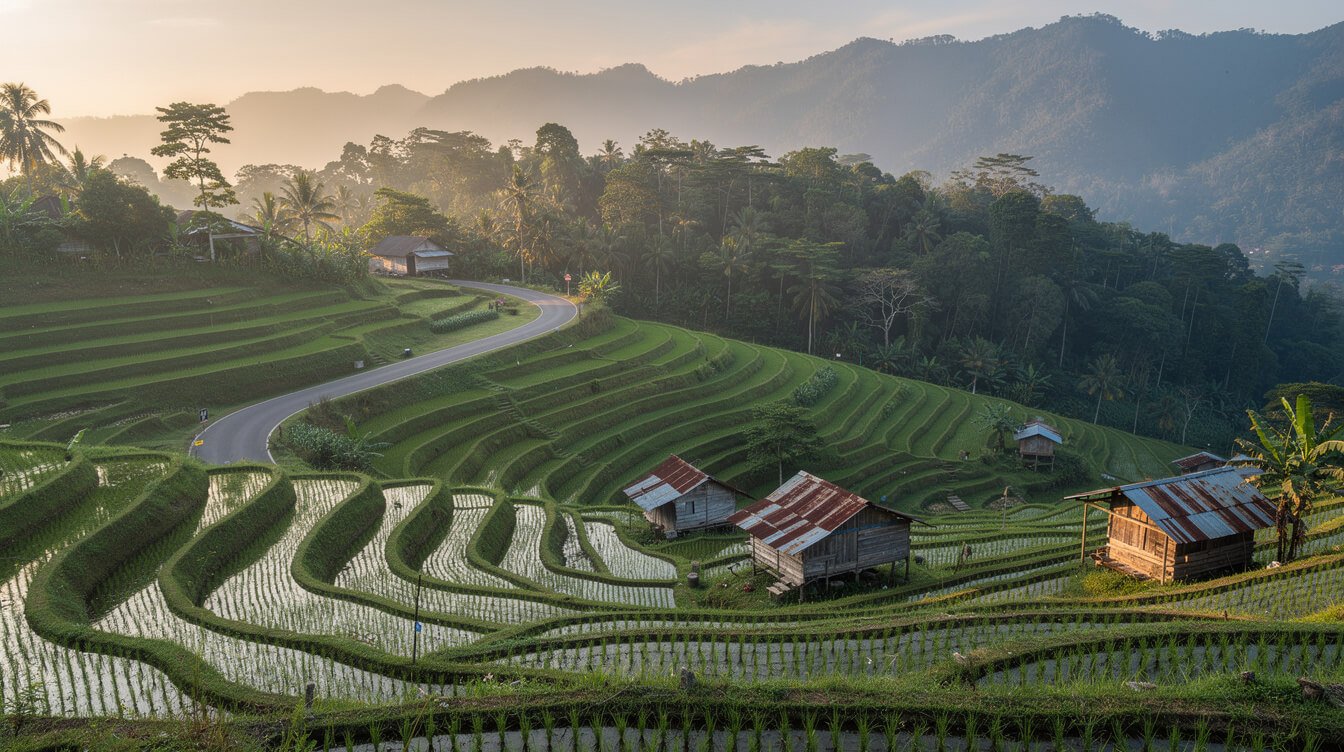
Jatiluwih is a farming village in the Penebel district of Tabanan Regency, in west-central Bali. Its terraces spread across the southern foothills of Mount Batukaru, the island’s second-highest volcano, at roughly 700 meters (about 2,300 feet) above sea level. That height matters. The air is cooler than in Ubud, the light is softer, and in the wet months clouds drift down the mountain and through the fields by early afternoon.
The name is often explained as a pairing of two old words, jati (truly) and luwih (marvelous or special). Stand at the viewpoint on a clear morning and you’ll understand why nobody has argued with it.
How far is Jatiluwih from Ubud?
Plan on about 1.5 to 2 hours each way by car, depending on traffic and your driver’s route. The road heads west through rice country and small market towns, then climbs gently into the Tabanan hills. It is an easy, scenic drive with a private driver, and we’d recommend that over a scooter for most guests: the last stretch is narrow and winding, and wet-season rain arrives quickly up here.
What UNESCO actually listed
In 2012 UNESCO inscribed the Cultural Landscape of Bali Province: the Subak System as a Manifestation of the Tri Hita Karana Philosophy on the World Heritage List. Notice what that title protects. It is not a pretty view. It is a system: the water temples, lakes, forests, channels and farmer cooperatives that have shared water across Bali for around a thousand years. Jatiluwih sits inside one of the listed areas, the Catur Angga Batukaru landscape on the slopes of the mountain, and it has become the most visited face of that listing.
Tri Hita Karana, the philosophy in the title, means “three causes of well-being”: harmony between people and the divine, between people and each other, and between people and nature. Every channel you’ll walk beside at Jatiluwih is an expression of all three. If you’d like the wider picture of how faith shapes daily life here, our guide to Bali’s religion is a good companion read.
How Subak Works: From the Lake Temple to the Field
Here is the story the Jatiluwih rice terraces tell, once you know how to read them.
It begins high in the mountains, at the crater lakes. In Balinese belief the lakes are sacred sources of life, watched over by Dewi Danu, the goddess of the waters. The great lake temples, including Ulun Danu Beratan Temple on Lake Beratan, honor her. Water seeps from the lakes through the volcanic rock, emerges as springs and rivers on the lower slopes, and is caught by weirs and led into channels.
From there, the water belongs to the subak. A subak is a cooperative of farmers who share one water source. Members meet, agree on planting dates, maintain the channels together, and decide how water is divided. The leader, called the pekaseh, is chosen by the members. It is, in a very real sense, a small democracy built around water, and it has worked for centuries without a central authority telling anyone what to do.
Reading the channels as you walk
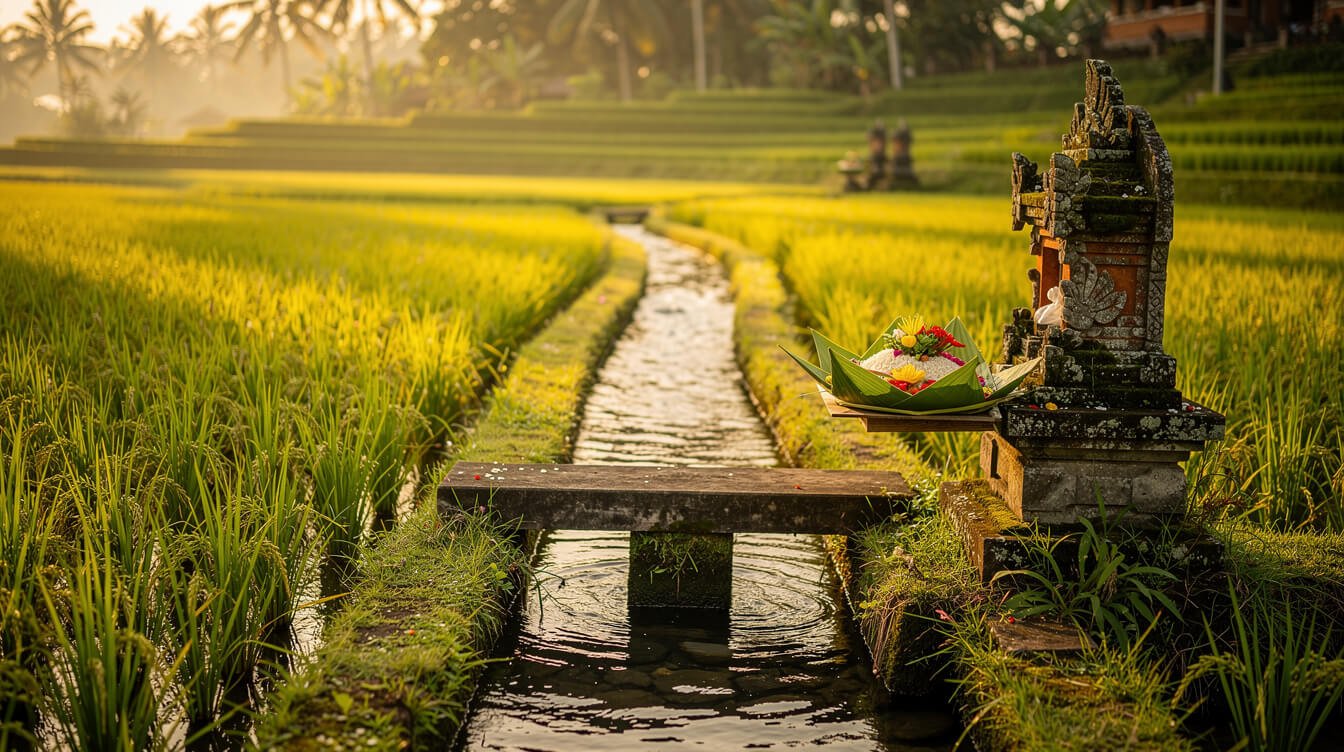
As you walk the terraces, look down. You’ll see stone or concrete dividers where one channel splits into two or three. The width of each opening is not random: it reflects how much land each branch must feed, agreed by the farmers. Water drops from the highest terrace to the next, then the next, so that every field gets its share before the flow moves on. When you hear water spilling through a gap in a terrace wall, that sound is the system working.
The temples in the fields
Watch for small shrines at the head of a channel or the corner of a field, often with a fresh palm-leaf offering tucked into it. Each subak has its own temple, and farmers make offerings at key points in the rice cycle: when water is opened to the fields, when the rice begins to flower, when the harvest comes in. Many are made to Dewi Sri, the goddess of rice and fertility. Above them stand the larger regional temples, and above those the lake temples. The whole island is linked, temple to temple, by the path the water takes.
Once you see it, you can’t unsee it. The terraces stop being a backdrop and become something closer to a living document. We wrote a small morning reflection on this very idea in a quiet piece about subak near Ubud.
What the Jatiluwih Rice Terraces Look Like Each Month
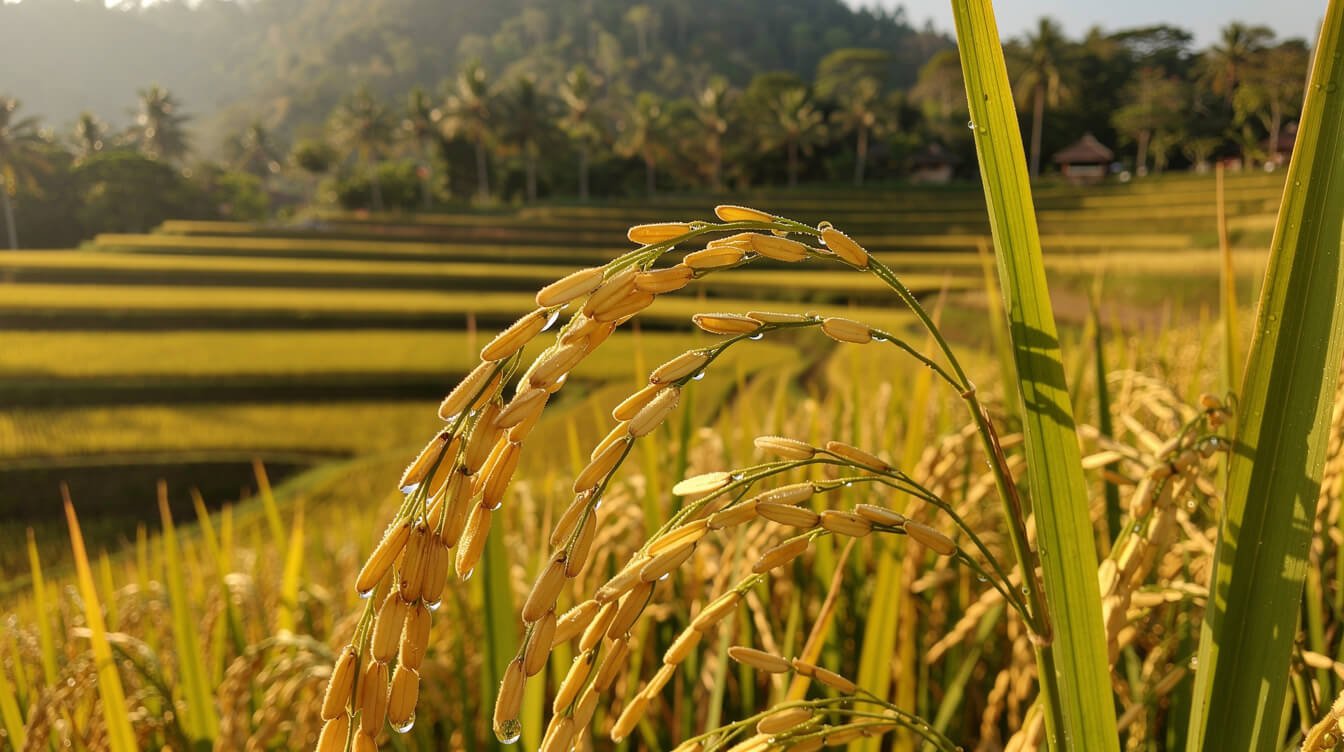
Here is what most visitors don’t realize: there is no single “Jatiluwih view.” The terraces change color, texture and mood across the year, because they follow the rice. Jatiluwih is known for its local red rice, and farmers here generally grow two main crops a year, timed together through the subak.
The village’s own visitor calendar sketches the cycle roughly like this:
- Late December to January: fields are plowed, flooded and planted. Terraces become mirrors that reflect the sky and the mountain.
- February to April: the young rice grows thick and vivid green. Many photographers consider this the classic look.
- May to June: grain forms and the fields begin to turn gold.
- July: harvest season for the first crop.
- August: plowing and planting begin again. This is also the busiest month for visitors.
- September to October: green and growing.
- November: golden paddies.
- December: harvest wraps up before the cycle restarts.
Treat this as a guide rather than a timetable. Planting dates shift from year to year with rainfall, water availability and auspicious days on the Balinese calendar, and neighboring fields can sit a few weeks apart. That patchwork, with gold beside green beside freshly flooded mud, is often more beautiful than a single uniform color.
If you’re visiting now
Visiting in November or December? You may catch the terraces in their golden stage, with harvesting under way in some fields. It is a wonderful time to see the work of rice up close: sickles, bundles of stalks, threshing by hand. It also coincides with the start of the wet season, so plan for a clear morning and a likely afternoon shower. Our guides to Bali weather in November and Bali weather in December will help you pack and plan, and the Bali rainy season guide covers the bigger picture.
Get a free 3-day sample itinerary
Three good days in Ubud: rice field walks at first light, a temple morning, a market, and a slow village afternoon, with room for a day among the Jatiluwih terraces. We will send you a free 3-day sample itinerary.
Choosing Your Walk: Routes, Time, Footwear and Wet-Season Mud
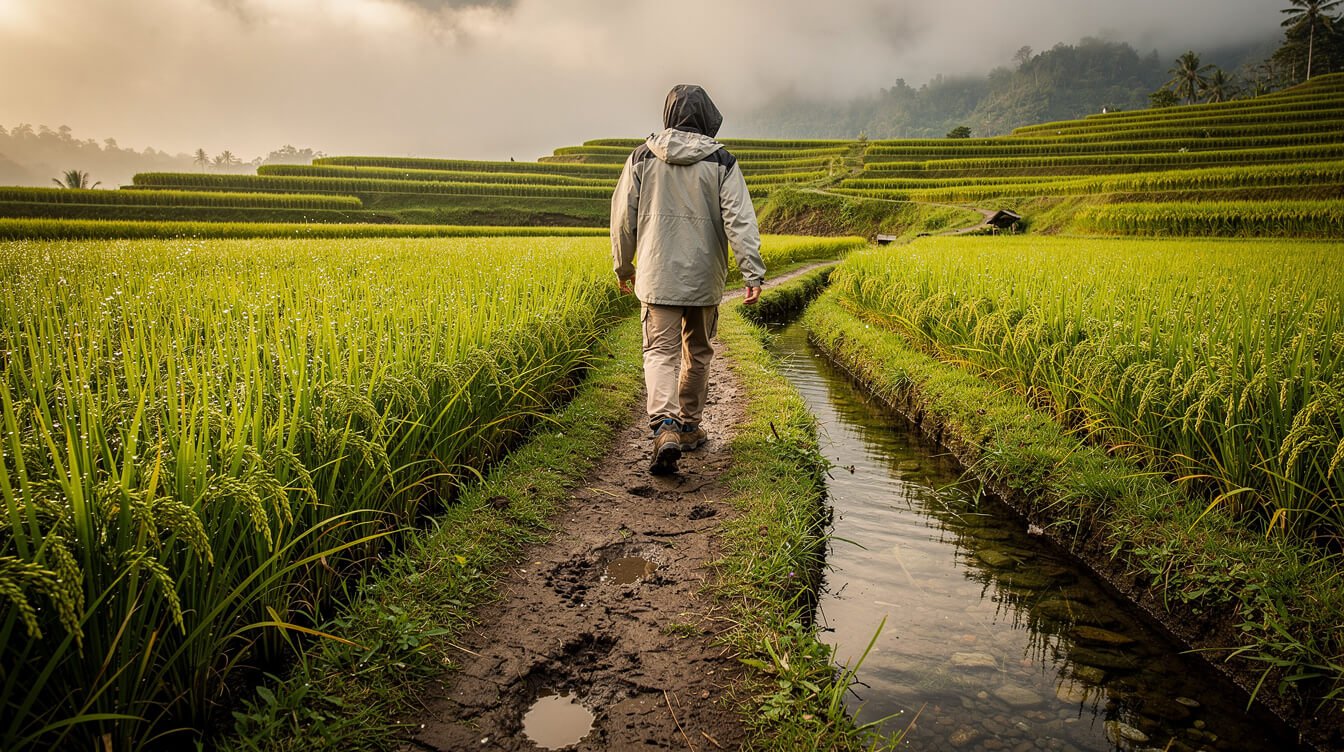
You can see the Jatiluwih rice terraces from the roadside viewpoints in twenty minutes. But the real experience starts when you walk down into them, on the narrow paths along the terrace edges, with water running beside you.
Several color-coded trekking routes start near the main entrance, with maps posted at the trailheads. Recent visitor reports describe them roughly as follows (lengths and times are approximate, and signage can change, so check the map on the day):
- Red line (short): about 1.5 km, 30 to 45 minutes. The easiest taste of the terraces, and the most popular.
- Purple line (medium): about 2 km, 1 to 1.5 hours.
- Yellow line (medium): about 2.3 km, 1 to 2 hours.
- Blue line (long): about 3.1 km, 1.5 to 2 hours.
- White line (extra long): about 5.5 km, 3 to 4 hours, with more forest and village sections. Also popular with cyclists.
Which route is right for you?
For most first-time visitors coming from Ubud, the sweet spot is the red line followed by the purple or yellow line: one to two hours of walking, enough to feel the scale and quiet of the place without exhausting yourself before lunch. Families with young children are usually happiest on the red line. Keen walkers who arrive early can start with a short loop while the light is soft, then head out on the longer white route when the midday crowds gather at the viewpoints.
If you’d rather ride than walk, guided cycling and e-bike tours run through the area. Our Bali cycling tour guide covers what to expect from those rides.
What to wear and bring
- Shoes with grip. Paths are packed earth, sometimes with loose stone or concrete. After rain they are slick. Trail shoes or sturdy sandals with straps work far better than flip-flops.
- A light rain jacket. Highland showers arrive fast, especially from November to March.
- Sun protection. There is little shade in the open terraces, even on a cool day.
- Water and a little cash. Small warungs along the routes sell drinks and snacks.
- Long, light layers. The mornings can be fresh at 700 meters.
In the wet season, start as early as you can. Mornings are usually clearer and drier, and the afternoon cloud that rolls down from Batukaru can turn a path to mud within the hour. For more on timing a terrace walk around the light and weather, see our guide to the best time to trek rice terraces near Ubud.
Jatiluwih or Tegallalang? An Honest Comparison for Ubud Guests
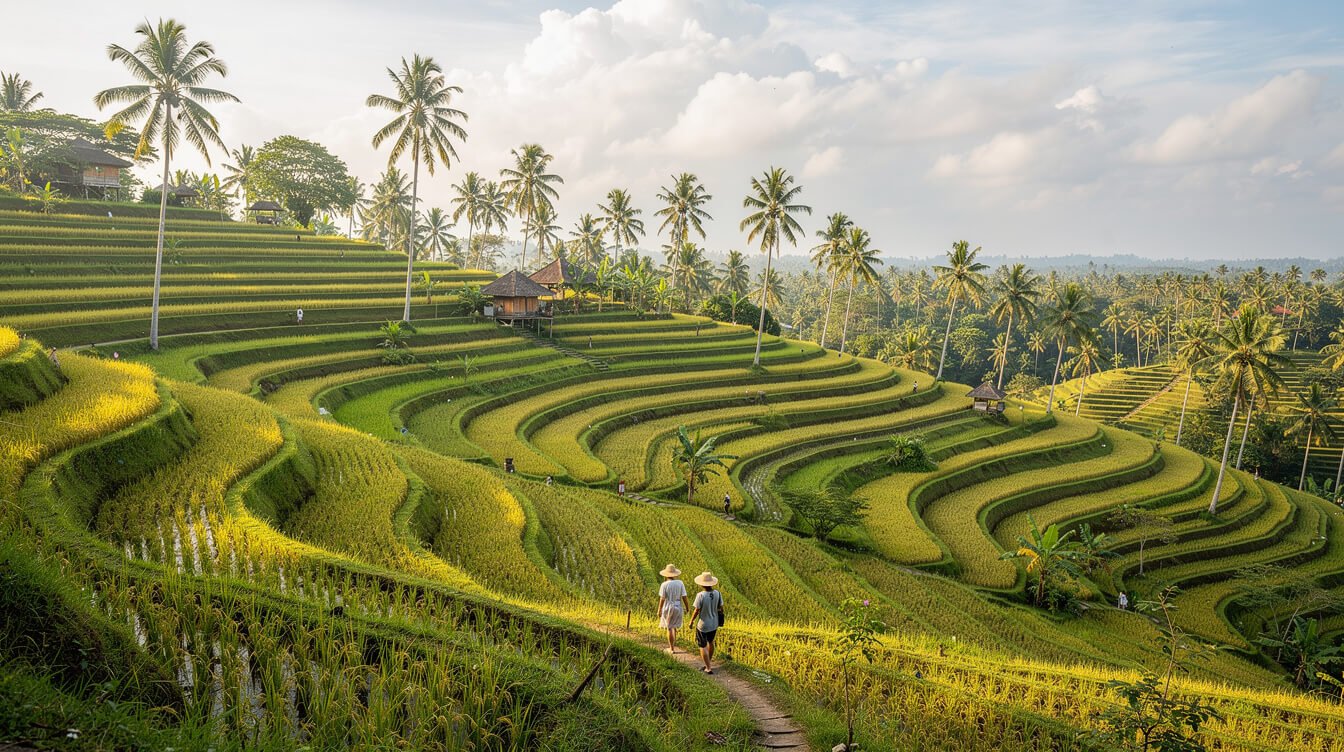
If you’re staying in Ubud, you’ll hear about two rice terraces again and again: Tegallalang, just north of town, and Jatiluwih, out west in Tabanan. Both are worth seeing. They are simply very different experiences.
Tegallalang: close, dramatic, busy
Tegallalang is about 20 to 40 minutes from central Ubud, which makes it an easy half-morning outing. Its terraces drop steeply into a narrow valley, which gives that famous layered look. It is also very popular, with cafes, swings and photo platforms along the rim and plenty of visitors from mid-morning onward. Our Tegallalang rice terrace guide covers it in detail.
Jatiluwih: far, vast, quiet
Jatiluwih asks more of your day: a long drive each way. In return you get scale. The terraces roll across the whole valley, often reported at several hundred hectares, and even on a busy day the walking routes spread people out so that you can find a stretch of path to yourself. The setting is more rural and agricultural, with farmers at work, ducks in the flooded fields and the mountain looking down on everything.
Our honest take
- Short on time or traveling with small children? Tegallalang, early in the morning.
- Want space, quiet and a sense of how rice country really works? Jatiluwih, as a full-day trip.
- Staying a week or more? See both, and add a walk closer to home, such as the Campuhan Ridge walk, for a third flavor of Ubud’s green.
For a wider look at your options, our overview of Bali rice terraces and our roundup of rice terrace day trips from Ubud compare more fields across the island.
Book the Villa
Come home from the rice terraces to three bedrooms, a private pool and a quiet tropical garden in Ubud, with a team on hand so your days stay yours. Check availability for your dates.
Walking Respectfully: Farmer Etiquette, Photos and the Landscape Under Pressure
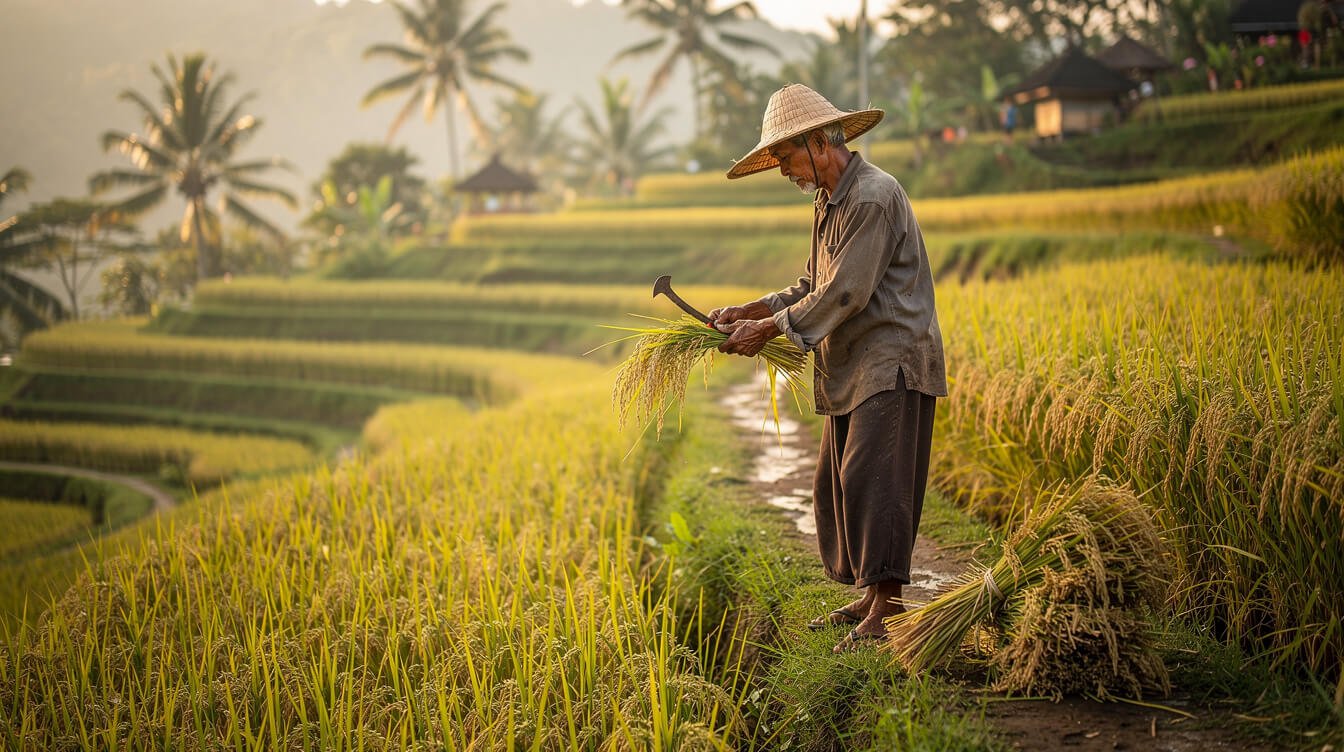
Every terrace you walk through at Jatiluwih is someone’s field, someone’s income and, in a real sense, someone’s place of worship. A few simple habits make your visit kinder for the people who keep this landscape alive.
On the paths
- Stay on marked paths and walk single file along the terrace edges. The low earth walls (bunds) hold the water in. Stepping off them can crack the edge and drain a field.
- Never step into the rice or pick the plants, even for a photo.
- Leave offerings and shrines untouched. If an offering lies on the path, step around it.
- Carry your rubbish out. Plastic in a channel travels to every field below.
Photographing people
Farmers working in the fields are not part of the scenery. If you’d like a photograph, smile and ask first, with a gesture toward your camera if words fail. Many will happily nod; some will prefer not to, and that’s their right. During harvest, keep a respectful distance from anyone using a sickle or threshing, and never walk through a field to get closer. Drones need prior authorization from the site management and carry an extra fee, so don’t fly one without arranging it first.
A landscape with real pressures
It is worth knowing that Jatiluwih’s beauty comes with tension. Tourism brings income to the village, yet rice farming pays little, and in recent years some landowners have built cafes and small tourism buildings among the fields. In 2025 local and provincial authorities reviewed buildings in the protected area against Tabanan’s zoning rules, and some were sealed late that year. In December 2025, a group of farmers put up metal roofing sheets in their fields as a protest, arguing that they too need a fair share of tourism’s benefits. The sheets were taken down in early 2026, and the discussion about how to support farmers while protecting the heritage landscape continues.
There is no simple villain in this story. It is the oldest question in rice country: how to keep water, land and livelihoods in balance. As a visitor you can help in small ways: pay the entrance fee (part of it supports the village and the upkeep of the area), buy your coffee or red rice tea from local warungs, and treat the fields as working land rather than a backdrop.
Pair It: Ulun Danu Beratan and the Jatiluwih Rice Terraces on One Highland Day
Because the drive from Ubud is long, it makes sense to build Jatiluwih into a full highland loop. The most natural pairing is the lake temple at Bedugul, roughly 45 minutes to an hour away by car. Together they tell the whole subak story in a single day: the sacred lake where the water begins and the terraces where it ends up.
A relaxed sample day from Ubud
- 6:30 a.m.: Leave Ubud with your driver. Coffee in the car.
- 8:00 to 10:30 a.m.: Walk the Jatiluwih rice terraces while the light is soft and the paths are quiet. Red line plus purple or yellow.
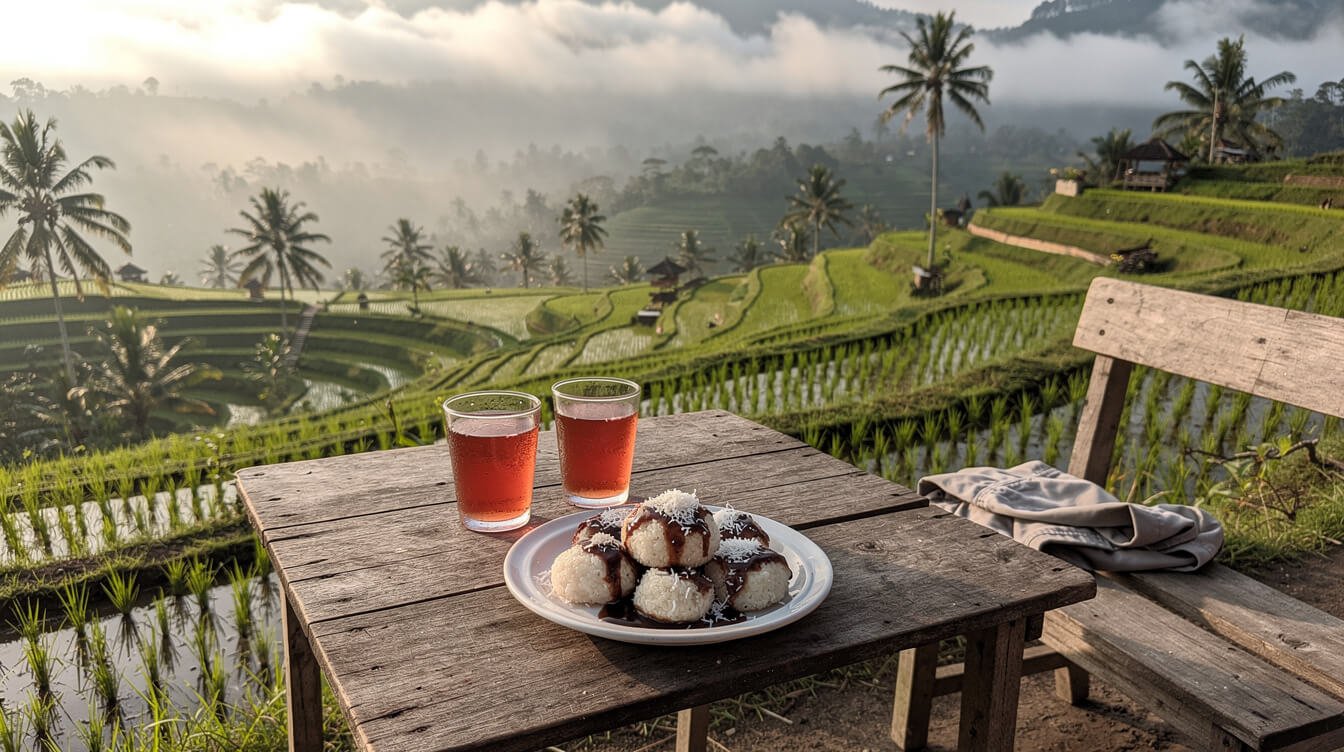
- 10:30 a.m.: Red rice tea and a sweet snack, such as laklak (small rice-flour pancakes with coconut and palm sugar), at a warung overlooking the fields.
- 11:00 a.m.: Drive north into the cool Bedugul highlands.
- Noon: Lunch near Lake Beratan, then a stroll through the fruit and flower stalls at the Candikuning market.
- 1:30 to 3:00 p.m.: Visit Ulun Danu Beratan Temple, ideally before the afternoon fog thickens.
- 3:00 p.m.: Head home to Ubud, arriving in time for a swim before dinner.
Prefer it the other way round? Start at the lake for misty morning photographs and finish at Jatiluwih in the warm late-afternoon light, when many tour groups have already left. Either way, keep the plan loose. Highland weather decides a lot. Ask the team to help you find a trusted driver and set the timing around your dates. For more ideas, see our guide to day trips from Ubud.
Other stops nearby
If you have energy to spare, the forest temple of Pura Luhur Batukaru lies about 20 minutes from Jatiluwih on the slopes of the mountain. It is one of the island’s most important directional temples and a deeply peaceful place. As at any temple, wear a sarong and sash and cover your shoulders.
Practical Guide to the Jatiluwih Rice Terraces: Fees and FAQ
How much does it cost to visit the Jatiluwih rice terraces?
The official Jatiluwih visitor site lists the entrance fee at IDR 75,000 for international adults and IDR 50,000 for international children (domestic visitors pay less). Parking is a small extra charge. Prices change from time to time, so bring some cash and check at the gate.
What are the opening hours?
The terraces are an open landscape, but the ticketed area and trekking routes are staffed during daylight hours, roughly from early morning to early evening. Arrive by 8 a.m. for the best light and the fewest people.
When is the best time to visit Jatiluwih?
For deep green fields, February to April and September to October are lovely. For gold and harvest, look at June to July and November to December. For the mirror look of flooded fields, late December to January or August. Mornings are best all year round, especially in the wet season.
Do I need a guide?
No. The routes are signposted and easy to follow. A local guide adds a lot, though: they can explain the subak, point out water temples and introduce you to farmers. Guided walks and cycling tours can be booked through the village’s official channels in advance.
Is Jatiluwih suitable for children and older travelers?
Yes, on the short red line, with care. Paths are uneven and can be slippery after rain, so supportive shoes matter. The roadside viewpoints and warung terraces offer beautiful views with no walking at all.
Is it worth the drive from Ubud?
If you love open landscapes, quiet walks and understanding a place rather than just photographing it, absolutely. Pair it with Lake Beratan and it becomes one of the most complete days you can have in Bali.
The Jatiluwih rice terraces are, at heart, a conversation between a mountain, a lake and the people who share its water. Walk slowly. Listen to the channels. Say hello to the farmers. By the time you head back down to Ubud, you’ll see every rice field on the island a little differently.

Join our newsletter — fun, new, exciting Bali news
Ceremony days, market finds, new trails and small stories from Ubud. Delivered now and then, always worth opening.